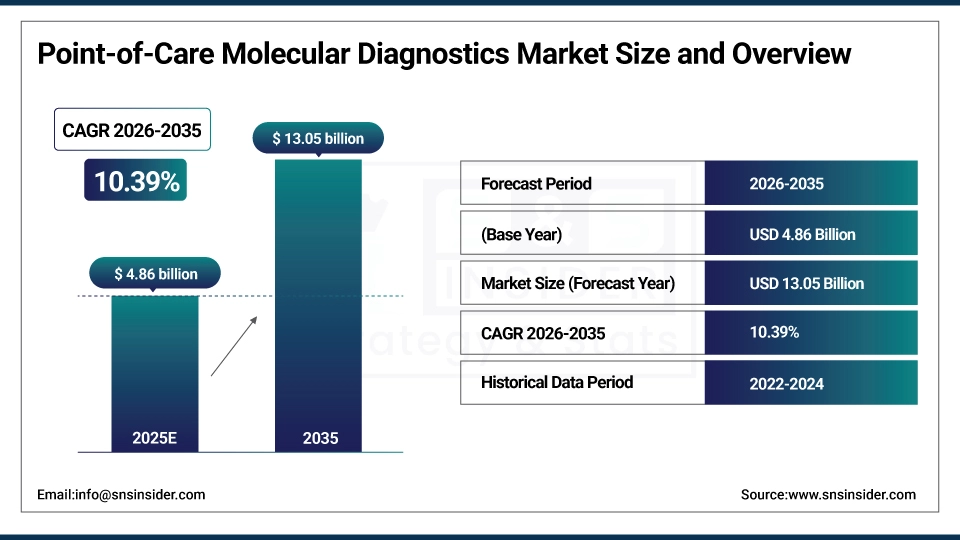
The point-of-care molecular diagnostics market is expanding because healthcare systems increasingly want lab-grade answers closer to the patient, whether that patient is in an emergency department, a clinic, or at home. The source report says demand is being driven by the need for faster testing, earlier diagnosis, and care that does not depend on a large centralized laboratory. That matters most for infectious diseases, where treatment decisions often need to be made within minutes or hours, but it also matters for chronic disease management and broader screening programs. The technologies behind this shift include polymerase chain reaction, or PCR, which copies tiny amounts of genetic material so they can be detected, as well as isothermal amplification methods that do similar work without the repeated heating and cooling used in standard PCR. The report also points to lab-on-a-chip platforms, miniaturized devices that shrink several lab steps onto a small cartridge or chip, much like putting an entire assembly line into a pocket-sized tool. Together, these systems aim to deliver tests that are faster, easier to use, and accurate enough to guide care where the patient is standing. The report frames this as a broad market shift, not just a technical upgrade: diagnostics are moving outward from the core lab into decentralized settings as healthcare providers try to speed decisions and improve outcomes. It also highlights a major business signal in that trend, noting Abbott Laboratories' planned 2025 acquisition of Exact Sciences for up to USD 23 billion as part of a larger push into cancer screening and molecular diagnostics.
What the market is actually selling
At its core, this market is about turning complex genetic testing into a near-patient service. Instead of shipping a sample away and waiting days for a result, point-of-care systems are designed to detect disease-related genetic material quickly enough to influence a same-visit decision.
The source identifies three main technology families: PCR-based tests, isothermal amplification, and lab-on-a-chip platforms. In plain terms, these tools look for the molecular signatures of disease, usually DNA or RNA, and package that search into instruments and disposable test cartridges that can be run outside a traditional high-throughput lab.
Why demand is rising now
The report links market growth to two big healthcare pressures: the rising incidence of infectious and chronic diseases, and the spread of decentralized healthcare services. When more care happens in outpatient clinics, urgent care centers, community settings, and homes, the old model of sending every sample to a central lab becomes less practical.
Fast testing is especially valuable when delays can change treatment. A rapid molecular result can help a clinician confirm an infection, start the right therapy sooner, and reduce uncertainty for both patients and staff. The report argues that this combination of speed and accuracy is a major reason hospitals, clinics, and home-testing settings are adopting these systems.
The technology shift behind the growth
PCR is often described as the gold standard in molecular testing because it can detect very small amounts of genetic material with high sensitivity. But standard PCR usually requires specialized lab equipment and trained staff, which is why companies have spent years adapting it into smaller, simpler point-of-care platforms.
Isothermal amplification takes a different route. A useful analogy is cooking with a slow, steady burner instead of constantly turning the heat up and down: unlike traditional PCR, it works at a more constant temperature, which can make devices faster, simpler, and easier to deploy in near-patient settings. Lab-on-a-chip systems add another layer by integrating sample preparation, reaction steps, and readout into a compact format that reduces hands-on work.
Abbott's role in the competitive landscape
The source singles out Abbott Laboratories, based in Abbott Park, Illinois, as a leading company in this market. It points in particular to Abbott's ID NOW platform, known for delivering rapid molecular test results for infectious diseases using PCR or isothermal amplification-based approaches.
That matters because commercial success in this market depends on more than scientific performance. Companies need instruments that fit real clinical workflows, test menus that cover common conditions, and platforms simple enough for decentralized sites that may not have expert lab personnel on hand.
A bigger molecular diagnostics play
The report also describes a significant strategic move by Abbott in 2025: a planned acquisition of Exact Sciences for up to USD 23 billion. According to the source, the deal would expand Abbott's position in cancer screening and strengthen its broader molecular diagnostics capabilities.
Even though point-of-care testing is often associated with infectious disease, this kind of acquisition signals that companies see molecular diagnostics as a much wider field. The same basic idea—detecting disease by reading molecular signals—can extend from urgent respiratory testing to oncology, screening, and long-term disease monitoring.
Why Asia-Pacific stands out
Among regions, the report identifies Asia-Pacific as a fast-growing market and projects a compound annual growth rate, or CAGR, of 15.82% during 2026-2035. CAGR is a way of describing the average yearly growth rate of a market over time, smoothing out year-to-year bumps.
The source attributes that projected growth to rising use of home testing, outpatient clinics, and decentralized healthcare services across the region. It also points to increasing adoption and commercialization activity in China, India, Japan, and Southeast Asia, suggesting that growth is being shaped both by patient demand and by local efforts to bring these products to market.
What is pushing adoption across healthcare
The report ties market expansion to a mix of technology and policy forces. It cites advances in PCR, isothermal amplification, and lab-on-a-chip design, along with rising healthcare expenditure and greater awareness of the value of early disease detection.
That combination is important because a better device alone does not create a market. Healthcare systems also need money to buy tests, clinicians need confidence that the results will help them act sooner, and patients need settings where rapid testing is accessible outside the central lab.
Why This Matters
This market matters because diagnostics shape almost every medical decision that follows. If accurate molecular testing can happen near the patient instead of far away in a central facility, clinicians may be able to diagnose earlier, isolate infectious patients faster, and choose treatment with less delay.
It also matters for the structure of healthcare itself. Point-of-care molecular systems support a more distributed model of care, where useful testing can happen in community clinics, outpatient sites, or homes rather than only in major hospitals. That shift could be especially important in places where lab infrastructure is limited but the need for timely diagnosis is growing.
Looking ahead, the report suggests that the next phase of growth will depend on how well companies convert technical progress into routine clinical use. Faster platforms, broader test menus, regional commercialization in Asia-Pacific, and large corporate bets such as Abbott's planned Exact Sciences acquisition all point in the same direction: molecular diagnostics are becoming less confined to the lab and more embedded in everyday care.