Source: RSC Advances, written by Xiaoqing Chen; Wansheng Lin; Qiang Lin; Bin Qiu; Zhixin Li; Chunjian Ye; Jianqing Liu (November 23, 2026). AI-generated summary by biochip.com, published . Not independently reviewed.
Key takeaways
- The paper-based hydrogel sensor detected microRNA-21 from 1 pM to 10 nM, with a reported 131.25 fM detection limit.
- Carbon-dot fluorescence spreads across filter paper after target-triggered hydrogel breakdown, and a smartphone image quantifies the area.
- Serum testing was reported as satisfactory, but the study does not establish clinical diagnostic performance or patient benefit.
Researchers in China built a portable paper-based biosensor that detects microRNA-21 by measuring the fluorescent area it spreads across filter paper. The device combines a DNA-loaded hydrogel with carbon dots, tiny fluorescent carbon particles, and uses a smartphone image to quantify the signal. In tests, it detected miR-21 across concentrations from 1 picomolar to 10 nanomolar, with a detection limit of 131.25 femtomolar. The approach could offer a simpler way to measure a molecule being studied as an early marker of diabetic kidney disease.
A signal that spreads across paper
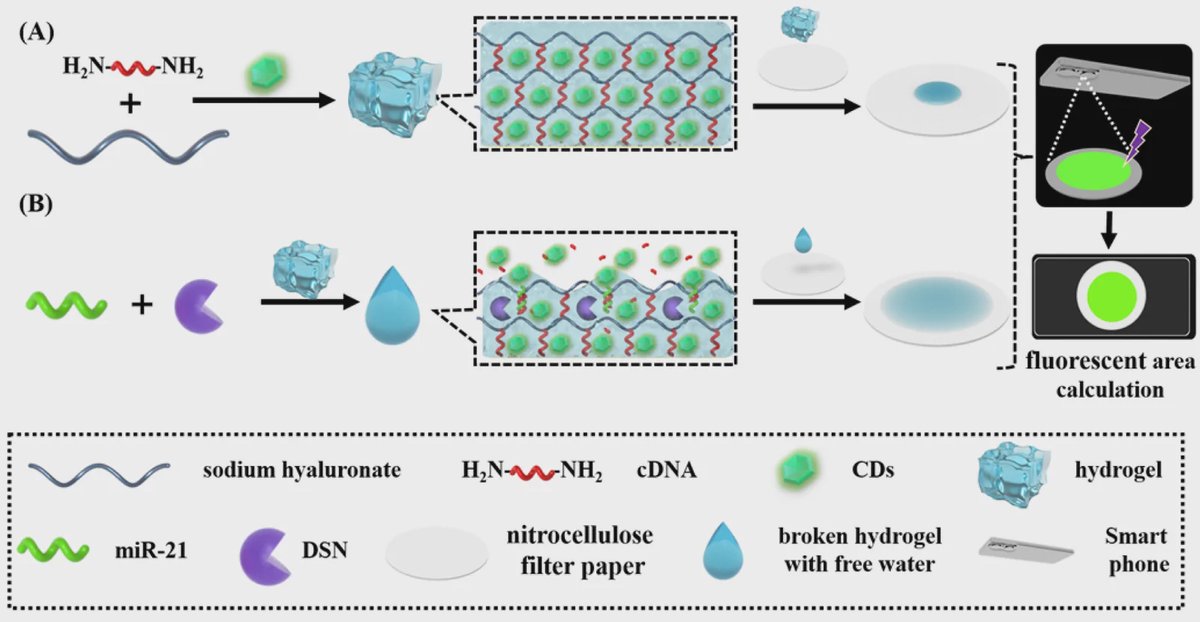
Think of the hydrogel as a small sponge that holds both fluorescent particles and DNA strands designed to recognize miR-21. The researchers made the hydrogel from sodium hyaluronate and DNA complementary to the target microRNA, then loaded it with carbon dots. On its own, the hydrogel holds its shape and restricts the dots from spreading far when placed on filter paper.
When miR-21 is present, it binds to the matching DNA. An enzyme called duplex-specific nuclease cuts the DNA in this paired structure, releasing the microRNA so it can bind to another DNA strand. This repeated cycle amplifies the signal and breaks down the hydrogel, releasing carbon-dot-containing liquid that spreads across the paper.
Turning a fluorescent patch into a measurement
The carbon dots make the spread area visible under a dark-field ultraviolet analyzer. A smartphone captures an image, and the fluorescent area is measured as a fraction of the paper's total area. Multiplying that pixel ratio by the paper's physical area gives the measured fluorescent area, which the researchers use to estimate the amount of miR-21.
Using a clear fluorescent boundary addresses a practical issue with earlier paper-based hydrogel sensors: the edge of a wet patch can be hard to distinguish from dry paper. The new readout also avoids separating the degraded hydrogel fragments from the liquid before applying them, reducing a step that could introduce handling error.
Detection range and serum testing
The sensor produced a linear response across miR-21 concentrations from 1 pM to 10 nM. Its reported detection limit was 131.25 fM. The researchers also applied the method to serum samples and reported satisfactory results, and described the sensor as selective for miR-21.
MiR-21 is a short RNA molecule linked to kidney inflammation and fibrosis, and changes in circulating levels may be useful in studying early diabetic kidney disease. The study presents the sensor as a potential screening tool, but the reported results do not establish that it can diagnose the disease or improve patient outcomes.
Why This Matters
The device shifts the readout from specialized measurements to a fluorescent area that can be photographed and quantified. That combination of a paper substrate, a hydrogel reaction, and smartphone imaging may make miR-21 testing more portable than methods that depend on sophisticated instruments.
The next question is how the sensor performs in broader testing beyond the reported serum experiments. Further studies would need to establish its reliability in clinical samples and clarify whether the method can support early screening in real-world settings.
Topics: Biosensors
Start here: Biosensors explained
Related articles
- Portable Biosensors Speed Food And Water Contamination Detection
- PV-See: A novel Escherichia coli-based biosensor for PVC microplastic detection
- Nanozyme-based biosensors for pathogenic microorganism detection: a mini-review
- Microfluidic-based biosensors toward point-of-care detection of nucleic acids and proteins