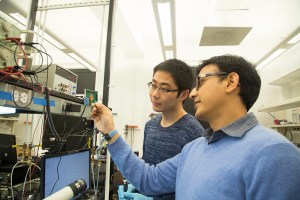
A Princeton engineering team is working on a diagnostic chip small enough to sit on a fingertip but ambitious enough to test for many disease signals at once. Led by Assistant Professor of Electrical Engineering Kaushik Sengupta, the project aims to pack hundreds, and eventually perhaps thousands, of sensors onto a single silicon device. The idea is to create a portable point-of-care test, meaning a diagnostic tool that can be used where the patient is, rather than in a distant laboratory. That matters most in clinics with limited staff, equipment, and infrastructure, where conventional lab testing can be slow, expensive, or simply unavailable. The chip is designed to detect biological clues such as DNA and proteins, both of which can reveal infection or other health conditions. Instead of relying on bulky laboratory instruments, the researchers want to combine optical sensing and electronics directly on one chip. If successful, the system could turn advanced molecular testing into something closer to a handheld consumer device, with results processed and displayed through software in a simple, readable format.
A lab on a fingertip
The Princeton concept falls into the category often called a lab-on-a-chip. This term refers to miniaturized devices that shrink parts of a laboratory workflow onto a small piece of hardware, reducing size, cost, and complexity.
In this case, the chip would not just run one test. Sengupta's team envisions a platform that can look for many different disease-related targets simultaneously, making it more flexible than a single-use assay built for only one pathogen or condition.
How the chip detects disease signals
The system is designed to detect the presence of DNA or proteins. DNA can point to the genetic material of a virus, bacterium, or even a patient's own cells, while proteins can serve as markers of infection, inflammation, or other biological processes.
Many modern diagnostic tests work by attaching fluorescent labels to these targets. A fluorescent label is a molecule that glows when illuminated, creating a signal that tells researchers the target is present. The challenge is that these light signals can be extremely faint, especially in real-world samples.
Why optical testing is usually cumbersome
Because fluorescent signals are often weak, conventional systems typically depend on sophisticated optical hardware to read them. That can mean carefully aligned light sources, lenses, filters, and detectors, all housed in expensive lab instruments.
This equipment works well in centralized facilities, but it is not ideal for low-resource clinics or mobile health settings. A test that requires delicate optics and large benchtop machines is much harder to deploy widely, even if the chemistry behind it is sound.
Putting optics and electronics on one silicon chip
What makes the Princeton project notable is its attempt to integrate optical elements and electronics inside a single silicon chip. Silicon is already the foundation of the computer and camera chip industries, so researchers can borrow ideas from mature manufacturing systems rather than building every diagnostic component from scratch.
Sengupta points to a useful comparison: smartphone cameras already pack millions of photodetectors into a tiny space. A photodetector is a sensor that converts light into an electrical signal. By adapting that kind of dense sensor integration for biology, the team hopes to create chips with hundreds or thousands of detectors tuned for diagnostic measurements.
From one sensor to many
A major advantage of this design is multiplexing, or testing for multiple targets in parallel. Instead of running separate assays for different pathogens or biomarkers, a single chip could potentially scan for many signals at once, saving time and sample volume.
That approach could be especially useful when symptoms overlap across diseases. Fever, cough, and fatigue can come from many causes, and a test that evaluates several possible culprits at the same time can give clinicians a clearer starting point for treatment.
Designed for portability and ease of use
The team is not aiming to build just a chip, but a complete portable system around it. Their vision is a handheld diagnostic device, roughly analogous to a smartphone, that can collect the chip's optical data and use software to interpret the results.
That matters because diagnostics are only useful if people can operate them correctly. A user-friendly interface that presents results in a clear format could reduce training barriers and make advanced testing accessible beyond specialized laboratories.
Why This Matters
The promise of point-of-care diagnostics is speed. When testing can happen in the clinic, the community health center, or even a remote setting, patients may receive answers during the same visit instead of waiting days for samples to travel to a central lab and back.
Cost and robustness are just as important. Sengupta's group envisions a platform that is cheap, durable, and practical for resource-limited environments, where maintaining complex laboratory infrastructure is often unrealistic. If a silicon-based diagnostic chip can deliver reliable molecular testing without the usual optical bulk, it could help narrow a long-standing access gap in global health.
The bigger picture
Projects like this also reflect a broader shift in medicine: bringing sophisticated analysis closer to the patient. As chips, sensors, and software improve, diagnostics may increasingly resemble consumer electronics in portability while still performing tasks that once required a research lab.
Princeton's work is still framed as a developing technology rather than a finished product, but the direction is clear. By combining biology, photonics, and chip design, the team is trying to make disease detection faster, smaller, and more widely available. If that effort succeeds, future frontline clinics could carry powerful molecular testing tools in the palm of a hand.