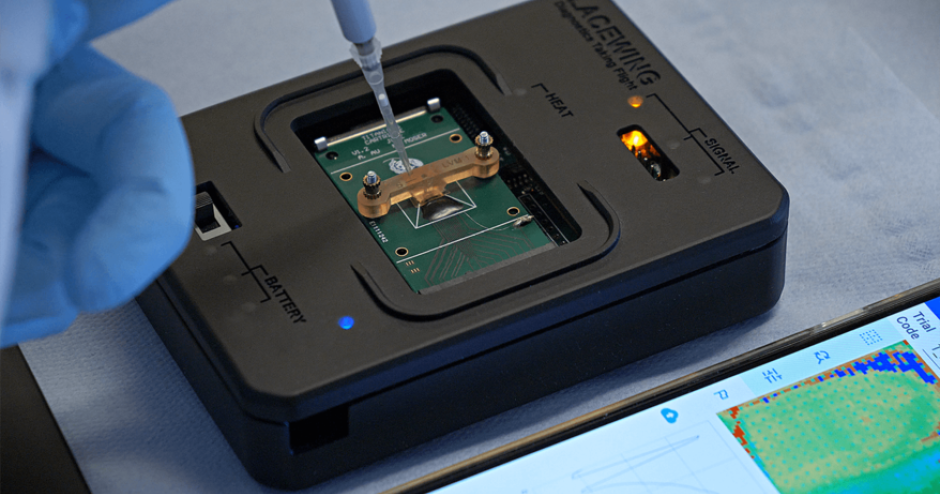
A research team at Imperial College London, led by Dr. Pantelis Georgiou, has developed a portable diagnostic platform called Lacewing that aims to bring lab-grade disease testing into the field. The device is designed to detect the genetic material of pathogens, meaning it looks for the DNA or RNA of viruses and other disease-causing organisms in a patient sample. Instead of relying on the bulky optical hardware used in many molecular tests, Lacewing uses an electrical sensing approach built around microchips, making the system smaller, cheaper, and easier to deploy. Results can be delivered in about 20 minutes through a smartphone app connected to a cloud server, which also allows data to be geotagged for tracking outbreaks and disease progression. The platform was originally intended for use in remote and underserved regions where traditional laboratory equipment is hard to access, but its relevance expanded sharply during the COVID-19 pandemic. The researchers say the system can be adapted for diseases including dengue, malaria, tuberculosis, and SARS-CoV-2, the virus that causes COVID-19. To build the disposable cartridge at the heart of the test, the team used Figure 4 3D printing technology and biocompatible materials, allowing rapid prototyping and production of tiny microfluidic parts. Taken together, the project points to a future in which molecular diagnostics are faster, more mobile, and more useful for both individual care and public health surveillance.
A lab test shrunk to chip size
Lacewing is what researchers call a lab-on-a-chip system. That term describes a device that miniaturizes several laboratory functions onto a tiny platform, often using very small channels to move and analyze fluid samples.
In this case, the disposable microfluidic cartridge measures roughly 30 mm by 6 mm by 5 mm. Those dimensions are small enough to fit sophisticated testing steps into a format that could realistically be used outside a conventional lab.
How the test works
The platform is a molecular diagnostic test, meaning it identifies the unique genetic signature of a pathogen. Rather than inferring infection indirectly from symptoms or general immune responses, it looks for the actual DNA or RNA of the target organism.
That matters because molecular tests can often provide more precise answers. According to the project description, Lacewing is designed not only to indicate whether a person is infected, but also to estimate the degree of infection, offering clues about how severe the illness may be.
Why the electrical approach is different
Many diagnostic systems depend on optical readouts, such as fluorescent signals measured with specialized instruments. Those tools can be highly accurate, but they are often expensive, relatively large, and poorly suited for remote settings.
Lacewing replaces that optical setup with electrical sensing on microchips. In simple terms, the device reads changes in electrical signals produced during the test, allowing the hardware to be more compact while still capturing biologically meaningful information.
Built for portability and speed
One of the strongest ideas behind Lacewing is that advanced testing should not be limited to major hospitals and centralized labs. The system was conceived before COVID-19 as a way to make pathogen detection practical in regions where infrastructure is limited and transporting samples can take too long.
The team says the platform can return results within about 20 minutes through a smartphone app synced to a cloud server. That combination of rapid testing and phone-based access could help clinicians make quicker decisions while also reducing delays associated with shipping samples to distant facilities.
3D printing made fast development possible
The device was rapidly prototyped and iterated using the Figure 4 Standalone platform and biocompatible materials. Rapid prototyping means researchers could design, print, test, and refine cartridge versions much faster than with many conventional manufacturing methods.
The cartridges themselves were printed in 10-micron layers, a level of precision that is important in microfluidics, the science of controlling tiny volumes of liquid through miniature channels. Fine control over these structures helps ensure that samples and reagents move reliably through the device during testing.
From individual diagnosis to outbreak tracking
Lacewing is not only about telling one patient whether they are infected. Because the results can be connected to a smartphone and cloud platform, the system can also support broader monitoring through geotagging, which links data to specific locations.
That could make the platform useful for following how disease spreads across communities or how clusters emerge over time. In an outbreak, this kind of near-real-time information can be just as important as the test result itself, because it helps public health teams see patterns early.
Why This Matters
The biggest promise of Lacewing is access. Molecular diagnostics are among the most informative tools in modern medicine, but they have traditionally been tied to costly instruments, trained personnel, and centralized labs that many communities simply do not have.
By shrinking this capability into a portable chip-based system, the Imperial team is addressing both the testing gap and the information gap. A tool that can quickly identify pathogens, estimate infection level, and feed results into a connected data network could improve patient care while strengthening disease surveillance at the same time.
What comes next
The platform has been in development for a little over two years, and its flexibility may be one of its biggest advantages. If the system continues to mature, it could become a model for diagnostics that are not only faster and smaller, but also easier to tailor to emerging threats.
That vision extends beyond any single disease. Whether the challenge is COVID-19, tuberculosis, malaria, or the next outbreak that catches health systems off guard, tools like Lacewing suggest a future where high-quality molecular testing can travel to the patient instead of forcing the patient to travel to the lab.