AI-generated summary by biochip.com, published . Not independently reviewed. Source: QRB Discovery, by Europe PMC.
Understanding how the brain works means tracking chemistry as it happens, not just taking snapshots after the fact. A recent scholarly review examines how electrochemical analysis at the micro- and nanoscale is making that possible, giving researchers tools to measure signaling molecules directly inside brain tissue and even in living brains. These approaches rely on tiny electrodes that can detect chemicals such as dopamine, serotonin, and other neurochemicals by translating molecular activity into electrical signals. The review brings together progress in in situ measurements, which are made in place within tissue, and in vivo measurements, which are made inside living organisms. It also highlights why size matters: shrinking sensors down to microscopic and nanoscopic dimensions can reduce tissue damage, improve spatial precision, and capture rapid chemical changes that older methods often miss. At the same time, the field still faces difficult engineering problems, including sensor fouling, long-term stability, and the challenge of distinguishing one molecule from many look-alikes in the crowded chemical environment of the brain. The picture that emerges is of a fast-moving area of research that is steadily turning brain chemistry from something inferred indirectly into something measured more directly and in real time.
Why Measuring Brain Chemistry Is So Hard
The brain communicates partly through neurotransmitters, small molecules released by neurons to send signals. But these molecules appear in tiny amounts, change on millisecond timescales, and often diffuse through extremely small spaces, making them hard to detect without disturbing the system being studied.
Traditional lab methods can identify brain chemicals with high accuracy, but they often require tissue extraction, chemical labeling, or sample preparation that breaks the connection to real-time brain activity. Electrochemical methods are attractive because they can read out chemical changes directly by measuring current or voltage shifts when molecules react at an electrode surface.
The Rise of Micro- and Nanoscale Sensors
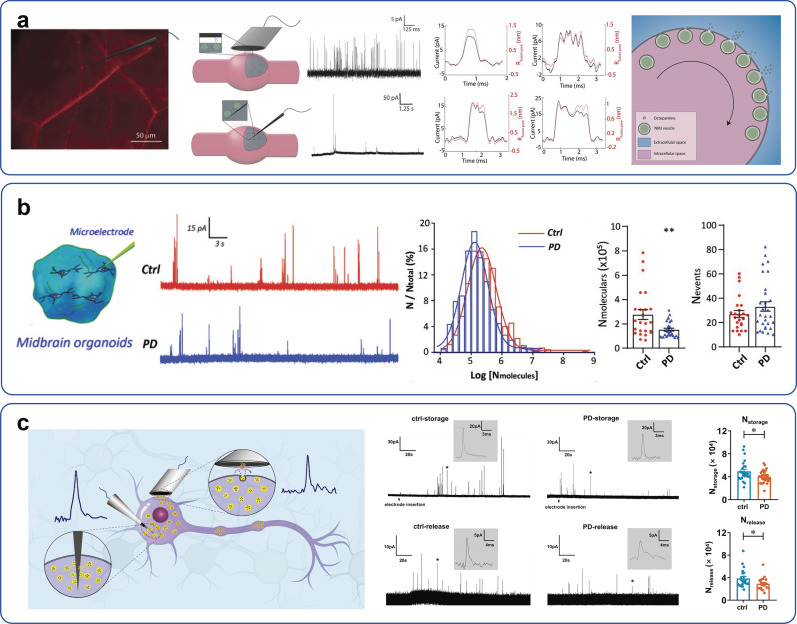
The review describes how the field has moved toward ever-smaller probes, including microelectrodes and nanoelectrodes. These are tiny conductive sensors, often made from carbon, metals, or composite materials, that can be inserted into tissue with less damage than larger devices.
Miniaturization matters for more than comfort or surgical precision. Smaller sensors can sample from highly localized regions, sometimes even approaching the level of individual cells or subcellular spaces, which helps researchers understand how brain chemistry varies across circuits instead of averaging signals over broad areas.
How Electrochemical Detection Works
Most of these methods depend on the fact that some neurochemicals can be oxidized or reduced, meaning they gain or lose electrons at an electrode. That electron transfer creates measurable electrical signatures that can be linked to concentration changes in specific molecules.
One widely used approach is fast-scan cyclic voltammetry, a technique that rapidly sweeps voltage to capture fleeting changes in compounds like dopamine. Other platforms use amperometry, potentiometry, or advanced surface modifications to increase sensitivity, improve selectivity, or broaden the range of detectable brain chemicals.
What the Latest Advances Have Improved
According to the review, recent progress has come from both better materials and smarter device design. Researchers have developed electrodes with nanostructured surfaces, specialized coatings, and hybrid architectures that increase the effective surface area available for reactions while helping resist biofouling, the buildup of biological material that can degrade sensor performance.
Another major improvement is multimodal integration. Some new systems combine electrochemical sensing with optical tools, electrophysiology, or microfluidics, allowing scientists to track chemistry alongside electrical activity or fluid handling in the same experiment. That matters because brain function is never purely electrical or purely chemical; it is an interaction of both.
In Situ and In Vivo Uses
In situ analysis is useful when researchers want to study intact tissue in a controlled environment, such as brain slices that preserve local circuitry. This setup allows precise testing of sensor behavior and targeted stimulation while maintaining more biological realism than simplified cell cultures.
In vivo analysis goes a step further by measuring chemistry in living animals, where blood flow, metabolism, movement, and ongoing neural activity all shape the signal. These experiments are more difficult, but they are crucial for linking chemical events to behavior, disease states, or treatment responses.
The Biggest Remaining Obstacles
Despite the progress, the review makes clear that the field is not solved. One core challenge is selectivity: many molecules in the brain have similar electrochemical behavior, so a sensor may struggle to tell them apart unless the electrode surface and signal analysis are carefully tuned.
Long-term implantation is another hurdle. A probe that performs well for minutes or hours can still fail over days or weeks because the tissue reacts to it, proteins accumulate on its surface, or the sensor drifts away from its original calibration. For applications in chronic disease monitoring or brain-machine interfaces, those stability issues are especially important.
Why This Matters
Better chemical sensing could reshape neuroscience by letting researchers watch the brain’s molecular language unfold in real time. That would deepen understanding of conditions such as Parkinson’s disease, depression, addiction, epilepsy, and traumatic brain injury, all of which involve changes in neurochemical signaling.
It could also improve therapy development. If scientists can measure exactly how neurotransmitter levels shift during stimulation, drug treatment, or behavior, they can design interventions with clearer mechanisms and more precise readouts, rather than relying mainly on symptoms or indirect biomarkers.
Where the Field Is Heading Next
The review points toward a future in which electrochemical sensors become smaller, smarter, and more integrated with computation and other measurement systems. Advances in materials science, machine learning-based signal interpretation, and flexible implantable devices may help researchers distinguish more molecules at once and track them longer with less disruption to tissue.
That does not mean a single breakthrough will suddenly make brain chemistry easy to read. But the steady convergence of nanotechnology, analytical chemistry, and neuroscience is building a toolkit that is far more capable than what existed even a decade ago. If that trajectory continues, researchers may soon be able to monitor the brain’s chemical conversations with a level of detail that changes both basic science and future neurotechnology.