AI-generated summary by biochip.com, published . Not independently reviewed. Source: International Neurourology Journal, by Nae Yoon Lee.
Lab-on-a-chip technology aims to shrink an entire medical testing workflow onto a device small enough to fit in the palm of your hand, and the work summarized here shows how close that vision has come in several key areas. Instead of sending samples through a series of bulky lab machines, researchers have been building tiny fluid channels, heaters, and sensors that can prepare, separate, and detect biological material on one compact platform. The article highlights progress in polymer-based systems, especially chips made from materials such as poly(methyl methacrylate) and PDMS, or polydimethylsiloxane, a flexible silicone widely used in microfluidics. Two studies stand out: one reported a disposable microchip electrophoresis device with electrochemical detection, and another combined polymerase chain reaction, ligase detection, and hybridization in a flow-through microfluidic system to find low-abundance DNA point mutations. Together, these efforts matter because they tackle the practical barriers that often keep diagnostics tied to centralized laboratories: cost, instrument size, and complicated assembly. They also show that miniaturization is not just about making devices smaller; it is about integrating multiple steps so that a test can move from raw sample to answer with fewer manual interventions. For clinical diagnosis, that could eventually mean faster results, less sample handling, and tools that are easier to deploy near the patient rather than far away in a specialized facility.
What the Field Is Trying to Do
A lab-on-a-chip works a bit like a miniature factory line for biology. Instead of moving a sample from one benchtop instrument to another, the sample travels through tiny channels where each stop performs a job such as mixing, heating, separating, or sensing.
That miniaturization matters because clinical tests often involve many steps that introduce delay and complexity. If those steps can be built into a single chip, diagnostics can become faster, cheaper, and potentially more suitable for point-of-care testing, meaning testing performed near the patient rather than in a distant laboratory.
Disposable Chips and On-Chip Detection
One of the studies cited, by Wang, Pumera, Chatrathi, Escarpa, Konrad, Griebel, and colleagues, described a disposable microchip electrophoresis device made from poly(methyl methacrylate), or PMMA. Electrophoresis is a method that separates molecules by driving them through a medium with an electric field, much like sorting objects by how quickly they move under a push.
The important step here was pairing that separation method with electrochemical detection on the chip itself. Electrochemical detection reads signals produced by chemical reactions at an electrode, offering a compact alternative to larger optical systems and supporting the broader goal of truly disposable analytical devices.
Why Materials Matter
The choice of chip material may sound like an engineering detail, but it shapes whether a diagnostic device can leave the research lab and become practical. PMMA and PDMS are attractive because they are easier to fabricate into small channels and structures than traditional materials used in microelectronics, and they can lower manufacturing costs.
For clinical use, disposable materials also help reduce contamination risk. A single-use chip can avoid the cleaning and carryover problems that come with reusable systems, which is especially important when dealing with patient samples containing very small amounts of genetic or chemical targets.
Finding Rare DNA Mutations on a Microfluidic Device
The second study, from Hashimoto, Barany, and Soper, focused on a harder diagnostic problem: detecting low-abundant DNA point mutations. A point mutation is a tiny change in a DNA sequence, and when it appears in only a small fraction of the sample, finding it can be like spotting a typo in a huge stack of nearly identical pages.
To tackle that, the researchers combined several molecular biology steps in a flow-through microfluidic device. Their system used polymerase chain reaction, or PCR, to amplify DNA; a ligase detection reaction to discriminate specific sequence changes; and hybridization, where matching DNA strands bind to one another for identification.
Integration Instead of Standalone Parts
The technical significance of that work lies in integration. Many diagnostic systems can perform one step well, but a clinically useful platform often needs to chain several operations together without forcing the user to transfer material between separate tools.
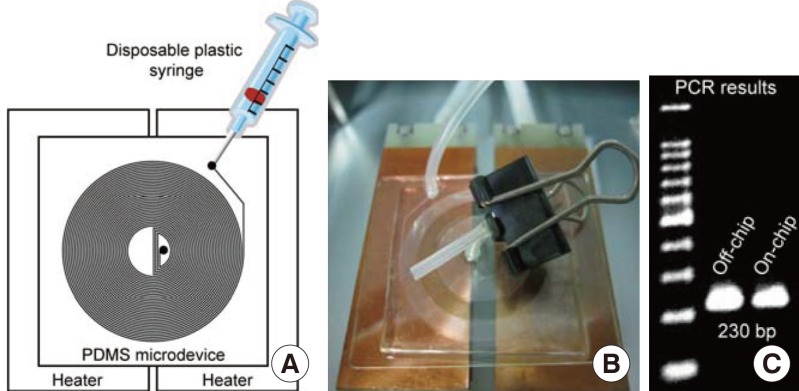
The authors described functional units made from PDMS and operated by pressure. They also showed pressure-driven sample amplification using a single heater rather than multiple heaters, a pressure-driven sample injection device that avoided a bulky syringe pump, and a room-temperature, atmospheric-pressure strategy for assembling the device.
Engineering Around Real-World Constraints
Those design choices may sound modest, but they address some of the reasons promising prototypes fail to become useful products. A device that depends on multiple heaters, large pumps, or demanding assembly conditions may work in a skilled research environment yet be too cumbersome for routine clinical settings.
By simplifying actuation and assembly, the researchers were pushing toward a totally integrated LOC system, with LOC standing for lab-on-a-chip. In plain terms, they were trying to replace a bench full of specialized hardware with a compact system that could be built, operated, and potentially distributed more easily.
Why This Matters
Clinical diagnosis is often a race against time, especially when decisions depend on quickly identifying a mutation, infection marker, or other molecular signal. A well-integrated lab-on-a-chip device could shorten the path from sample collection to result, which can improve both workflow and patient care.
There is also a broader access issue. If chip-based systems can be made disposable, pressure-driven, and less dependent on bulky support equipment, they become more plausible for settings outside large hospitals and research centers, including clinics with limited infrastructure.
What Progress Still Means in Practice
The picture that emerges from these studies is not that lab-on-a-chip has solved clinical diagnostics outright, but that researchers have been steadily removing practical obstacles. They are reducing device size, consolidating multiple assay steps, and choosing materials and operating methods that support lower-cost fabrication and simpler use.
The next phase is the one that always determines whether a technology sticks: translating careful engineering into robust clinical performance. If future systems can preserve analytical accuracy while keeping the advantages shown here—disposability, integration, and minimal hardware—they could move diagnostics closer to where patients are actually seen, which has been the promise of lab-on-a-chip from the start.