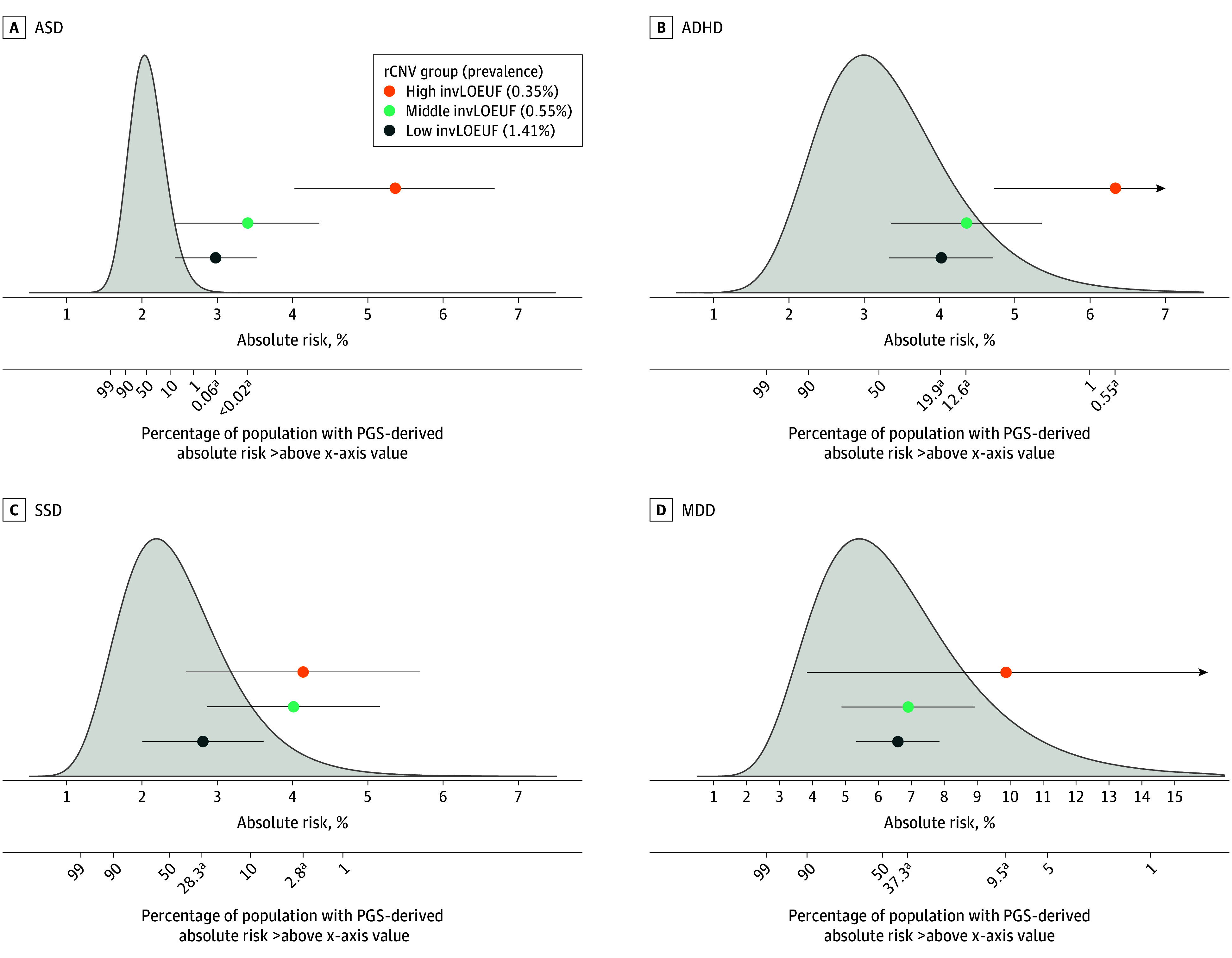
A large Danish genetics study has taken a clearer look at how two different kinds of inherited risk for psychiatric illness work together. One kind comes from recurrent copy number variants, or rCNVs—stretches of DNA that are deleted or duplicated in places where the same changes appear again and again across people. The other comes from polygenic scores, which add up the tiny effects of many common genetic variants into a single estimate of risk. Using data from 94,276 people in the Lundbeck Foundation’s iPSYCH cohort, researchers asked how each type of risk related to attention-deficit/hyperactivity disorder, autism spectrum disorder, schizophrenia spectrum disorder, and major depressive disorder. They found that rCNVs were linked to higher risk for autism, ADHD, and schizophrenia, while polygenic scores were associated with risk for all four conditions. The study also suggests these signals are not simply redundant: polygenic scores often identify many more people at elevated risk, while rCNVs can mark smaller groups with more concentrated risk. Taken together, the findings point to a more nuanced model of psychiatric genetics, one in which rare high-impact variants and the background effect of many common variants can each add useful information. They also hint that in some cases, a person’s broader polygenic background may soften or sharpen the effect of a known risk variant.
Two different kinds of genetic risk
If genetic risk were weather forecasting, an rCNV would be like spotting a strong storm system on radar: uncommon, distinct, and sometimes associated with a sizable shift in risk. A polygenic score, by contrast, is more like a long-range forecast built from many small signals that are weak on their own but meaningful when combined.
That distinction matters because psychiatric disorders do not arise from a single genetic pattern. Some people carry a rare DNA deletion or duplication with a relatively large effect, while many others inherit a broad collection of common variants that modestly push risk up or down. Until now, it has been less clear how those two sources of risk should be compared side by side and whether they interact.
How the researchers studied it
The study used the Lundbeck Foundation Initiative for Integrative Psychiatric Research, better known as iPSYCH, a major Danish case-cohort resource based on people born in Denmark between 1981 and 2008 and followed through 2015. The sample included everyone with a hospital diagnosis of ADHD, autism spectrum disorder, schizophrenia spectrum disorder, or major depressive disorder, plus a randomly selected comparison subcohort from the broader population.
The researchers analyzed neonatal blood samples that had been genotyped on microarrays, a technology that reads many points across the genome at once. From those data, they determined whether each person carried one of 27 autosomal recurrent copy number variants and calculated polygenic scores using results from previously published genetic association studies.
What stood out in the results
Among 94,276 unrelated people of European ancestry, rCNV carriage was associated with increased risk of autism spectrum disorder, ADHD, and schizophrenia spectrum disorder. It was not associated with a clear increase in risk for major depressive disorder in this analysis.
Polygenic scores, meanwhile, tracked positively with risk for the matching disorder in every case the team examined. In plain terms, higher ADHD polygenic scores were linked to more ADHD, higher autism scores to more autism, and the same pattern held for schizophrenia and major depression.
The comparison between the two approaches is one of the paper’s most practical contributions. At similar levels of absolute risk, polygenic scores identified more individuals than rCNV carriage did, with autism as the notable exception. That makes sense statistically: common-variant scores can spread moderate risk information across a much larger slice of the population, while rare structural variants tend to affect fewer people.
Not just additive, but potentially interactive
The team also tested whether copy number variants and polygenic scores might modify each other’s effects rather than simply stack up independently. They found one specific negative interaction between a 16p13.11 duplication and the ADHD polygenic score in relation to ADHD risk.
A negative interaction here means the combined effect was smaller than expected if the two risk signals just added together in a straightforward way. More broadly, the authors observed a trend toward negative interaction coefficients across grouped rCNVs and across the nine most common rCNVs they examined, a pattern that suggests polygenic background may sometimes temper rCNV-associated risk rather than amplify it.
That point deserves careful interpretation. It does not mean an rCNV is harmless in someone with a low polygenic score, nor does it mean polygenic scores can fully explain away rare variant effects. It means the genetic context around a high-impact variant may matter, and risk may be more adjustable than a simple yes-or-no carrier model would imply.
Why autism looked somewhat different
Autism stood out because rCNV carriage remained especially informative compared with polygenic scoring at comparable absolute risk levels. The paper does not frame this as a contradiction, but rather as a reminder that the genetic architecture of psychiatric conditions differs from one diagnosis to another.
In genetics, architecture means the mix of rare and common variants, their effect sizes, and how they combine. For autism, this study suggests recurrent structural variants may still capture a particularly important part of the risk picture, even as polygenic scores add useful information.
What this means for risk assessment
One of the clearest takeaways is that neither approach makes the other obsolete. Rare copy number variants can flag people with meaningful elevated risk, while polygenic scores can sort risk across a wider portion of the population and even help distinguish lower-risk from higher-risk carriers within some rCNV groups.
That could eventually matter for research design, counseling, and long-term monitoring. If clinicians and researchers know that a person carries a medium- or high-impact rCNV, a polygenic score might provide added context rather than a duplicate answer. Likewise, a low polygenic score could, in some cases, be associated with a lower-than-expected level of risk among carriers.
Why This Matters
Psychiatric genetics often gets simplified into misleading headlines about “the gene for” a disorder, but this study shows a more realistic picture. Risk comes from layers: some rare variants carry larger effects, many common variants carry small effects, and the combination may shape outcomes in ways that are measurable but not deterministic.
That matters because the future of genetic medicine will depend less on finding one decisive marker and more on combining different kinds of evidence responsibly. Studies like this help define where each tool is useful, where it falls short, and how genetic information might be interpreted without overstating certainty.
The work also shows the value of very large, population-based datasets with long follow-up and carefully defined diagnoses. As similar analyses expand to more diverse ancestries and additional psychiatric outcomes, researchers should get a better sense of when polygenic scores sharpen the meaning of rare variants, when they do not, and how these insights could be used ethically in practice. For now, the main message is not that genetics can predict psychiatric illness with precision, but that combining rare and common variant information gives a fuller map of risk than either approach alone.