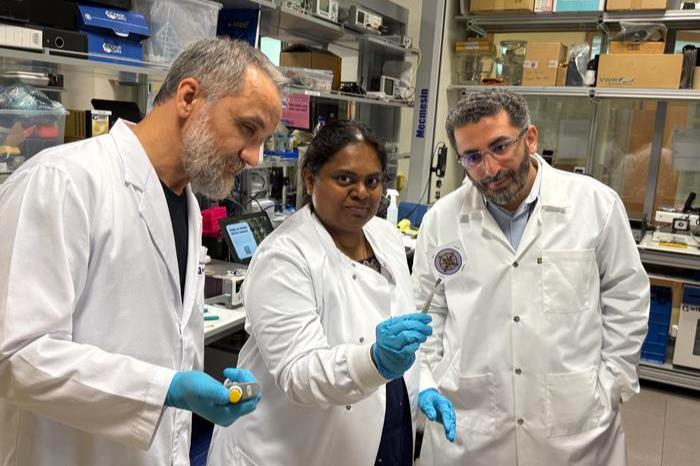
Researchers at NYU Abu Dhabi have developed a paper-based test designed to spot infectious diseases quickly, cheaply, and with minimal equipment. The device, called the single-layer radially compartmentalized paper chip, or RCP-Chip, was described in Advanced Sensor Research in a study focused on detecting SARS-CoV-2, the virus that causes COVID-19. Its main promise is practical: it can identify tiny amounts of viral genetic material from a small droplet of sample and show the result through a visible color change. Unlike standard laboratory tests, the chip does not need electricity or specialized instruments to run. It works with mild heat of about 65 degrees Celsius, roughly the temperature of very warm water, which makes it easier to use outside fully equipped labs. The team says the same design can be adapted for other pathogens, including bacteria and viruses, and for different sample types such as saliva, blood, and environmental samples. That makes the work less about one virus and more about building a simple diagnostic platform for places where fast testing is often hardest to deliver.
A diagnostic lab on a sheet of paper
The RCP-Chip is built from a single sheet of paper, but it packs in several functions that would normally be spread across lab equipment. The design includes sample ports and vents, tiny pathways that guide liquid flow, and reaction chambers that already contain the materials needed for testing.
You can think of it like a compact plumbing system printed onto paper. A droplet enters at one point, then moves through carefully arranged channels into separate compartments where different reactions take place, all without the pumps and electronics used in conventional systems.
How the test detects the virus
The chip was developed for isothermal multiplex detection of SARS-CoV-2 gene targets. Isothermal means the test runs at one steady temperature instead of cycling through repeated heating and cooling steps, as happens in polymerase chain reaction, or PCR, a standard method for amplifying genetic material. Multiplex means it can look for several genetic targets in the same run.
That matters because checking multiple targets can improve confidence in the result while using less sample and fewer materials. According to the study description, the device can detect even minute traces of viral genetic material and translate that signal into a visible color change, making the readout simpler for users in low-resource settings.
Designed during the COVID-19 crisis
The project took shape during the early COVID-19 lockdowns, when the weaknesses of centralized testing systems became painfully clear. In many places, diagnosis depended on sending samples to labs with trained staff, expensive instruments, and stable infrastructure, which slowed access and widened gaps between regions.
Senior author Mohammad A. Qasaimeh, an associate professor of mechanical engineering and bioengineering at NYU Abu Dhabi, said the team set out to create a tool that was fast, affordable, and easy to use, especially where laboratory access is limited. That goal explains many of the design choices: low cost materials, minimal handling steps, and no dependence on electricity or specialized machines.
Why paper and low heat matter
Paper may sound almost too simple for molecular testing, but that simplicity is the point. It is lightweight, inexpensive, easy to store, and well suited for devices that need to be distributed widely or used in settings with few resources.
The mild heating requirement also removes a major barrier. Instead of needing a thermocycler or another complex instrument, the chip only needs heat around 65 degrees Celsius, which opens the door to testing in clinics, field settings, and temporary response sites where power and equipment may be limited.
More than a COVID-19 test
Although the reported study focused on SARS-CoV-2, the RCP-Chip was built as a flexible platform rather than a one-pathogen tool. The team says it can be reconfigured to detect other infectious diseases, which could include different viruses or bacteria depending on which primers and reagents are loaded into the reaction chambers.
That flexibility is important because outbreaks rarely stay confined to one setting or one organism. A platform that can be retuned for different threats has more long-term value than a test designed only for a single emergency, especially in public health systems that have to stretch limited budgets across many needs.
Why This Matters
Fast diagnostics shape what happens next in an outbreak. If a test is slow, expensive, or available only in centralized labs, treatment decisions are delayed and infected people may keep moving through communities before anyone knows what they have.
A tool like the RCP-Chip aims at a different model: bring the test closer to the patient, simplify the workflow, and lower the cost enough that wider screening becomes realistic. Because it supports multiplex testing, it also uses sample volume more efficiently, a useful feature when collecting material is difficult or when labs need to process many cases with limited supplies.
What to watch next
The study positions the RCP-Chip as a promising option for low-resource infectious disease detection, but its broader impact will depend on how well it performs across pathogens and real-world settings. Future work will likely focus on expanding the menu of detectable targets, validating the system with different sample types, and showing that the paper-based format remains reliable outside controlled research conditions.
Still, the central idea is compelling in its straightforwardness: shrink a molecular test onto a single piece of paper, keep the heating simple, and make the result easy to read. If that approach continues to hold up, it could help move high-quality infectious disease testing out of specialized labs and into the places that need it most.