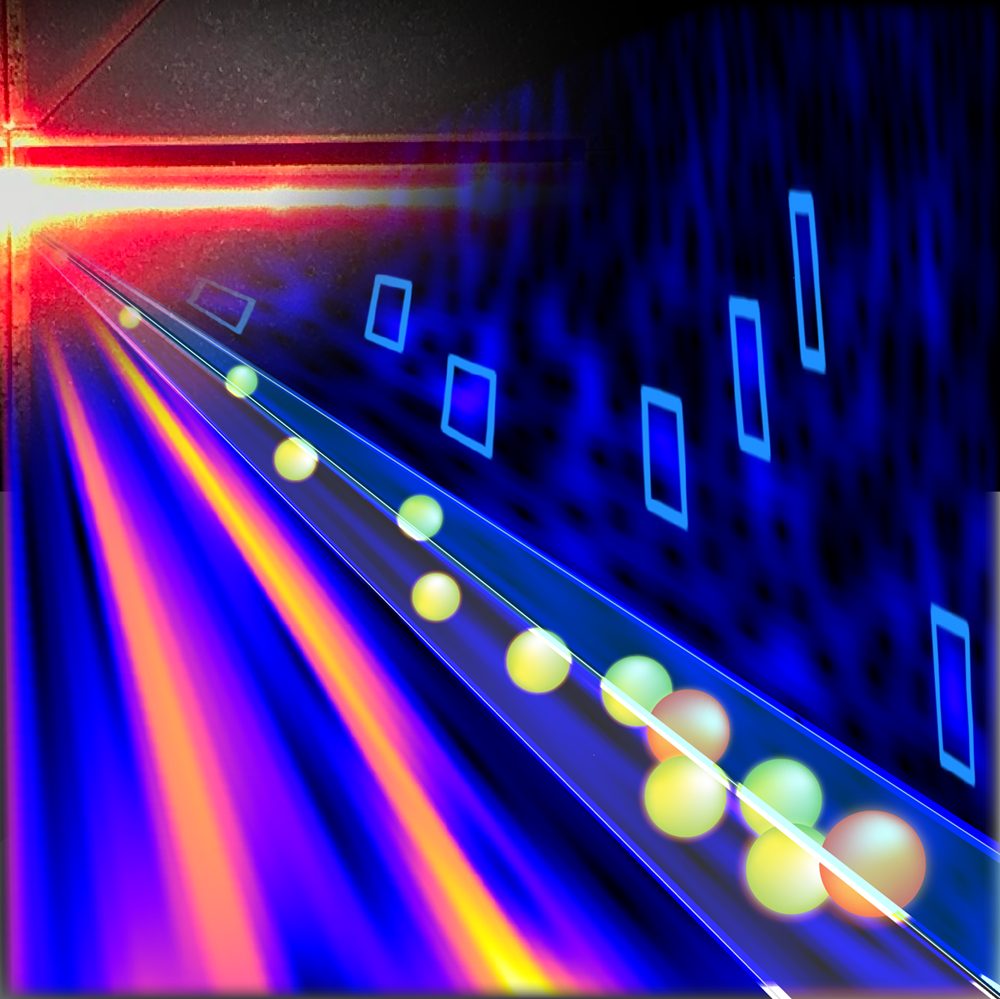
A team led by researchers at the University of California, Santa Cruz has taken an important step toward a long-sought goal in diagnostics: a single chip that can test for many different biological targets at once, even when those targets exist in wildly different amounts. Working with Aaron Hawkins at Brigham Young University, Holger Schmidt’s group is refining an optofluidic biosensor, a device that merges tiny fluid channels with light-based detection on a chip made from silicon or plastic. In the new work, reported in Optica, the researchers improved the way the chip interprets fluorescent signals, allowing it to detect particles spanning eight orders of magnitude in concentration, from attomolar to nanomolar levels. That matters because real biological samples are messy: one important protein might be vanishingly rare while another is abundant. Most chip-based tests are built for one kind of molecule or one narrow concentration range, which limits their usefulness in the clinic or in the field. The UCSC-led team says its approach moves beyond that constraint by using a single sensing method to spot and distinguish multiple particle types at the same time. If the technology continues to mature, it could help create more flexible lab-on-a-chip systems for medical testing, environmental monitoring, and biological research. The advance is less about a finished product today than about solving a core engineering problem that has held back truly multipurpose biosensor chips.
Building a More Flexible Biosensor
The central challenge in biosensing is that biological molecules do not come in one standard format. Proteins, viruses, and other targets differ in size, shape, and abundance, so a device tuned for one analyte often struggles with another.
Schmidt’s group is trying to get around that limitation by building a platform rather than a one-off test. Their optofluidic chip combines microfluidics—the controlled movement of tiny amounts of liquid through miniature channels—with optical detection, which uses light to read out what is inside the sample.
How the Chip Sees Particles
In this system, particles flowing through the chip are illuminated with a laser beam. A light-sensitive detector then measures the fluorescent response, producing a signal that reveals the presence of the particle.
That basic idea is already common in biosensing, but the difficulty comes when many particle types are mixed together and present at very different concentrations. A strong signal from abundant particles can overwhelm rarer ones, making it hard to measure everything accurately in a single run.
A Big Gain in Dynamic Range
The new advance came from improved signal processing, the mathematical handling of detector data to separate meaningful signals from noise and from one another. By refining that step, the team showed seamless fluorescence detection of mixed nanobeads across concentrations ranging from attomolar to nanomolar.
An attomolar concentration is extraordinarily small—roughly a billion times lower than a nanomolar one. Covering that span on one chip means the sensor can operate across a much wider dynamic range, the term engineers use for the spread between the weakest and strongest signals a device can reliably measure.
Why That Range Is So Important
The researchers say the new method expands the useful concentration range of these sensors by more than a factor of 10,000. That kind of improvement is especially relevant for disease biomarkers, because medically important proteins can differ in concentration by more than ten orders of magnitude.
In practical terms, a clinician may want to detect both a scarce early-warning marker and a much more common background molecule in the same sample. If a chip cannot handle both ends of that spectrum, the test either misses crucial targets or requires separate devices and workflows.
From One Test to Many
According to Schmidt, the broader goal is to create integrated optofluidic sensing devices sensitive enough to detect single biomolecules while still working over a very wide range of concentrations. Just as important, the team says it can do this with a single measurement strategy rather than stitching together several specialized methods.
That could make future biosensor chips far more versatile. Instead of designing a new platform for every target, researchers could potentially adapt one core chip architecture for many kinds of analyses, saving time in development and simplifying how tests are performed.
Why This Matters
Multipurpose biosensor chips are appealing because they promise the speed and portability of miniaturized testing without the narrow focus of today’s most common assays. A single compact platform that can detect multiple targets across a broad concentration range would be useful in hospitals, research labs, and places where full laboratory infrastructure is unavailable.
The work also highlights an often overlooked truth about modern diagnostics: progress does not only come from better hardware. Smarter data interpretation can dramatically improve what an existing sensor is able to detect, extending performance without requiring an entirely new physical device.
What Comes Next
This study used nanobead mixtures as a controlled stand-in for more complex real-world samples, so the next steps will likely involve pushing the platform toward actual biomolecules and clinically relevant assays. The long-term ambition is clear: a robust chip that can identify many different biological targets at once, from extremely rare to relatively abundant, on a single integrated device.
If that goal is achieved, optofluidic biosensors could become a powerful bridge between sophisticated lab analysis and practical point-of-care testing. For now, the latest results show that one of the hardest parts of that vision—measuring many things at many concentrations on the same chip—is becoming much more realistic.