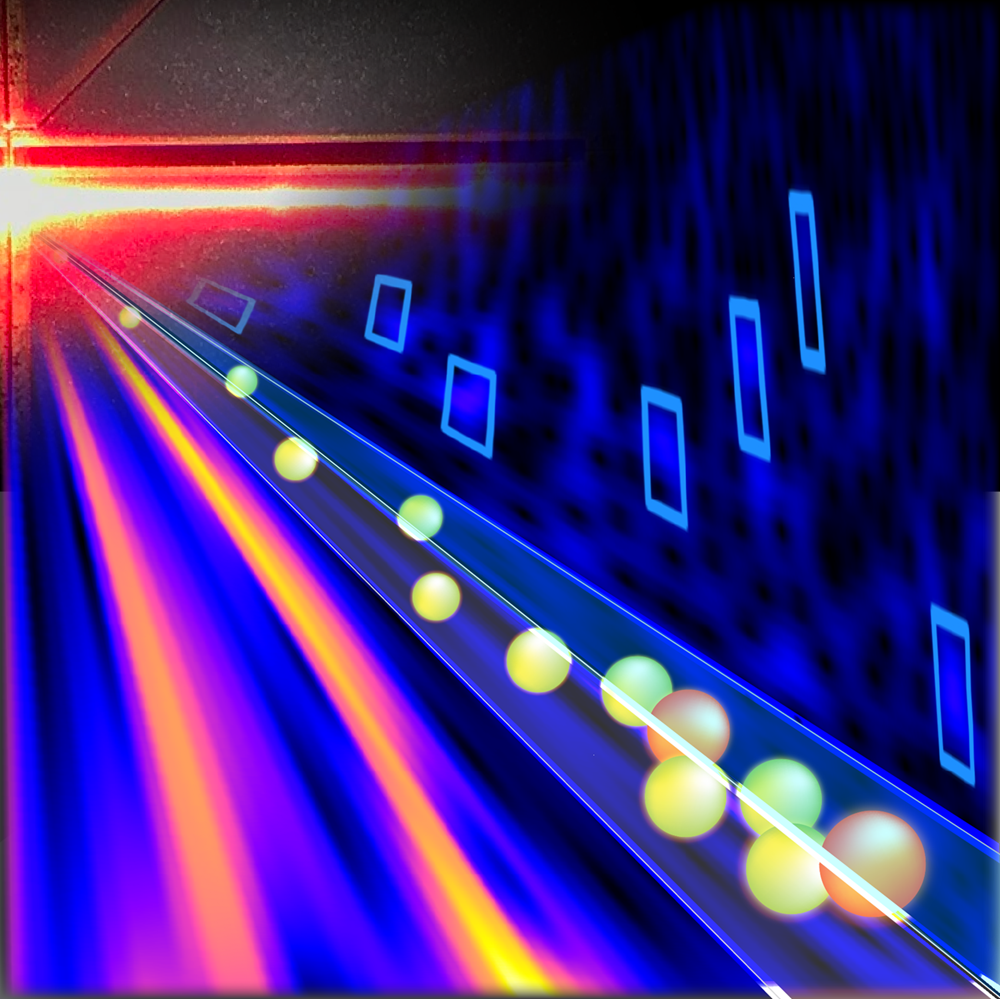
A team led by researchers at the University of California, Santa Cruz has pushed chip-based biosensing much closer to an all-purpose diagnostic platform. Reporting in Optica, the group showed that an optofluidic biosensor chip could accurately detect fluorescent particles across an enormous concentration range, from attomolar levels, meaning extremely sparse molecules, up to nanomolar levels, which are vastly more abundant. That span covers eight orders of magnitude, or a 100 million-fold range, and extends the useful operating window of the sensor by more than 10,000 times compared with earlier performance. The advance did not come from inventing an entirely new chip, but from applying smarter signal-processing methods to the data the chip already produces. In practical terms, that means one portable device could eventually handle very different biological targets in the same test, even when some are rare and others are common. That is a major hurdle in real-world diagnostics, where viruses, DNA fragments, proteins, and other biomarkers often show up at wildly different levels. If the approach holds up in future studies, it could help turn lab-grade sensing into compact tools for medical testing, environmental monitoring, and beyond.
What the team improved
The work centers on an optofluidic biosensor, a device that combines optics and microfluidics on a chip. Microfluidics means controlling tiny amounts of liquid in channels thinner than a human hair, while optics provides a way to read out signals using light.
These systems are attractive because they can be small, sensitive, and potentially inexpensive. But they often struggle with a basic problem: a signal that is ideal for spotting very rare particles can become overwhelmed when many particles are present, while settings tuned for abundant targets can miss the rare ones.
Why concentration range matters so much
In medicine, not every biomarker appears in the same amount. A viral particle might be present at a very low concentration early in infection, while a fragment of DNA or a background protein could be far more plentiful in the same sample.
That mismatch makes multiplexed testing hard. A multiplexed test is one that looks for several targets at once, and for it to be useful, the sensor has to distinguish weak and strong signals without confusing one for the other.
How the demonstration worked
To show the new approach in action, the researchers pumped the chip with a solution containing fluorescent nanobeads. These tiny beads glow in different colors under the right light and are often used as stand-ins for biological particles because they are easier to control in experiments.
The mixture included both yellow-green and crimson beads at very different concentrations. Even when the amounts differed by more than 10,000-fold in the same sample, the system correctly identified both populations, showing that the analysis method could separate strong and weak signals in one run.
The key idea was smarter signal analysis
The most important part of the advance was not simply brighter fluorescence or a redesigned chip layout. Instead, the team developed new ways to analyze time-dependent signals, meaning signals that change moment by moment as particles pass through the sensor.
That matters because single-particle sensing often produces a stream of peaks, bursts, or fluctuations rather than one neat number. Better processing can recover meaningful information from that noisy stream, allowing the system to estimate concentration more accurately across a much broader range.
Why this could apply beyond fluorescence
Lead researcher Holger Schmidt said the method is not limited to this particular fluorescence-based sensor. In principle, the same analysis framework could be used for any sensor that produces time-varying data over a wide dynamic range.
That opens the door to broader use in other optical devices and even in electrical sensors. If the mathematics works across platforms, the impact could reach beyond one chip design and become a general tool for improving compact biosensors.
What makes this promising for portable diagnostics
Portable diagnostic devices have to do more with less. They need to operate with small sample volumes, minimal preparation, and simple hardware, yet still deliver results that are sensitive enough for clinical decisions.
This study suggests one way to get more performance out of integrated chips without adding major complexity to the physical device. If software and signal processing can compensate for limitations that would otherwise require more elaborate hardware, it becomes easier to imagine field-ready instruments or point-of-care tests built around the same concept.
Why This Matters
The bigger story is that biosensing is increasingly becoming a data problem as much as a hardware problem. Many diagnostic platforms can already generate signals from tiny biological events, but extracting reliable information across a messy, real-world range of concentrations has remained a bottleneck.
By extending the chip’s working range from attomolar to nanomolar concentrations, the UCSC-led team addressed one of the central obstacles to building a truly versatile sensor. A device that can detect both rare and abundant targets at once would be far more useful in settings like infectious disease testing, cancer monitoring, and multi-analyte screening.
What comes next
The current demonstration used fluorescent nanobeads rather than a full clinical sample, so more work is needed before the technology can move into everyday use. Researchers will have to show that the method performs just as well with real biological materials, where samples are more complex and signals are less predictable.
Still, the result is an important proof of principle. It suggests that the path to an all-purpose biosensor chip may depend not only on better materials and better fabrication, but also on better interpretation of the information already flowing through these tiny devices.