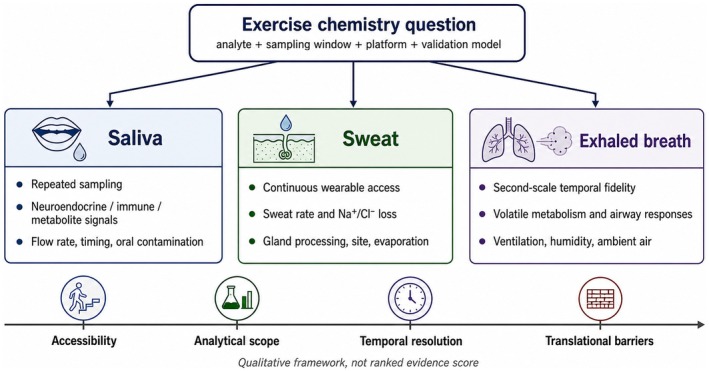
A new review takes a hard look at three appealing alternatives to blood draws in sports and exercise science: saliva, sweat, and exhaled breath. The authors do not ask whether these samples can replace blood or urine across the board; instead, they ask a narrower and more practical question: when are these noninvasive materials actually useful for answering exercise-related questions? Their conclusion is measured but important. Each sample type has real strengths, yet each also comes with biological quirks and technical limits that can easily mislead researchers or coaches if ignored. Saliva appears most reliable for repeated measurements of stress hormones, immune markers, and some fast-changing metabolites, especially when timing and contamination are tightly controlled. Sweat is furthest along for tracking sweat rate and salt loss, and it fits naturally with wearable sensors, but many popular sweat biomarkers still lack strong proof that they mirror what is happening in the bloodstream. Exhaled breath can capture rapid shifts in metabolism and airway chemistry almost in real time, though the instruments are complex and the readings are easily distorted by breathing patterns, food, humidity, and room air. The review's central message is simple: these specimens are best treated as specialized windows into exercise physiology, not as universal stand-ins for blood tests.
What the Review Set Out to Do
This article is a critical narrative review, meaning it surveys and interprets existing research rather than reporting a single new experiment. The authors focus specifically on exercise chemistry, where repeated sampling during or after training is valuable but traditional blood collection can be inconvenient, uncomfortable, or impractical.
That framing matters. Rather than grading saliva, sweat, and breath against the impossible standard of doing everything blood can do, the review examines their sampling biology, the tools used to measure them, their quantitative performance, and whether they are ready for real-world use in sport and exercise settings.
Saliva: Convenient, but Sensitive to Context
Saliva comes out strongest in the review, especially for repeated monitoring. Because it can be collected often and without needles, it works well for tracking neuroendocrine signals such as hormones linked to stress, autonomic responses tied to the body's automatic control systems, immune markers, oxidative stress indicators, and some metabolites that change on short time scales.
An easy way to think about saliva is as a stream connected to many processes happening in the body, but filtered through the mouth. That makes it useful, but also tricky. Measurements can shift depending on saliva flow rate, the exact timing of collection, food debris or blood contamination from the mouth, and how the sample is normalized so one person's watery sample is not compared unfairly with another's thicker one.
Sweat: Best for Fluids and Salt, Not Yet for Everything Else
Sweat has a different profile. The review says it is most mature for monitoring sweat rate and losses of sodium and chloride, the main salts that matter for hydration planning during exercise. That is a practical strength because these measures can help athletes and practitioners estimate fluid needs and salt replacement during training or competition.
Sweat is also uniquely compatible with wearable technology. Patches, skin-mounted sensors, and other devices can collect data continuously, which explains why sweat has become such a popular target for sports-tech development. But the review draws a clear line between what is technically measurable and what is physiologically proven.
That distinction is especially important for sweat lactate, glucose, cortisol, and cytokines, which are signaling proteins involved in inflammation and immune responses. These markers are often discussed as if they reveal the body's internal chemistry directly, yet the review argues they still need much stronger validation before they can be trusted as systemic markers of what is happening in blood or deeper tissues.
Exhaled Breath: Fast Signals, Complex Interpretation
Exhaled breath offers something the other specimens cannot: access to chemistry on the scale of seconds. Breath contains volatile compounds, meaning molecules that readily enter the air, and those compounds can reflect rapid shifts in metabolism, fuel use, and airway responses during exercise.
A useful analogy is a car's exhaust. You can learn something about the engine from what comes out of the tailpipe, but the reading depends on speed, fuel, temperature, and the surrounding air. Breath analysis works in a similar way: it can reveal real-time physiological changes, but the signal is shaped by ventilation, diet, humidity, and whatever is already present in ambient air.
The review notes that breathomics—the broad profiling of chemicals in breath—remains technically demanding. The instruments can be powerful, but they are not simple field tools, and interpreting their output requires care because a detected compound may reflect the environment or the way a person is breathing, not just internal metabolism.
Why Validation Matters More Than Novelty
Across all three specimen types, the review returns to one core issue: validation. In plain terms, validation means showing that a measurement is accurate, repeatable, and meaningful for a specific question. It is not enough for a sensor to detect a chemical; researchers also need to know what that chemical level actually means in the context of exercise.
The authors emphasize that protocols and platforms are still highly heterogeneous, meaning different studies collect samples in different ways, use different instruments, and report results differently. Because of that variation, the review interprets the evidence qualitatively rather than combining it in a formal meta-analysis, which would risk mixing unlike things and overstating certainty.
Matching the Matrix to the Question
One of the review's most practical contributions is its insistence that usefulness depends on matching the matrix—the sample type—to the question being asked. If the goal is repeated monitoring of stress or immune signals with minimal burden, saliva may be the best fit. If the goal is fluid and electrolyte planning with wearable compatibility, sweat has clear advantages. If the goal is capturing moment-to-moment changes in volatile metabolism or airway chemistry, breath may offer the right window.
That sounds obvious, but it pushes back against a common mistake in biomarker research: assuming that because a substance can be measured in a convenient sample, it must also be informative for every decision context. The review argues instead for matrix-specific validation models and for practical use cases defined in advance.
Why This Matters
This review matters because noninvasive testing is moving quickly from the lab into training centers, consumer wearables, and performance services. The appeal is obvious: easier sampling, more frequent measurements, and less disruption to exercise. But convenience can create false confidence if the biology behind the readout is poorly understood.
For researchers, the message is to design studies that respect the peculiarities of each specimen rather than forcing them to mimic blood tests. For coaches, athletes, and product developers, the takeaway is more cautious: some readouts, especially sweat sodium and sweat rate, are closer to practical readiness than others. Claims that a patch or saliva test can reveal broad internal physiology still need to be judged biomarker by biomarker.
What Comes Next
The field is not standing still. Better standardization, improved wearable platforms, and tighter validation against defined exercise outcomes could make these specimens much more useful over time. The review suggests the path forward is not to search for a universal replacement for blood, but to build a toolkit in which saliva, sweat, and breath each answer the kinds of questions they are actually suited to answer.