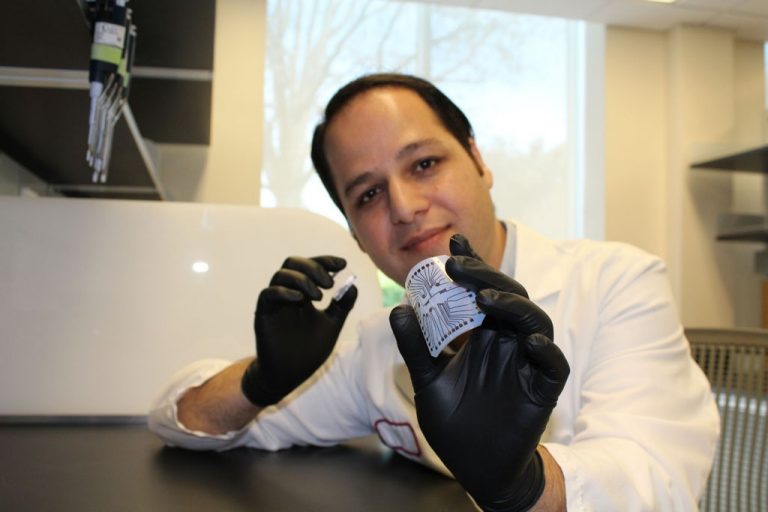
A team of researchers has built a remarkably cheap lab-on-a-chip, a miniaturized device that performs some of the jobs of a full laboratory on a tiny platform, for about one cent per disposable unit. The system was designed to avoid the expensive clean-room manufacturing and specialized staff that usually make advanced biochips difficult to produce outside well-funded labs. Instead, the researchers combined microfluidics—the controlled movement of tiny amounts of liquid—with simple electronics and ordinary inkjet printing methods. The chip is made in two parts: a clear silicone chamber that holds cells and fluids, and a reusable electronic strip printed on flexible polyester with conductive nanoparticle ink. According to the researchers, one chip can be made in roughly 20 minutes, making the approach both fast and scalable. The low cost could be especially important in places where even a small increase in testing expenses limits access to early diagnosis. Beyond medicine, the device may also help researchers study cells more quickly and cheaply in routine lab work. Taken together, the project points to a future where sophisticated biological testing tools can be printed and used almost anywhere.
How the device works
The chip is built as a two-part system. On top sits a transparent silicone microfluidic chamber, which contains cells or liquid samples and guides them through tiny channels smaller than a grain of rice.
Underneath is a reusable electronic strip made from a flexible sheet of polyester. That strip is printed with commercially available conductive nanoparticle ink, which allows it to carry electrical signals and interact with the biological sample above it.
Why printing matters
Traditional biochips often require clean rooms, highly controlled manufacturing spaces that keep out dust and contaminants because even microscopic particles can ruin delicate devices. Those facilities are expensive to build and run, which means many promising diagnostic tools never become widely available.
This design was created specifically to avoid that bottleneck. By using a regular inkjet printer and off-the-shelf conductive ink, the team showed that advanced chip fabrication does not always need specialized industrial equipment.
Designed for speed and access
The researchers said a single chip can be produced in about 20 minutes. That is fast enough to support small-batch manufacturing in ordinary laboratories and could eventually allow clinics or field teams to create devices close to where they are needed.
Cost is the other major breakthrough. While one dollar may seem trivial in a wealthy country, the difference between a one-cent disposable test component and a much more expensive conventional chip can determine whether screening programs are practical in low-resource settings.
Possible uses in medicine and research
Lab-on-a-chip systems are attractive because they shrink lab tasks like sample handling, measurement, and cell analysis into a compact format. In practical terms, that can mean less sample volume, faster turnaround, and lower costs for diagnostics and experimental work.
The team says the platform could help scientists and clinicians analyze more cells in less time. It may also support work with stem cells, which are immature cells that can develop into different tissue types, and make it easier to perform efficient gene transfer, the process of introducing genetic material into cells.
A tool for earlier detection
One of the clearest opportunities for a device like this is early disease detection. Many illnesses are easier and cheaper to treat when they are found sooner, but broad screening often stalls because tests are too expensive, too slow, or too dependent on centralized labs.
A printable, low-cost chip could help move some testing closer to patients. That does not mean it replaces full hospital laboratories, but it could act as a first-line tool for faster triage, routine monitoring, or research in settings that lack advanced infrastructure.
Why This Matters
This work matters because it tackles a quiet but important problem in health technology: many powerful inventions are still too hard to manufacture or distribute. A diagnostic platform that is cheap, quick to make, and simple to use has a better chance of reaching community clinics, research groups with limited budgets, and regions where conventional lab equipment is scarce.
The project also fits into the broader push toward precision health, an approach aimed at predicting, preventing, and diagnosing disease more accurately. If devices like this become reliable at scale, they could help shift medical testing from rare, expensive events toward more routine and accessible measurement.
What comes next
The bigger promise is not just one inexpensive chip, but a new way of thinking about biomedical tools: print them, use them, and adapt them quickly for different tasks. If the technology continues to mature, researchers may be able to customize chips for specific diseases, experiments, or patient groups without waiting for costly manufacturing pipelines.
That kind of flexibility could reshape both laboratories and clinics. A future where sophisticated biological analysis is as easy as printing a component and loading a sample is still developing, but this work suggests that future may be much closer—and much cheaper—than expected.