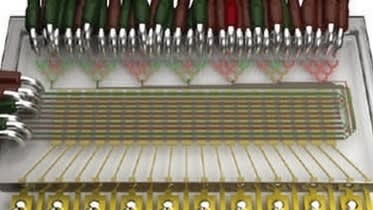
At-home medical tests have become familiar to millions of people, especially since the pandemic made rapid COVID-19 screening part of everyday life. But most home tests are still relatively simple: they can often tell you whether something is present, but not much more. More advanced diagnostic chips, the kind that could identify a virus strain or measure biomarkers such as glucose or cholesterol, usually depend on tiny pumps, tubing, seals, and electrical connections that are hard to shrink down and expensive to manufacture. Researchers at the University of Minnesota Twin Cities say they have found a way around that problem with a new microfluidic chip, a device that moves very small amounts of liquid through miniature channels. Their design works without many of the bulky moving parts that have long limited portable diagnostics. Even more striking, the chip can be powered wirelessly by a smartphone using the same near-field communication, or NFC, technology behind tap-to-pay transactions. The result could be a cheaper and more accessible path to home tests that are faster, more sensitive, and capable of doing far more than today’s common strip-based kits. If the platform can be commercialized, it may help push sophisticated lab-style analysis out of clinics and into people’s homes.
Why microfluidic chips are hard to miniaturize
Microfluidic devices are often described as labs on a chip because they can handle and analyze tiny liquid samples. In principle, that makes them ideal for home diagnostics, since they require only small amounts of blood, saliva, or other fluids.
In practice, though, these systems usually need a lot of supporting hardware. Fluids have to be sealed inside the device, moved through channels, and controlled with pumps, tubing, or wires, all of which add complexity and make the chip harder to scale down.
A simpler design with fewer moving parts
The Minnesota team developed a microfluidic platform that avoids much of that machinery. Instead of relying on conventional structures to guide and push liquids, the chip is designed so electric fields can do the work with far less physical infrastructure.
That matters because every extra component increases cost and creates another manufacturing challenge. A chip with fewer parts is not just smaller; it is also potentially easier to mass-produce and more practical for consumer use.
How the chip runs on very little power
The key engineering trick is the placement of electrodes, the conductive elements that create an electric field. In this device, the electrodes are separated by only 10 nanometers, which is about ten-billionths of a meter.
Because the gap is so tiny, the electric field becomes extremely strong even at very low voltage. The chip needs less than a volt of electricity to operate, a small enough energy demand that it can be activated by a smartphone without any direct wired connection.
Turning a phone into part of the diagnostic system
The researchers used NFC to wirelessly power the chip. NFC is a short-range wireless standard already built into many phones for contactless payments and other simple data exchanges.
That means the phone is not just displaying results or sending data to the cloud; it can also help activate the test itself. According to the researchers, this is the first time a smartphone has been used to wirelessly activate narrow channels in this kind of simplified microfluidic setup without traditional microfluidic structures.
What kinds of tests this could enable
The platform is designed for broad diagnostic use. The team says it could be adapted to detect viruses, pathogens, bacteria, and other biomarkers, measurable substances in the body that can signal normal function or disease.
That flexibility is important because the same core chip architecture could potentially support many different tests. Rather than building a completely new device for each condition, developers may be able to create a family of assays on a shared platform.
From the lab toward commercialization
Lead author Christopher Ertsgaard described the work as an exciting new concept and linked it directly to the demand for rapid, point-of-care testing. Point-of-care diagnostics are tests performed near the patient, rather than in a centralized lab, so results can come faster and be used immediately.
The project is also moving beyond the academic stage. The lab of Professor Sang-Hyun Oh is working with Minnesota startup GRIP Molecular Technologies, which makes at-home diagnostic devices, to help commercialize the chip platform.
Why This Matters
The big promise here is not just convenience. A smartphone-powered chip that works with very low energy and minimal hardware could lower the cost of sophisticated testing and make advanced diagnostics available in places where medical equipment is scarce.
It could also improve the quality of at-home testing. Instead of a simple yes-or-no answer, future devices might be sensitive enough to identify specific strains, measure changing biomarker levels, or detect disease earlier, when treatment decisions matter most.
What comes next
There is still a difference between a clever prototype and a reliable product people can buy at a pharmacy. The technology will need further validation, manufacturing development, and regulatory review before it becomes part of everyday healthcare.
Still, the concept points to a future where the phone in your pocket is more than a communication tool. It could become the power source and interface for a new generation of low-cost diagnostic chips that bring more of the medical lab into the home.