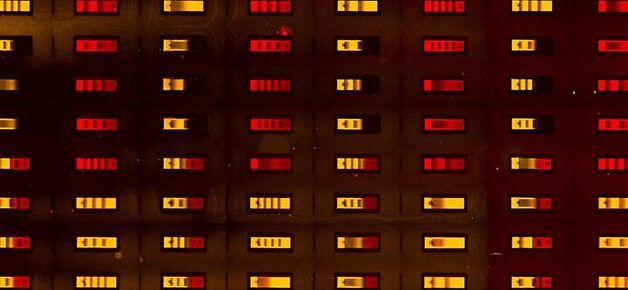
When a new virus appears, one of the first scientific challenges is figuring out exactly how the human immune system responds to it. Researchers need tools that can quickly test which viral pieces, called antigens, are recognized by antibodies in a person’s blood. A team at the Weizmann Institute of Science has developed a biochip designed to do just that, with a speed and flexibility that could be especially useful in a future pandemic. Instead of relying on pre-made viral proteins prepared in advance, the chip builds those proteins directly on its own silicon surface from printed DNA instructions. That means the system can be reconfigured much more easily when a virus mutates or when an entirely new pathogen emerges. The chip can display 30 to 40 viral proteins or fragments at once and uses only about one microliter of serum, less than a drop of blood-derived fluid. By reading how antibodies bind across all those targets, scientists can create a detailed immune “fingerprint” for each person. In practical terms, this could make it faster to compare variants, track immune responses, and better understand who has protection against what.
A chip that makes its own test targets
Most antibody tests depend on proteins that have already been grown, purified, and prepared in the lab. That process can take time and effort, especially when researchers want to compare many viral variants or protein fragments side by side.
This new biochip takes a different approach. Each section contains a tiny printed patch of DNA carrying the genetic instructions for a specific viral protein or protein fragment, and those instructions are turned into proteins right on the chip itself.
How the biology happens on silicon
To make this work, the researchers add a cell-free mix, a solution containing the biological machinery normally found inside cells. In simple terms, it is a stripped-down system that can read DNA and build proteins without needing living cells.
Once the mix is added, the DNA on each spot is translated into its matching protein. Because every spot can encode a different antigen, the chip becomes a compact testing platform for many viral features at the same time.
Designed for fast adaptation
One of the biggest advantages of the system is flexibility. If a virus changes, researchers do not have to rebuild an entire testing pipeline around purified proteins; they can instead print new DNA instructions for the updated targets.
That matters for fast-evolving viruses like the coronavirus, where different variants can carry meaningful changes in the outer spike protein, the structure the virus uses to enter cells. The chip can also include other viral components, such as proteins from the inner shell, making it possible to look beyond a single target.
Reading an immune fingerprint
Each chip can produce 30 to 40 viral proteins or fragments, giving researchers a broad panel of antigens in one experiment. Using just one microliter of serum, the team can see how strongly a person’s antibodies bind to each separate target.
Because every antigen occupies a specific position on the chip, the readout is organized and precise. The result is an immune fingerprint: a map of which viral components the immune system has seen before and how strongly it reacts to each one.
Why this is simpler than standard setups
According to the team, the method avoids much of the hardware and preparation that conventional systems often require. It needs no pumps or tubes, reducing complexity and making the setup easier to run.
That simplicity could be important in real-world outbreak conditions, when labs need to move quickly and compare many samples. Running dozens of antigens on a single chip also means scientists do not have to perform separate tests one by one, saving both material and time.
The researchers behind the platform
The development was led by Senior Staff Scientist Dr. Shirley Daube together with Dr. Aurore Dupin and Dr. Ohad Vonshak from Professor Roy Bar-Ziv’s lab in the Weizmann Institute’s Chemical and Biological Physics Department. Their work reflects a blend of biology, physics, and microengineering, which is exactly the kind of cross-disciplinary effort often needed to build useful diagnostic tools.
Dupin highlighted the practical appeal of the system: there is no need to grow or purify proteins in advance because each spot makes its own protein or fragment. That allows many antigens to be tested at once in a single experiment rather than through a series of separate assays, or laboratory tests.
Why This Matters
In a pandemic, speed is not just convenient; it can shape public health decisions. Scientists and clinicians need to know whether antibodies raised by infection or vaccination still recognize a new variant, and they need that answer quickly.
A platform like this could help by making immune profiling faster, smaller-scale, and easier to update. It may also improve our understanding of which viral regions trigger durable immunity and which ones are most likely to escape detection as a pathogen evolves.
What comes next
The promise of this technology is not limited to one virus. A chip that can rapidly generate its own protein targets from DNA could be adapted for influenza, future coronaviruses, or entirely new pathogens that have not yet entered public awareness.
That does not mean it replaces every existing diagnostic method, but it offers a powerful complement: a nimble way to study immune responses in fine detail. If the next pandemic arrives with the same urgency as the last one, tools like this biochip could help researchers get answers sooner and turn those answers into smarter vaccines, better surveillance, and faster action.