DNA microarrays did not appear out of nowhere as a single flash of invention. They emerged by combining older lab methods for handling DNA with new ways to arrange thousands of biological tests on a glass surface at once. The result was a tool that let researchers measure gene activity on a scale that had previously been slow, expensive, and fragmented. In practical terms, a microarray works a bit like a densely packed checkerboard, where each spot tests for a different DNA sequence and the pattern of signals reveals what genes are present or active. The source article traces how this technology grew from earlier techniques such as Southern blotting and fluorescence in situ hybridization, then spread through universities, companies, and government-backed research systems. It also shows that the story was not just scientific but organizational: standards, manufacturing quality, data analysis, and commercial strategy all had to mature before the field could stabilize. Early enthusiasm was real, but so were concerns about reliability, reproducibility, and how to compare one company’s chip with another. Seen this way, DNA microarrays were less a single product than a new research infrastructure that changed how biology was done.
Built on older tools, not invented from scratch
The core idea behind a DNA microarray is simple: place many known DNA fragments in an ordered pattern on a solid surface, then see which ones bind to a sample. But that idea depended on techniques researchers had been refining for years. The article points back to Southern blotting, introduced by Edwin Southern, which gave biologists a way to detect specific DNA sequences among many others.
Another important predecessor was fluorescence in situ hybridization, or FISH, a method that uses glowing probes to locate specific DNA sequences on chromosomes or inside cell nuclei. FISH mattered because it showed that biological material could be fixed onto glass slides and studied in an ordered way. That glass-slide logic later became central to microarray design.
How researchers turned a lab technique into a platform
The article highlights the role of researchers such as Ron Davis, whose work on gene identification contributed to the methods later used in microarrays. If Southern blotting was like checking one address at a time, microarrays turned the process into a whole city map. Thousands of DNA spots could be placed on a surface and tested in parallel, making large-scale gene analysis possible.
That shift from one-at-a-time experiments to parallel measurement was the real breakthrough. It did not just speed up existing work; it changed the kinds of questions scientists could ask. Instead of studying a few genes individually, researchers could compare activity across large portions of the genome in a single experiment.
Why the technology spread so quickly
The citation patterns discussed in the source show how rapidly microarray methods drew attention across multiple fields, especially biochemistry, biotechnology, and genetics. That broad uptake makes sense: the chips were designed to answer exactly the kind of questions these disciplines were already asking. Once the method became available, many labs saw it as a practical route to high-throughput biology, meaning they could run many measurements quickly and in a standardized format.
Still, diffusion was not driven by biology alone. Universities saw a chance to build new research capacity, companies saw commercial opportunities in manufacturing and instrumentation, and government agencies had reason to support a tool that could accelerate genomic science. The technology spread because each part of the system had something to gain, even if those motives were not identical.
The messy reality behind the hype
Early microarrays generated excitement, but the source makes clear that confidence in the technology was not automatic. Researchers worried about whether the chips were reliable, whether they were being manufactured consistently, and whether results from one experiment could be reproduced in another lab. Those are not side issues; they determine whether a scientific tool can be trusted.
Interpreting results was also a challenge. A microarray produces a large matrix of signals rather than a simple yes-or-no answer, so scientists had to decide what counted as meaningful variation and what was just noise. In everyday terms, it was like trying to hear a melody in a crowded room: the instrument was powerful, but the signal-processing skills had to catch up.
Not all chips were the same
One of the article’s more important points is that different manufacturers’ DNA microarrays came with different strengths and weaknesses. That meant choosing a chip was not merely a purchasing decision; it shaped the experiment itself. Probe design, surface chemistry, manufacturing consistency, and data-processing methods could all affect the final readout.
Because of those differences, many follow-on studies focused on quality control, benchmarking, and method comparison. Researchers needed to know when two chips agreed, when they disagreed, and why. This work may sound technical, but it was essential for turning microarrays from a promising invention into a dependable research tool.
More than a gene-expression story
The source also argues that DNA microarrays should be understood as part of a wider technological family. The same basic concept—building dense arrays to test many interactions in parallel—could be used for more than gene chips. In other words, the deeper innovation was the array format itself, not just one biological application.
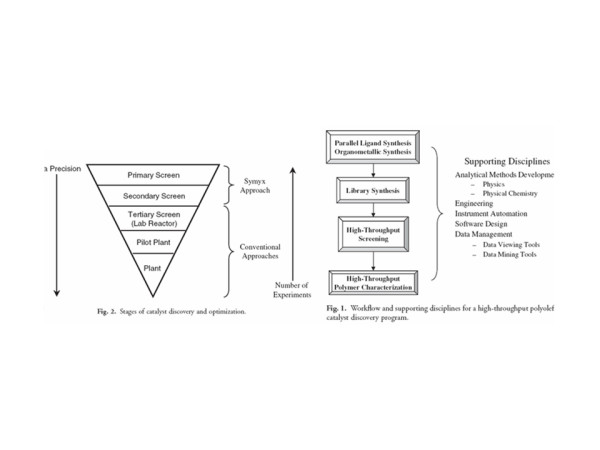
That broader view becomes especially clear in the case of Symyx, which the article describes as a company linked to people involved in the original microarray work at Affymax. Rather than staying focused on DNA analysis, they applied the underlying microarray idea to combinatorial chemistry, a method for rapidly creating and testing many material or chemical variants. It was a sign that the microarray concept could travel beyond molecular biology into other research and commercial domains.
Why This Matters
The history of DNA microarrays helps explain how modern life-science tools actually take hold. A useful technology needs more than a clever concept; it needs manufacturing methods, standards, software, trained users, and institutions willing to invest in it. Microarrays succeeded not because every early result was perfect, but because a broader ecosystem formed around the technology and kept improving it.
That lesson still applies to today’s biochip and genomics platforms. When a new diagnostic device, sequencing method, or lab-on-a-chip system appears, the real question is not only whether it works once, but whether it can be reproduced, interpreted, compared, and integrated into everyday research. The microarray story shows that scientific tools become transformative when they grow into reliable systems, not just exciting prototypes.
From invention to infrastructure
What makes this history enduring is that it reframes microarrays as a case study in technological diffusion. The important development was not only the first chip, but the gradual construction of a shared framework that linked academic science, industry, and government support. By the time microarrays were widely used, they had become part of the operating system of genomics.
That perspective also helps explain why their influence outlasted any one product generation. Even as newer technologies emerged, the microarray era established habits of large-scale measurement, data-intensive biology, and platform-based experimentation that continue to shape the field. The next wave of biochip innovation will likely follow a similar path: first a clever method, then a struggle over quality and standards, and finally, if it succeeds, an entire infrastructure built around it.