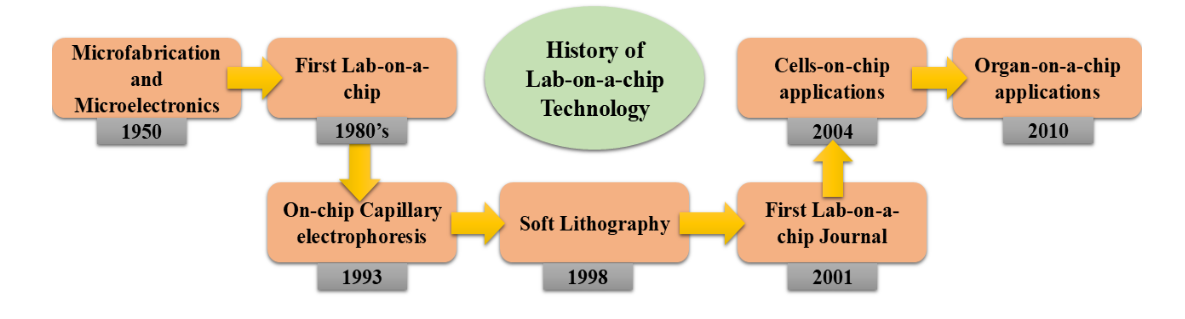
AI-generated summary by biochip.com, published . Not independently reviewed. Source: Knowledge Enterprise Journals, by Ida Tiwari; Ankit Singh.
Miniaturizing a laboratory onto a chip sounds futuristic, but it is quickly becoming a practical tool for safer and faster drug research. In a review published through the European Society of Medicine, researchers examine how lab-on-a-chip systems are changing pharmaceutical testing by shrinking key lab tasks—mixing chemicals, separating compounds, and detecting biological signals—into compact devices. These platforms combine microfluidics, the controlled movement of tiny volumes of liquid through small channels, with biosensors that can detect drugs or biological responses in real time. The result is a technology that can perform complex analyses with less sample, lower cost, and often better speed than conventional lab workflows. The review focuses on what is sometimes called Pharm-LOC, meaning chip-based tools for drug production, toxicology, and pharmacology. It highlights not only analytical devices that identify drug molecules, but also miniature biological models that can help researchers test whether medicines are effective or harmful. That matters because traditional drug development is expensive, slow, and still often relies on animal models or simplified cell cultures that do not fully predict human biology. By bringing sensing, modeling, and analysis onto a single platform, lab-on-a-chip systems could make pharmaceutical research both safer and more precise.
What lab-on-a-chip actually does
At its core, a lab-on-a-chip device takes functions that would normally require multiple pieces of laboratory equipment and compresses them into a small, integrated system. The chip can handle tasks such as reagent mixing, dilution, electrophoresis, separation, staining, and detection, often using only tiny droplets of fluid.
This matters because many chemical and biological tests are limited by time, cost, and sample availability. If the same work can be done on a device small enough to fit in the palm of a hand, researchers can run experiments more efficiently and with tighter control over conditions.
The rise of Pharm-LOC
The review frames these advances under the broader idea of Pharm-LOC, which covers chip-based methods for pharmaceutical manufacturing, drug analysis, and pharmacological or toxicological testing. In other words, it is not just one gadget, but a growing toolkit for studying how drugs are made, how they behave, and whether they are safe.
That broad scope is important. Drug development is not a single step; it includes finding candidate compounds, measuring their purity, testing how they move through biological systems, and evaluating side effects. A chip platform that can support several of those steps could reduce handoffs between instruments and simplify the overall process.
Biosensors bring detection onto the chip
A major theme in the review is the growing role of biosensors. A biosensor usually combines three parts: a biological recognition element that binds a target, a transducer that converts that interaction into a measurable signal, and a processor that reads out the result. On a chip, that setup can enable label-free detection, meaning a molecule may be measured directly without adding fluorescent or radioactive tags.
For pharmacology, that is especially valuable when researchers want to detect toxic drugs or monitor biological interactions as they happen. The review notes strong interest in electrochemical biosensors, which read chemical events as electrical signals. These systems are attractive because they can be sensitive, compact, and relatively easy to integrate with microfluidic channels.
Why nanomaterials are getting attention
The article also points to efforts to improve chip performance using nanomaterials, materials engineered at an extremely small scale. Nanomaterials can amplify signals, increase surface area for molecular binding, and improve the sensitivity of a sensor when target molecules are present in very low concentrations.
That could help solve one of the toughest problems in toxicology and drug screening: finding weak or early warning signals before a harmful effect becomes obvious. By pairing nanomaterial-based signal amplification with high-affinity biological receptors, researchers are trying to build devices that are both selective and sensitive enough for real-world pharmaceutical testing.
From molecule detection to drug safety models
Lab-on-a-chip is not limited to identifying chemicals in a sample. One of the review’s most significant points is the use of chip-based biological models to evaluate drug safety and drug efficacy, or whether a medicine works as intended. These systems can mimic aspects of tissues or organs more realistically than standard flat cell cultures.
That opens the door to testing how a compound affects living cells under more lifelike conditions. Researchers can potentially observe toxicity, metabolism, or therapeutic response in miniature controlled environments, which may improve predictions about how a drug will behave before it reaches animal studies or clinical trials.
The practical advantages—and the real limits
The promise of lab-on-a-chip technology is easy to see: high sensitivity, faster diagnostics, lower reagent use, improved process control, portability, and potentially lower fabrication costs. In pharmaceutical settings, those benefits could support quicker screening and safer workflows, especially when dealing with hazardous compounds or precious biological samples.
But the review does not present the field as finished. It acknowledges disadvantages and limitations, particularly around the design of nanoscale sensor chips. Terms such as “biosensor” are sometimes used loosely, which can blur comparisons between technologies, and performance in a research setting does not always translate cleanly into robust, standardized tools for industry use.
Why This Matters
Drug development has a notorious failure rate, and much of that failure comes from discovering too late that a compound is unsafe or ineffective. Technologies that can test smaller samples, generate faster data, and better model human biology could help researchers identify bad candidates earlier and focus resources on better ones.
There is also a wider safety argument. If chip-based systems can improve toxicology testing and reduce dependence on slower, more cumbersome methods, they may support more ethical and efficient research. For patients, that could eventually mean medicines developed with better evidence about risk, response, and biological mechanism.
Where the field goes next
The review ultimately presents lab-on-a-chip as a platform technology still moving from promise to practical maturity. The biggest opportunities appear to lie in tighter integration: combining microfluidics, biosensors, nanomaterials, and biologically realistic models into systems that are easier to manufacture and validate.
If that happens, Pharm-LOC could become more than a niche research tool. It could turn into a standard part of the pharmaceutical pipeline, helping scientists run smarter experiments, detect danger earlier, and build a more predictive path from molecule discovery to safe medicine.