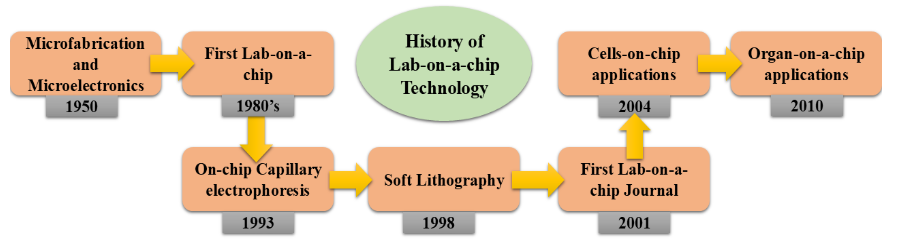
Lab-on-a-chip technology shrinks many steps of a laboratory workflow onto a device small enough to fit in the hand, and that basic idea is becoming increasingly important for drug safety and health testing. The article from the European Society of Medicine describes these systems as miniature platforms that can move tiny amounts of liquid, mix samples with stored chemical or biological components, and detect the result on the same chip. In practical terms, that means tests that once needed bulky instruments, multiple operators, and long turnaround times can be performed faster and with less material. The appeal is not just convenience. Smaller devices can also support high-throughput analysis, meaning many tests can be run in parallel, which is especially useful in screening drugs or monitoring biological responses. The source also points to a broader trend in analytical science: as sensors and microfluidics improve, testing tools are becoming more portable, more automated, and easier to use outside a traditional lab. That opens the door to applications ranging from clinical diagnostics and environmental monitoring to studies of the blood-brain barrier and anticancer drug screening. At its core, the story is about compressing the logic of a laboratory into a compact system that can deliver quicker answers where they are needed.
How a lab fits onto a chip
A useful way to picture a lab-on-a-chip device is to imagine a tiny, highly organized kitchen where every ingredient moves through narrow channels to exactly the right station. Instead of flour and water, the ingredients are droplets containing cells, proteins, DNA, or other biological particles. The chip guides those droplets through micrometer-scale pathways, where they can be separated, mixed, reacted, and measured.
The source highlights three core functions. First, the device transports liquid samples into a region containing preloaded electrode molecules or sensing elements. Next, it supports extraction, mixing, and binding reactions while trying to reduce non-specific binding, which is when the wrong molecules stick to a surface and muddy the result. Finally, it detects the target signal, turning a chemical or biological event into a readable output.
Why miniaturization matters
The article places lab-on-a-chip within a long-running push toward miniaturization in chemistry and biology. In plain terms, scientists have been trying to do more with less: less sample, less reagent, less time, and less equipment. Shrinking workflows can cut costs and speed up analysis while making systems easier to deploy in clinics, field settings, or remote locations.
That portability matters because many important decisions cannot wait for samples to travel back to a central lab. A chip-based sensor can potentially analyze a sample close to the patient, the drug development bench, or the environmental source being tested. The source also notes the promise of wireless communication, suggesting that results from these devices could be transmitted quickly to distant specialists or health systems.
What these devices actually do
Lab-on-a-chip devices belong to the broader field of microfluidics, the science of controlling very small volumes of fluid. Think of microfluidics as plumbing scaled down to the width of a hair. At that size, liquids behave differently, and engineers can exploit those behaviors to guide samples precisely through a sequence of steps.
That precision is one reason these systems are attractive for biosensing. A biosensor combines a biological recognition element, such as an antibody, enzyme, or nucleic acid probe, with a detector that converts binding or reaction into a signal. By integrating the sensor directly into the chip, researchers can automate not just fluid handling but also the readout itself, reducing the need for manual intervention.
Drug safety and disease testing
One of the most important applications mentioned in the source is drug release investigations and drug screening. In drug development, researchers need to know not only whether a compound works, but also whether it is toxic, how quickly it is released, and how cells respond over time. A small chip that can run many controlled experiments at once offers a practical way to gather that information more efficiently.
The references included with the article point to recent progress in on-chip anticancer drug screening using microfluidic platforms. That work aims to address long-standing chemotherapy challenges by modeling cell responses in more controlled environments. While the source page is broad rather than focused on one experiment, it clearly positions lab-on-a-chip systems as useful tools for testing how drugs behave before they reach patients.
From the brain barrier to the environment
The technology's reach extends well beyond one corner of medicine. The source cites work on microfluidic models of the blood-brain barrier, the tightly regulated boundary that protects the brain from many substances circulating in the blood. Researchers use chip-based models to study how drugs or disease processes interact with that barrier without relying solely on animal or large-scale laboratory systems.
The article also connects lab-on-a-chip platforms to environmental monitoring. That may sound far from medicine, but the underlying need is similar: detect specific molecules quickly, reliably, and outside a centralized lab when possible. The same miniaturized handling and sensing strategies that help analyze biological samples can also help track pollutants or other environmental targets.
The advantages and the technical hurdles
The case for lab-on-a-chip tools is straightforward. They are described as affordable, portable, fast, and capable of being integrated into sophisticated responsive biological systems. For researchers and clinicians, that combination can mean quicker experiments, smaller sample requirements, and more opportunities to test in real-world settings.
But the source also hints at the engineering difficulty underneath that simplicity. Moving liquids reliably at the microscale, preventing stray molecules from sticking where they should not, and getting a clean signal from a tiny amount of material are all hard problems. A successful chip must coordinate fluid control, reaction chemistry, surface design, and detection in one compact device.
Why This Matters
What makes this area important is not just that the devices are small. It is that miniaturization can change where and how testing happens. Instead of sending every question back to a distant laboratory, health systems and research teams can imagine more decisions being made closer to the patient, the experiment, or the source of contamination.
For drug safety, that could mean faster early-stage screening and better models of how treatments interact with cells and tissues. For health care more broadly, it could support more accessible diagnostics and quicker feedback. And for science as a whole, it offers a path toward experiments that are easier to automate, repeat, and scale.
What comes next
The European Society of Medicine article presents lab-on-a-chip as part of a steady technological evolution rather than a single breakthrough moment. The trend lines are clear: smaller analytical systems, stronger biosensors, and wider use in medicine, biology, and environmental testing. If those strands continue to come together, the future chip will not just imitate pieces of the lab. It will package transport, reaction, sensing, and communication into a tool that brings useful answers much closer to the moment of need.