Source: Clinical and Translational Science, by Federico M Goodsaid. AI-generated summary by biochip.com, published . Not independently reviewed.
Liquid biopsy tests promise a simpler way to guide cancer care: instead of cutting out a piece of tumor tissue, clinicians can look for tumor material shed into blood. That idea has attracted enormous interest because a blood draw is easier on patients, can be repeated over time, and may capture changes in a cancer that a single tissue sample misses. But turning that promise into a real clinical product is not just a science problem; it is also a product development and regulatory problem. The source article argues that developers must prove, step by step, that a liquid biopsy can reliably find the right biological signal, connect that signal to a treatment decision, and perform consistently enough for regulators and physicians to trust it. This is especially hard because liquid biopsy samples often contain only tiny amounts of tumor-derived material mixed into a large background of normal blood components. Different technologies also look for different targets, such as circulating tumor cells or cell-free DNA, and each target creates its own technical and regulatory hurdles. Prior milestones, including the US Food and Drug Administration's 2008 clearance of the CellSearch System, show that approval is possible, but they also show how high the bar can be. The result is a field full of opportunity, but also one that must navigate a complicated path from clever prototype to dependable diagnostic.
Why liquid biopsy is appealing
The appeal of liquid biopsy is easy to understand. It works like checking a river downstream instead of hiking to the exact mountain spring: if a tumor is shedding cells or DNA into blood, a blood sample may reveal what is happening inside the body without an invasive procedure.
In practice, these tests are being developed to detect cancer-related signals such as oncogenic molecular aberrations, meaning DNA changes that help drive tumor growth. A 2015 review by J. Polivka Jr., M. Pesta, and F. Janku asked a simple but still relevant question about cell-free DNA testing in the clinic: are we there yet? That framing captures the field's central tension - strong potential, uneven readiness.
The biology makes the assay difficult
The core technical challenge is scarcity. Tumor material in blood can be extremely rare, so a test must distinguish a faint signal from a huge amount of normal material, much like trying to hear one specific voice in a crowded stadium.
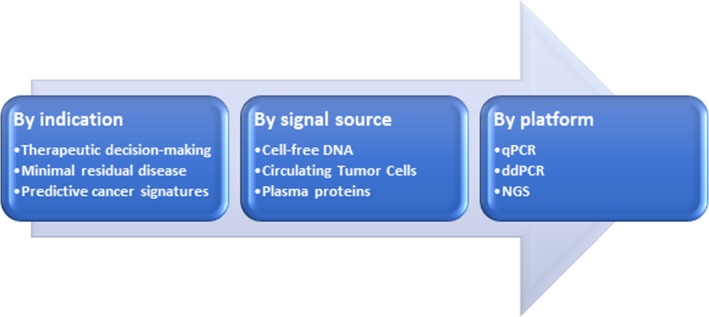
That challenge affects both major liquid biopsy approaches discussed in the source material. Some platforms try to isolate circulating tumor cells, or intact cancer cells moving through the bloodstream. Others analyze cell-free DNA, small fragments of DNA released into blood, some of which may come from tumor cells. Both can be clinically useful, but both require sensitive, reproducible methods.
Different platforms solve the problem in different ways
The article points to a wide mix of device designs for capturing circulating tumor cells. Some methods use surface markers, essentially molecular name tags on the outside of cells, to pull out suspected tumor cells. Others are label-free, meaning they do not rely on those tags and instead sort cells based on physical features such as size or deformability.
Several examples in the source show how engineering choices shape the field. Clearbridge technology uses hydrodynamic sorting in a microfluidic chip through Dean flow fractionation, a way of steering cells through tiny channels based on fluid behavior. Other systems use microfilters or syringe-based size exclusion to remove smaller cells, while the Parsortix device sorts by both size and deformability, and the Vortex Chip uses microfluidic design to separate cells in flow.
Regulation follows the same logic as development
Regulatory review may seem like a separate obstacle, but the source makes the opposite point: the regulatory landscape maps closely onto product development itself. In other words, regulators are asking many of the same questions a rigorous developer should already be asking. What exactly is the test measuring? How consistently does it measure it? And does the result actually help make a clinical decision?
That is particularly important when a liquid biopsy is used as a companion diagnostic, a test tied to the use of a specific therapy. In cancer trials, enrichment biomarkers are often used to select the subgroup of patients most likely to benefit from a treatment. If a blood-based test is going to stand in for a tissue biopsy in that role, it must show that its result is trustworthy enough to guide who gets the drug.
Companion diagnostics raise the stakes
This is where liquid biopsy becomes especially attractive and especially difficult. Tissue biopsies can be hard, risky, or sometimes impossible to obtain, so a blood-based alternative could open access to precision treatment for patients who otherwise could not be tested. But using liquid biopsy for treatment selection means errors matter more: a false negative could deny a useful therapy, while a false positive could send a patient toward the wrong one.
The source emphasizes that success depends on both the sample and the detection platform. A test cannot be judged only by whether the underlying idea is clever. It must perform reliably from blood collection through sample handling, signal enrichment, detection, and interpretation. Small weaknesses anywhere along that chain can undermine the final result.
Past approvals show the bar
The source cites the FDA's 2008 action on the CellSearch System, one of the field's early regulatory landmarks. That matters because it shows regulators will clear liquid-biopsy-related tools when the evidence is strong enough. It also shows that approval tends to favor systems with a clearly defined target, a controlled workflow, and a specific clinical use case.
The article also references the 2009 discussion by L.V. Sequist, S. Nagrath, M. Toner, D.A. Haber, and T.J. Lynch on the CTC-chip for lung cancer patients. That work reflected the excitement around microfluidic devices, which use tiny channels to manipulate cells with precision. But excitement alone is not enough; devices still must translate into standardized products that work outside a specialized research setting.
Why This Matters
The larger lesson is that liquid biopsy is not one technology but a family of technologies, each with different strengths, weaknesses, and evidence needs. A test that is useful for monitoring disease may not automatically be ready for diagnosing cancer, and a test that can detect a mutation in research conditions may not yet be dependable enough to choose a therapy in routine care.
For patients, this distinction matters because the phrase “blood test for cancer” can sound more settled than the science really is. For clinicians and regulators, the task is to separate promising signals from clinically actionable ones. The source's caution is not pessimism; it is a reminder that medical decisions require evidence that a test is analytically sound and clinically meaningful.
What comes next
The path forward is likely to depend on tighter links between engineering, clinical trial design, and regulation. Developers will need to build assays with real-world use in mind from the start, especially if they want liquid biopsy to replace hard-to-obtain tissue samples in companion diagnostics. If that happens, liquid biopsy could become less of a futuristic concept and more of a routine tool - still complex under the hood, but simple and reliable where it counts: at the bedside.