Point-of-care tests have become one of the most visible examples of medicine moving closer to the patient, whether that means a glucose check at home, a rapid infection test at urgent care, or a simple screening done in a doctor’s office. But behind the convenience of these tests is a hard engineering problem: sensors need to be sensitive enough to spot tiny amounts of biological material while still being practical, affordable, and easy to use. Researchers at the University at Buffalo are now reporting a sensing chip designed to address that tradeoff in a clever way. Their approach uses optical sensing, meaning it detects changes in light reflected from a surface, and combines it with a removable liquid metal layer that helps molecules reach the part of the chip where detection happens. According to the researchers, even a single molecular layer on the sensor can change reflected light by about 10%, a much larger shift than the roughly 1% seen in more typical sensors. Just as important, the liquid gallium used on the chip can be wiped away after measurement, allowing the device to be reused. That combination of high sensitivity, simple handling, and reusability could make the technology attractive for future diagnostic tools used by nurses, clinics, or even patients at home. While the work is still in the research stage, it points toward a new generation of compact medical tests that may be more powerful without becoming more complicated.
A sensor with a basic design problem
Modern biosensors often rely on nanostructures, tiny engineered features measured in billionths of a meter. These structures can amplify a signal and make it easier to detect very small amounts of a target, such as a protein or other biomarker, a measurable substance linked to a disease or condition.
But making the sensing features extremely small creates a practical problem. If the active parts of the chip are nearly the same size as the molecules being measured, it becomes harder to guide those molecules into the right place. As Peter Q. Liu of the University at Buffalo put it, it is like building a streamlined race car with a door too small for the driver to enter.
How the new chip tries to solve it
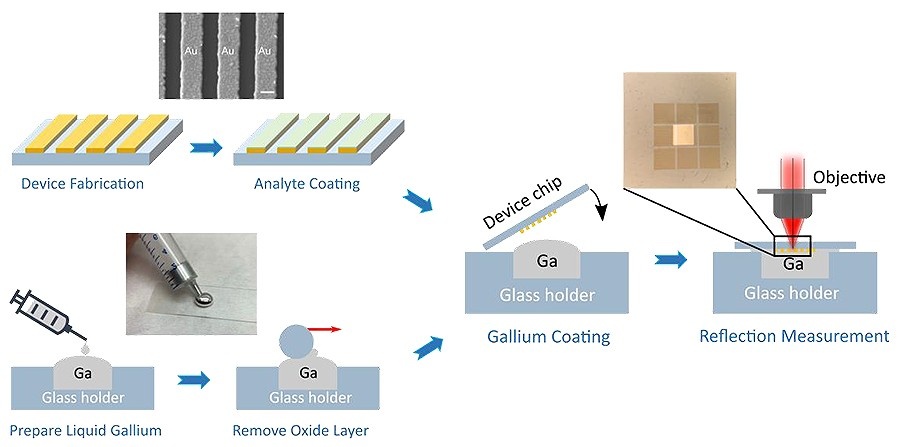
The team’s idea is to make the sensor easier for molecules to access without giving up the performance benefits of nanoscale design. They do this by using liquid gallium on the chip surface. Gallium is a metal that can be liquid near room temperature, which makes it unusual but useful in small-scale devices.
In this setup, the liquid metal appears to help bridge the gap between the sample and the sensor’s tiny active structures. That matters because a sensor is only as good as its ability to bring the right molecules into contact with the area doing the measurement. A design that improves that interaction can raise sensitivity without requiring a more complex instrument.
Why the optical signal stands out
The chip works through optical sensing, which means it detects a target by measuring changes in light reflected from the sensor surface. When molecules attach to the chip, they slightly alter the optical properties of that surface. The instrument reads those changes as a signal.
What makes the new device notable is the size of that signal. Liu said that even a single molecular layer can produce about a 10% change in reflected light, compared with around 1% for a typical sensor. In plain terms, that means the sensor may be much easier to read and potentially better at detecting small amounts of material.
Reusable by design
Many high-performance sensors are used once and then discarded, which can raise costs and limit their usefulness outside specialized settings. The University at Buffalo researchers say their chip avoids that problem in a strikingly simple way. After measuring what the article describes as the ODT, the liquid gallium can be removed from the chip surface with a swab.
That means the underlying sensor can be used again rather than thrown away after a single test. Reusability does not just save money; it can also make a technology more realistic for clinics, lower-resource environments, and situations where supplies are limited. In point-of-care medicine, those practical advantages can matter almost as much as raw performance.
Built for testing closer to patients
The researchers also emphasize where this kind of sensor could eventually be used. Liu said the structure makes it suitable for point-of-care applications, meaning tests performed near the patient rather than in a centralized laboratory. That could include use by nurses, in outpatient settings, or potentially in a patient’s home.
This is an important design target because point-of-care tools face different demands than lab instruments. They need to be straightforward, compact, and reliable, often with minimal training. A sensor that is sensitive, easy to refresh, and potentially low-cost could fit well into that growing market.
Potential uses in disease detection
The researchers say they plan to continue refining the sensor for bioanalytical sensing and medical diagnostics. Bioanalytical sensing refers to measuring biological substances, such as proteins, nucleic acids, or other markers in blood, saliva, or urine. These are the building blocks of many modern diagnostic tests.
One likely future application is detecting biomarkers associated with disease. If the chip can reliably pick up tiny changes caused by these molecules, it could help support tests for earlier diagnosis or more frequent monitoring. That is especially relevant for conditions where a fast answer can change treatment decisions.
Why This Matters
This story is not just about making one sensor better. It reflects a broader challenge in medical technology: the best devices are not simply the most sensitive, but the ones that combine sensitivity with usability and cost control. A clever engineering solution that makes molecules easier to detect, while also allowing the chip to be cleaned and reused, addresses several bottlenecks at once.
If that promise holds up in further development, the result could be a class of diagnostic tools that are more capable without becoming harder to deploy. That would matter for hospitals, clinics, home care, and public health settings where fast, local testing can reduce delays and improve access. In a field crowded with sophisticated ideas that are tough to scale, a reusable optical chip has the appeal of being both advanced and practical.
What comes next
For now, the sensor remains a research effort rather than a commercial product. The next steps will likely involve refining performance, validating it with real biological samples, and showing that it works consistently outside controlled lab conditions. If those studies go well, this tiny chip could become part of a larger shift toward diagnostics that are not only smarter, but also simpler to bring directly to the people who need them.