Point-of-care testing has been steadily reshaping medicine by moving diagnostics closer to the patient, whether that means a nurse using a handheld tool in a clinic or someone running a quick test at home. Researchers at Yale have now reported a tiny reusable sensing chip that could push that trend further by making sensitive chemical and biological measurements cheaper and easier to perform. The device is built from simple layers, including gold strips, a drop of liquid gallium, and a thin glass cover, but together those parts form a highly responsive optical sensor. In early work, the team showed that the chip can detect very small amounts of material by tracking changes in reflected infrared light, a part of the spectrum often used to identify molecules by their chemical bonds. The design is especially notable because it can be cleaned and reused after a measurement, which could lower cost compared with many single-use sensor platforms. According to the researchers, the sensor is sensitive enough that even a single molecular layer can produce a measurable signal change. That combination of sensitivity, compact size, and reusability makes it a promising candidate for future medical diagnostics, including tests that look for disease-linked biomarkers. If the technology continues to improve, it could help bring sophisticated lab-style sensing into everyday care settings.
A tiny optical sensor with an unusual design
The new chip centers on a structure the researchers call a nanopatch antenna. In simple terms, it is a nanoscale light-trapping device that concentrates light into tiny spaces, making it easier to detect molecules that collect there.
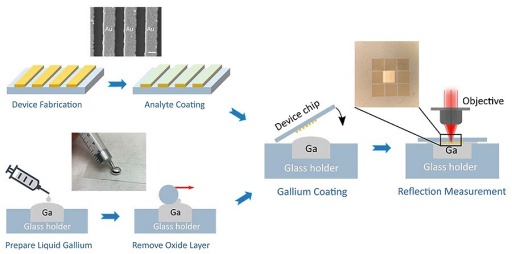
To build it, engineers start with arrays of microscopic rectangular gold strips. They coat those strips with 1-octadecanethiol, a molecule that helps prepare the surface, then place a drop of gallium on top and seal the structure with a thin glass cover, creating a sandwich-like device.
How it detects molecules
The sensor works with infrared light, which is useful because many molecules absorb or alter infrared wavelengths in distinctive ways. When a sample enters the tiny cavities in the device, it changes how much light is reflected back, giving the researchers a readout that can be linked to the material present.
The antenna design does two jobs at once: it funnels molecules into the sensing region and absorbs enough infrared light to make the signal strong. That matters because one of the hardest parts of sensing tiny amounts of biological material is getting enough interaction between the sample and the light used to analyze it.
Why sensitivity matters so much
According to Peter Q. Liu and colleagues, the device can produce a much larger optical response than a typical sensor. Liu said that even a single layer of molecules on the sensor can change reflected light by about 10%, while more conventional sensors may show only around a 1% change.
That is a big difference because stronger signals are generally easier to measure accurately outside a specialized laboratory. In practical terms, higher sensitivity can improve the odds of detecting scarce biomarkers, which are measurable molecules in blood, saliva, or other samples that can indicate disease.
Reusable instead of disposable
One of the most interesting parts of the work is that the chip is not necessarily a one-and-done device. After measuring the sample, the researchers removed the liquid gallium from the chip surface with a simple swab, allowing the sensor to be used again.
Reusability may sound like a small engineering detail, but it could have an outsized effect on cost and access. If a sensor can be reset rather than discarded after every test, clinics and home users may eventually be able to perform advanced measurements more affordably.
Built for care outside the central lab
The team says the sensor's structure makes it well suited for point-of-care use, meaning tests performed near the patient rather than in a centralized lab. That could include use by nurses in clinics, bedside monitoring in hospitals, or even testing in a patient's home.
This is an important shift in diagnostics. Traditional lab testing can be highly accurate, but it often requires expensive equipment, trained operators, and time-consuming sample transport, all of which slow down decisions about treatment.
Why This Matters
The broader significance of this sensor is that it points toward a future where high-performance molecular detection is not locked inside specialized research facilities. A small chip that can sensitively read chemical signatures and then be reused could help expand access to testing in rural clinics, urgent care settings, and home health environments.
It also fits into a larger trend in medicine: replacing bulky instruments with miniaturized systems that are faster, simpler, and more patient-friendly. If the device can be adapted to detect real-world disease biomarkers reliably, it could support earlier diagnosis, more frequent monitoring, and more personalized care.
What comes next
The researchers say they plan to continue refining the platform for bioanalytical sensing, the measurement of biological substances for medical or research purposes. The obvious next step is to move from proof-of-concept measurements toward detecting clinically relevant targets linked to specific diseases.
That transition will take more validation, including showing that the chip can work consistently with messy real samples rather than idealized test materials. But the underlying idea is compelling: a tiny gold-and-gallium sensor that combines optical precision with practical reusability could become a useful building block for the next generation of point-of-care diagnostics.