AI-generated summary by biochip.com, published . Not independently reviewed. Source: Oncology Letters, by Kazumasa Kure; Masaki Hosoya; Takae Ueyama; Midori Fukaya; Kiichi Sugimoto; Yuichi Tomiki; Takashi Ohnaga; Kazuhiro Sakamoto; Hiromitsu Komiyama.
A small study suggests that a polymeric circulating tumor cell chip can find signs of colorectal cancer in blood with greater sensitivity than two standard blood markers. The device is designed to capture circulating tumor cells, or CTCs, which are cancer cells that have broken away from a tumor and entered the bloodstream. In the reported patient samples, researchers detected CTCs in 12 of 13 people with colorectal cancer, and among patients with stage II through stage IV disease, 92% had at least one CTC per milliliter of blood. That detection rate was much higher than the 15% positive rate reported for the carbohydrate antigen 19-9 test, known as CA19-9. The team also found CTCs in all patients with stage II and III colorectal cancer in the study, including some whose conventional blood tests for carcinoembryonic antigen or CEA and CA19-9 were negative. That matters because earlier-stage patients often do not show clear signals on routine serum marker tests, even when disease is present. If the approach holds up in larger studies, the chip could become a useful add-on tool for detecting disease, monitoring progression, and spotting changes that standard blood markers miss.
What the chip is trying to catch
Think of CTCs like a few leaves drifting downstream from a tree upstream: they are rare, but if you can catch them, they tell you something important about where they came from. In cancer, those cells can carry clues about the presence and behavior of a tumor without requiring a tissue biopsy.
That is the promise behind CTC testing, often called a kind of liquid biopsy. Instead of removing a piece of tumor, clinicians analyze a blood sample for tumor-derived material, and in this case the focus is on whole cells that have escaped into circulation.
How the polymeric CTC-chip works
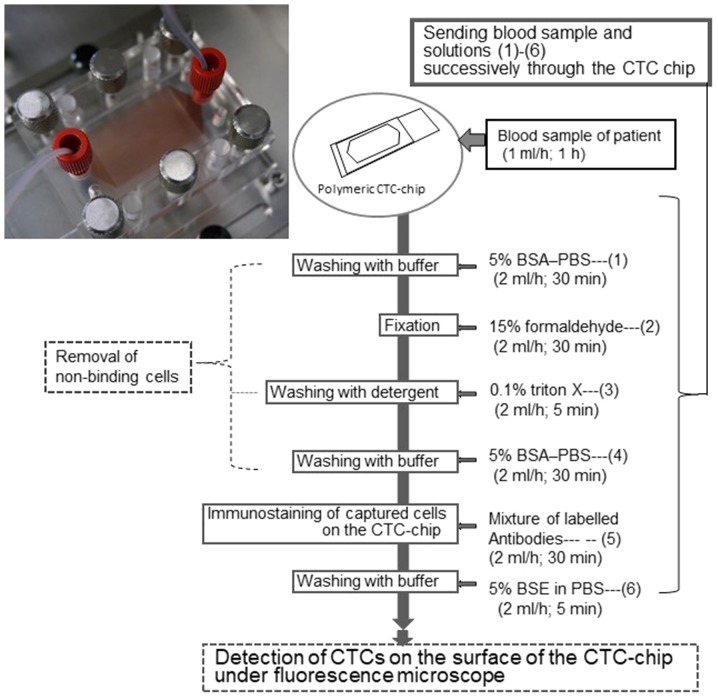
The study used a microfluidic device, meaning a chip with tiny channels that guide fluids in a highly controlled way. The polymeric CTC-chip was coated with antibodies, proteins that act like highly specific Velcro, helping the device latch onto target cells as blood passes through.
The chip itself measured 75 by 25 millimeters and contained surface microstructures made of two types of micropost arrays inside a wide channel. During the procedure, the chip was mounted in a holder on an inverted fluorescence microscope stage, connected by tubing to a syringe or sample tube, and the sample was pushed through at a constant flow rate using a syringe pump.
The researchers also shook the sample tube to reduce cell settling and adhesion before the blood moved through the system. That detail matters because CTCs are scarce, and losing even a small number during handling can affect whether a test reads positive or negative.
What the study found in colorectal cancer samples
According to the report, the chip detected CTCs in blood samples from 12 of the 13 patients with colorectal cancer who took part. Across patients with stage II to stage IV disease, 92% had at least one CTC per milliliter of blood.
The study also noted a difference by stage. Patients with stage II and III colorectal cancer had a lower average CTC count, 3.3 plus or minus 2.3, than patients with stage IV disease, who had an average of 7.0 plus or minus 6.2.
That pattern fits the basic biology of cancer spread. Stage IV disease is metastatic, meaning the cancer has spread to distant sites, so it makes sense that more tumor cells might be shed into the bloodstream.
Why the comparison with standard blood markers matters
Doctors commonly use serum markers such as CEA and CA19-9 to help track colorectal cancer, but these tests are imperfect. A marker can be negative even when cancer is present, especially in earlier stages or in patients whose tumors simply do not release much of the marker into blood.
In this study, the chip outperformed CA19-9 on simple positivity rate: 92% of stage II to IV patients had detectable CTCs, compared with 15% who tested positive by CA19-9. Just as important, the researchers reported that all patients with stage II and III colorectal cancer had detectable CTCs, including several whose CEA and CA19-9 results were negative.
That finding points to a practical use case. If a patient has suspected or known colorectal cancer but standard serum markers are uninformative, a CTC-based test might provide another window into what the disease is doing.
What the results do and do not say
The results are promising, but they come from a very small group of patients. With only 13 participants, the study can show feasibility and signal, but it cannot establish how well the chip would perform across the broad range of real-world colorectal cancer cases.
It also does not answer every clinical question. A strong detection rate does not automatically mean the test improves diagnosis, predicts recurrence, or changes treatment decisions unless those outcomes are studied directly in larger, carefully designed trials.
Still, the stage-related difference in CTC counts hints at another possible role: monitoring progression. If CTC levels rise as disease advances, serial blood testing could someday help clinicians track changes over time in a less invasive way than repeated imaging or tissue sampling alone.
Why This Matters
Colorectal cancer care depends heavily on timing. The earlier clinicians can detect meaningful signs of disease or progression, the more options patients usually have for surgery, chemotherapy, and follow-up planning.
A test that works from blood and catches signals missed by CEA or CA19-9 could be especially useful for stage II and III patients, the group highlighted in this report. These are often the patients where doctors are trying to judge risk after diagnosis or surgery, and where better biological clues could sharpen decision-making.
The appeal is also broader than one cancer type. Microfluidic CTC chips are part of a larger push to make cancer monitoring more precise, less invasive, and easier to repeat over time, turning a blood draw into a richer source of information.
The next step is clear: larger studies need to test how reproducible the polymeric CTC-chip is, how it compares with other liquid biopsy methods, and whether CTC counts actually improve patient management. But even from this early dataset, the message is straightforward: rare tumor cells in blood may offer clinically useful information, and a carefully engineered chip can make them easier to find.