A new study focuses on an unusual corner of the p53 cancer gene, one of the most closely watched genes in oncology because it helps cells stop dangerous growth or self-destruct when damage becomes too severe. Researchers report that two inherited changes at a single amino acid in p53, known as R181H and R181C, weaken the protein's ability to switch on many of its usual DNA-based target genes, yet do not erase all of its protective functions. In families carrying these variants, cancer risk appears to be lower than in people with classic high-risk TP53 mutations, even though the variants still disrupt an important part of p53 biology. The work points to a rare and informative “split” in p53 function: the gene can lose much of its normal gene-control activity while still keeping a separate route to trigger cell death at the mitochondria, the cell's energy-producing structures. That matters because p53 is often described as a single master tumor suppressor, but in reality it acts through several mechanisms at once. By separating those mechanisms, the study offers a clearer picture of why some inherited TP53 mutations cause severe cancer syndromes while others produce a milder pattern. It also gives researchers a more precise way to think about risk, function, and treatment for people whose genetic test results do not fit the usual rules. More broadly, the findings suggest that not all harmful-looking p53 mutations are biologically equivalent, even when they affect the same critical region of the protein.
What the researchers found
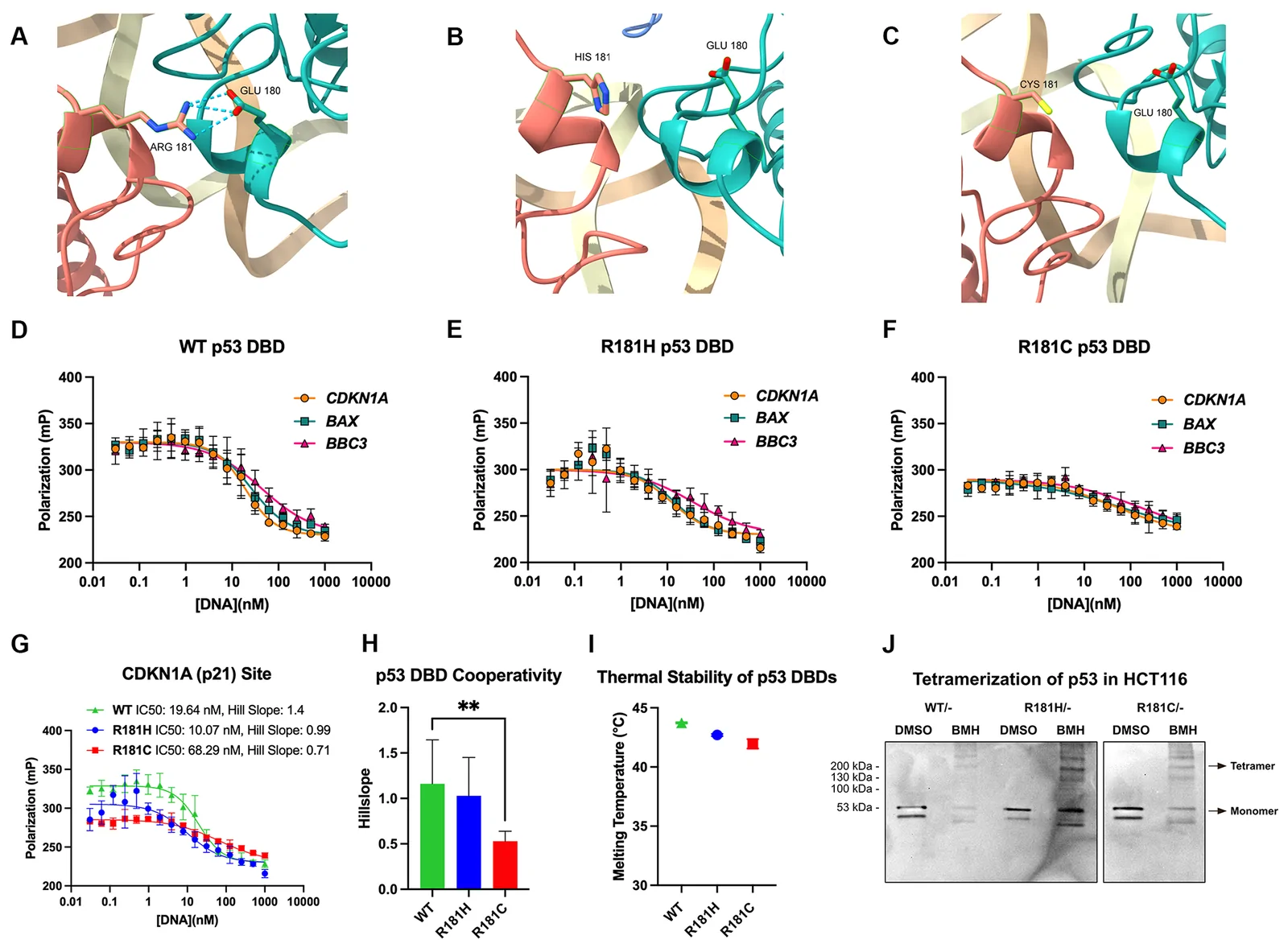
The study examined changes at the R181 residue, a single position in the p53 protein that helps neighboring p53 molecules work together. p53 usually binds DNA as a tetramer, meaning four copies of the protein assemble into a functional unit, and this teamwork depends in part on a salt-bridge interaction involving residues E180 and R181 from different monomers.
When R181 is altered to histidine or cysteine, producing the variants p.R181H and p.R181C, that cooperative DNA binding falls apart. The researchers found that these variants were much less able to bind p53 target sequences in promoters and enhancers, the stretches of DNA that control whether genes are turned on.
Why that loss looked surprising
On paper, the defect resembles a major loss of function. The mutant proteins showed a sharply reduced ability to transactivate p53 target genes, meaning they could no longer effectively activate the genetic programs p53 normally uses to pause cell division, repair damage, or push a cell toward death.
That kind of failure often tracks with severe inherited cancer risk in people with damaging TP53 variants. But the family data here did not match the most aggressive pattern seen with classic p53 hotspot mutations that act in a dominant-negative way, where a mutant copy interferes with any remaining normal p53 activity.
A milder inherited cancer pattern
According to the report, families carrying p.R181H and p.R181C showed an attenuated cancer risk phenotype. In plain English, that means the syndrome appeared milder or less penetrant than the one typically associated with strongly disruptive TP53 mutations.
This is an important clinical clue because germline TP53 testing increasingly finds rare variants, and clinicians must decide how much risk each one really carries. A result that looks dangerous by sequence alone may behave differently if part of p53's tumor-suppressing machinery remains intact.
What the variants did not destroy
One of the most interesting findings is that the R181 variants did not simply unravel the entire protein. The researchers report that p53 R181H and R181C retained wild-type structure and tetramerization, meaning the protein still kept its overall normal shape and could still assemble into four-part complexes.
That distinction matters because many p53 mutations damage the protein so badly that it misfolds or loses multiple functions at once. Here, the defect seems more selective: the protein can still form properly, but its cooperative grip on DNA is compromised, like a key that still fits the lock but no longer turns smoothly enough to open the door.
A second route to cell death survives
The other major result involves mitochondria-associated apoptosis. Apoptosis is the tightly controlled process cells use to self-destruct when they become too damaged or dangerous, and mitochondria can serve as one of the key launch points for that process.
The researchers found that cells carrying the R181 mutations could still undergo apoptosis through wild-type-like p53 activity at the mitochondria. This is a different branch of p53 biology from its role as a DNA-binding transcription factor, and it suggests that some tumor-suppressive activity can survive even when p53 can no longer activate many of its usual genes.
A rare separation of p53 functions
The authors describe this as the first reported separation-of-function mutation in the p53 DNA-binding domain that preserves transcription-independent functions while losing transactivation activity. That phrase can sound technical, but the core idea is simple: one part of p53's job is broken, while another part still works.
Scientists value cases like this because they act like natural experiments. Instead of shutting off the whole p53 system, the R181 variants isolate one branch of the pathway and reveal how much protection that branch alone can still provide in people.
Why This Matters
The finding has practical implications for both cancer genetics and drug development. Inherited TP53 mutations are often discussed under the umbrella of Li-Fraumeni syndrome and related risk states, but this study suggests that risk may depend not just on whether p53 is altered, but on which of its functions are lost and which remain.
That could eventually influence how clinicians interpret genetic test results, counsel families, and decide on surveillance intensity. It also sharpens a broader lesson for cancer biology: tumor suppressors are not single on-off switches but multi-part machines, and preserving even one protective circuit may meaningfully change disease risk.
What comes next
The work does not mean R181 variants are benign; the study clearly shows they impair central p53 functions and are associated with inherited cancer susceptibility. But it does suggest that residual mitochondrial apoptosis may soften the clinical outcome compared with more destructive TP53 mutations.
The next step will be to test how general this principle is across other p53 variants and whether retained transcription-independent activity can be measured in ways useful for patient care. If that happens, genetic reports may move beyond labeling TP53 variants simply as harmful or not, and toward a more nuanced readout of which protective layers of p53 are still standing.