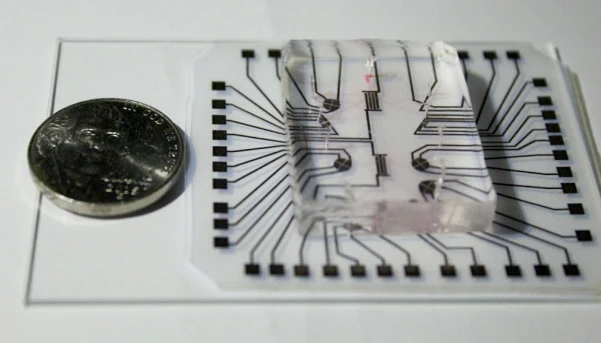
A team of researchers has developed a remarkably cheap lab-on-a-chip device that can be made for about 1 cent, pointing to a new way to bring sophisticated medical testing to places that cannot afford conventional diagnostic equipment. A lab-on-a-chip is a miniaturized system that performs laboratory-style analysis inside tiny channels, often using just a small sample of blood, fluid, or cells. In this case, the researchers combined microfluidics—the precise handling of liquids in microscopic channels—with printed electronics made using an ordinary inkjet printer and commercially available conductive ink. The result is a two-part device: a clear silicone chamber that holds cells and fluids, paired with a reusable electronic strip printed on flexible polyester. According to the researchers, the system was designed specifically to avoid the need for expensive clean-room manufacturing facilities and highly trained operators, two major barriers that have kept many chip-based diagnostics out of low-resource settings. One chip can reportedly be produced in about 20 minutes, making it not just cheap but also relatively fast to fabricate. The work is aimed at a larger problem in global health: many deadly diseases are far easier to treat when caught early, but the tools for early detection are often concentrated in wealthy hospitals and labs. By driving the cost of the hardware down to nearly nothing, the researchers are making the case that advanced diagnostics do not have to be complex, fragile, or financially out of reach.
A Different Kind of Medical Test Platform
The device is built as a two-part system. On top sits a transparent silicone microfluidic chamber, which acts as the small testing environment where cells or liquid samples can be placed and controlled.
Underneath is a reusable electronic strip printed onto a thin sheet of polyester. That strip is made with conductive nanoparticle ink, meaning the printed patterns can carry electrical signals and help the chip sense what is happening inside the chamber above.
How Inkjet Printing Changes the Equation
What makes this work especially notable is the manufacturing approach. Instead of relying on specialized semiconductor-style fabrication, the researchers used a regular inkjet printer to create the electronic component of the device.
That matters because traditional chip fabrication often requires clean rooms, highly controlled spaces designed to prevent dust and contamination from ruining delicate structures. Those facilities are expensive to build and operate, which pushes up the cost of devices and limits where they can be made.
By contrast, printing electronics onto flexible plastic with commercially available ink suggests a much more accessible production route. If the process can be scaled reliably, it could allow research labs, hospitals, or manufacturing partners in many regions to produce components without the infrastructure normally associated with advanced diagnostics.
Built for Low-Cost, Faster Access
The researchers say a single chip can be produced in about 20 minutes. That short turnaround is important because low cost alone is not enough; a useful diagnostic platform also needs to be practical to make and easy to replace.
Because the electronic strip is reusable, the disposable portion can stay extremely cheap. That design choice helps reduce waste and cost at the same time, while also making the overall system more realistic for repeated testing in clinics with tight budgets.
The Global Health Problem It Targets
The team frames the device as a response to a stark inequality in healthcare access. In many low-income countries, patients often reach care later, and clinicians may have fewer tools available to identify disease at an early, more treatable stage.
The source article highlights breast cancer as one example, noting that survival rates in low-income nations are far lower than in developed countries, in part because of weaker access to early diagnostics. The same broader challenge applies to other serious diseases such as malaria, tuberculosis, and HIV, where delayed detection can lead to worse outcomes and continued spread.
Many diagnostic systems now in use cost thousands of dollars, putting them out of reach for clinics that need them most. A platform that costs pennies to fabricate changes the economics dramatically, especially in settings where even a dollar can be a meaningful barrier.
Why Simplicity Matters as Much as Price
One of the most interesting aspects of the project is that it tries to simplify both the device and the manufacturing process. The researchers explicitly designed it to remove the need for specialized facilities and trained personnel, suggesting they were thinking beyond the laboratory from the start.
That is crucial because many promising biomedical devices fail to make a real-world impact not because the science is weak, but because the technology is too difficult to deploy. A test that works beautifully in a well-funded research center may still be useless in a rural clinic if it requires expensive equipment, stable infrastructure, or expert handling.
By using familiar materials like silicone, polyester, and printable conductive ink, the device leans toward practicality. It represents a broader trend in medical engineering: building tools that are not only sensitive and accurate, but also rugged, cheap, and easy to distribute.
Why This Matters
At its core, this story is about shifting advanced diagnostics from rare, high-cost systems toward something closer to everyday technology. If a meaningful portion of lab testing can be miniaturized and printed cheaply, then early disease detection could become available in far more places than it is today.
That has implications well beyond one chip design. Cheaper diagnostics can support faster treatment decisions, reduce the need to transport samples to distant labs, and help health systems identify outbreaks or chronic disease earlier.
For patients, the stakes are even more personal. Earlier detection often means more treatment options, better survival odds, and less financial strain from late-stage care.
What Comes Next
The promise of the device will ultimately depend on how well it performs in practical medical settings, including whether it can deliver reliable results across different diseases and sample types. Cost is a powerful advantage, but clinical accuracy, durability, and ease of use will determine whether the technology becomes a real diagnostic tool rather than just an elegant prototype.
Still, the concept is compelling: a printable, low-cost chip that reduces dependence on expensive infrastructure while opening the door to broader global access. If future development confirms its usefulness, this kind of platform could help redefine what affordable healthcare technology looks like.