Source: Healthcare in Europe, by Kurt Vesterager Gothelf (September 29, 2026). AI-generated summary by biochip.com, published . Not independently reviewed.
Key takeaways
- Aarhus University tested its optical cassette platform on blood samples from 52 patients, producing drug readings in under 10 minutes.
- The system measured three anticoagulants, methotrexate, and linezolid after filtering blood cells inside a disposable cassette.
- The technology is still being developed by MedicQuant and has not yet established routine clinical performance or patient outcome benefits.
Researchers at Aarhus University have built a compact blood-testing system that measures concentrations of critical medicines in less than 10 minutes. Tested with blood samples from 52 patients, the platform combines a disposable chip-based cassette with optical detection to avoid the centrifugation and manual preparation used in central laboratories. The immediate application is stroke care, where clinicians need to know whether a patient has blood thinners in their system before giving clot-busting drugs. The work, published in ACS Sensors, could move certain drug measurements closer to the patient.
A laboratory workflow inside a cassette
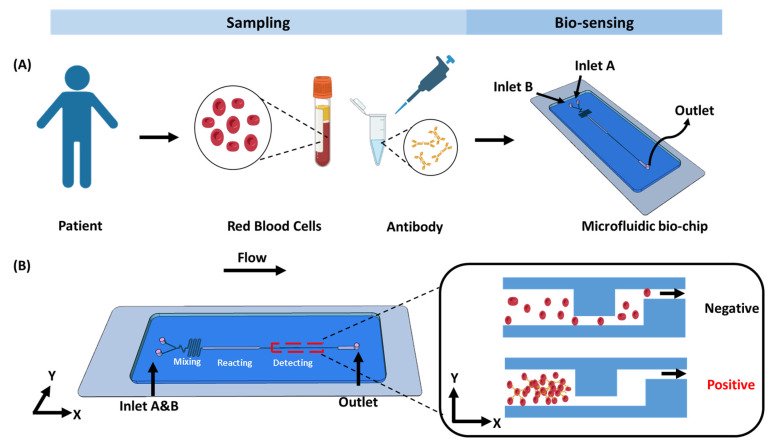
The system is designed to turn a small untreated blood sample into a concentration reading automatically. A clinician places a cassette containing a specific assay into a compact optical reader, then adds a drop of blood to the cassette.
Inside, an integrated filter holds back blood cells while plasma, the liquid component of blood, flows toward a measurement chamber. Pre-dried chemical and biological reagents dissolve when plasma reaches the filter and begin the analysis. The reader measures an optical signal, meaning a change in light produced by the test chemistry, and calculates the drug concentration.
That workflow resembles a tiny laboratory production line: the filter sorts the sample, the reagents recognize the target, and the reader translates the resulting light signal into a result. Kurt Vesterager Gothelf, professor of chemistry and head of the Aarhus research group, said the approach eliminates the need to send the sample to a lab for centrifugation and several manual processing steps.
Why minutes matter in stroke treatment
The team chose drug monitoring because a technically successful measurement is most useful when clinicians need an answer immediately. In acute stroke, doctors must determine whether a patient is taking anticoagulants, commonly called blood thinners, before administering drugs intended to dissolve a clot.
A patient with high levels of an anticoagulant could face a risk of life-threatening brain hemorrhage if given clot-busting medication. When those drugs are not appropriate, mechanical removal of the clot may be an alternative. Gothelf said reducing the wait for a drug measurement could preserve crucial decision-making time while the brain is deprived of oxygen.
Results across five medicines
The researchers tested the technology on three anticoagulants: dabigatran, rivaroxaban, and apixaban. They also tested it with methotrexate, a cancer drug, and linezolid, an antibiotic.
Blood samples came from Danish and international hospitals. The platform produced results that matched those from traditional central laboratory instruments, while delivering the analysis much faster. The study does not establish how the device will perform across routine clinical settings or whether its use changes patient outcomes.
From DNA nanotechnology to drug sensing
The work grew out of Gothelf's research in DNA nanotechnology, which uses DNA strands' ability to bind to matching partners with high precision. That molecular recognition can be used to construct sensors that identify a selected molecule in a complex biological sample.
For this platform, the key advance was a biochemical test that recognizes a specific drug molecule and generates an optical signal when it finds it. The cassette also uses specific antibodies, proteins that bind selected targets, to help make the measurement selective.
Why This Matters
Central laboratory instruments can perform sophisticated drug measurements, but they are large, expensive, and often distant from the bedside. Gothelf estimated that the compact reader could cost DKK 30,000 to 50,000, potentially allowing smaller hospitals and local clinics to run tests without transporting samples or patients over long distances.
Gothelf co-founded the Aarhus University spinout MedicQuant in 2019 with former PhD students Line D. F. Nielsen and Malthe Hansen-Bruhn. The company is further developing and manufacturing the technology, with an expectation that it could be market-ready within three years. The next challenge is not only engineering the device, but fitting rapid drug testing into clinical workflows where centralized testing has long been the norm.
Start here: What is a biochip?
Related articles
- Microchip Can Electronically Detect Covid Antibodies in Just a Drop of Blood
- Biochip uses AI to identify genetic markers in 20 minutes
- A New Liquid Biopsy Chip Developed at WPI Detects Circulating Tumor Cells in 100 Percent of Blood Samples from Stage 1-4 Breast Cancer Patients
- 90% of drugs that pass animal tests fail in humans; FDA makes room for alternatives