Source: WJLA, by Lisa Fletcher (October 5, 2026). AI-generated summary by biochip.com, published . Not independently reviewed.
Key takeaways
- The FDA updated regulations to recognize scientifically valid non-animal drug tests, including organs-on-chips, cell assays, and computer models.
- Wyss Institute Liver-Chips predicted human drug-induced liver injury with 87% sensitivity and 100% specificity across 27 known drugs.
- The FDA change does not ban animal testing or require developers to use any specific alternative method.
The U.S. Food and Drug Administration has updated its drug-development regulations to explicitly recognize scientifically valid non-animal testing methods, including organs-on-chips, human cell tests, and computer models. The change follows the 2022 FDA Modernization Act 2.0 and removes regulatory language centered on animal testing, while keeping the evidentiary bar for entering human trials intact. At Harvard University's Wyss Institute, researchers have shown how a human Liver-Chip can detect drug-related liver injury more accurately than animal models for a defined set of medicines. The policy shift matters because drugs that appear safe and effective in animals often fail when tested in people.
A regulatory opening for human-based tests
For decades, animal studies were treated as a standard gateway before a potential drug could move into clinical trials. Former FDA Commissioner Dr. Marty Makary said that 90% of drugs that pass animal testing do not ultimately meet safety and efficacy requirements in humans.
Congress passed the FDA Modernization Act 2.0 in 2022, allowing developers to use alternatives to animal testing. The FDA's updated regulations now use broader language for nonclinical testing, recognizing cell-based assays, computer models, organs-on-chips, and other scientifically valid approaches.
The change does not prohibit animal studies or require companies to adopt a particular alternative. Instead, it gives developers flexibility to choose methods that can provide evidence that a candidate drug is safe enough to test in people.
How organs-on-chips work
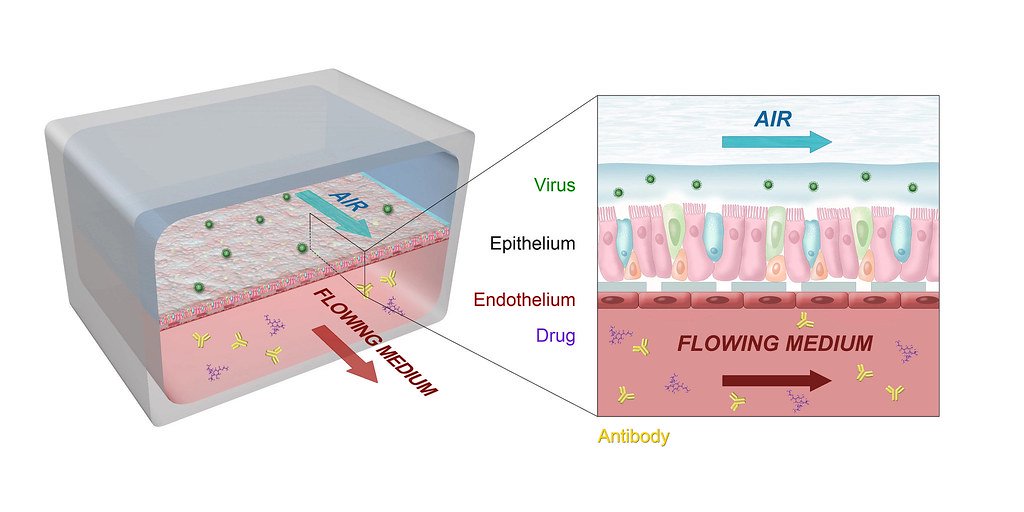
An organ-on-a-chip is like a tiny, living test track for human tissue. The thumb-drive-sized device contains small hollow channels lined with living human cells, allowing scientists to recreate selected functions of organs such as the lung, liver, or kidney.
At the Wyss Institute for Biologically Inspired Engineering, founding director Dr. Donald Ingber and colleagues use these devices to observe how human cells respond to candidate drugs. Lung-Chips, for example, can combine human lung and blood-vessel cells in channels designed to mimic breathing and blood flow.
Unlike a conventional cell dish, the chip system is designed to reproduce parts of an organ's physical environment and interactions between different cell types. That gives researchers a human-based model for tracking toxic effects before a drug reaches a clinical trial.
Liver-Chip results
Researchers tested 870 human Liver-Chips made with cells from three human donors against a blinded set of 27 drugs with known effects in animals and people. The Liver-Chip predicted human drug-induced liver injury with 87% sensitivity, meaning it detected most drugs that caused liver injury, and 100% specificity, meaning it did not falsely label safe drugs in that set as toxic.
Ingber said the Liver-Chip was roughly seven to eight times more accurate than animal models at predicting liver toxicity for those 27 drugs. The researchers concluded that using the chip in place of animal testing for that group could have reduced the number of liver-toxic compounds moving into human trials by nearly eightfold.
Why This Matters
Drug development can take 10 to 15 years and cost billions of dollars. A more predictive human-based test could help developers stop unsafe or ineffective candidates earlier, while also identifying potentially useful drugs that might fail animal studies for reasons that do not translate to people.
Ingber said organ-chip systems can be 10 times faster and 10 times cheaper than traditional approaches. Moderna is already using advanced non-animal methods to replace nonhuman primates in some testing, indicating that such methods are moving beyond laboratory demonstrations.
The FDA's regulatory change does not settle which method will work best for every disease, organ, or drug class. It does, however, make room for developers to support their decisions with human-relevant tools, leaving scientific performance rather than tradition to determine which tests gain broader use.
Topics: Organ-on-a-chip · Drug development & safety
Start here: Organ-on-a-chip explained
Related articles
- Physicians Committee Champions National Institutes of Health Program to Qualify Human-Based Methods for Drug Development
- Researchers develop 'organ on a chip' for better drug testing
- Engineering human multi-organ tissue chip niches for drug absorption, distribution, metabolism, excretion and toxicity prediction
- Journey of organ on a chip technology and its role in future healthcare scenario