Source: Nanotheranostics, by Pranjal Chandra. AI-generated summary by biochip.com, published . Not independently reviewed.
Key takeaways
- A two-module ALP biosensor combined a paper sensor with a bioelectronic chip for detecting alkaline phosphatase in milk and human serum.
- The palm-sized Raspberry Pi-based OPTILIZER optical device reportedly measured ALP in about 30 seconds and distinguished raw, pasteurized, and synthetic milk.
- Performance remains uncertain because no study size, detection limits, false-positive rates, or comparisons with standard clinical assays were provided.
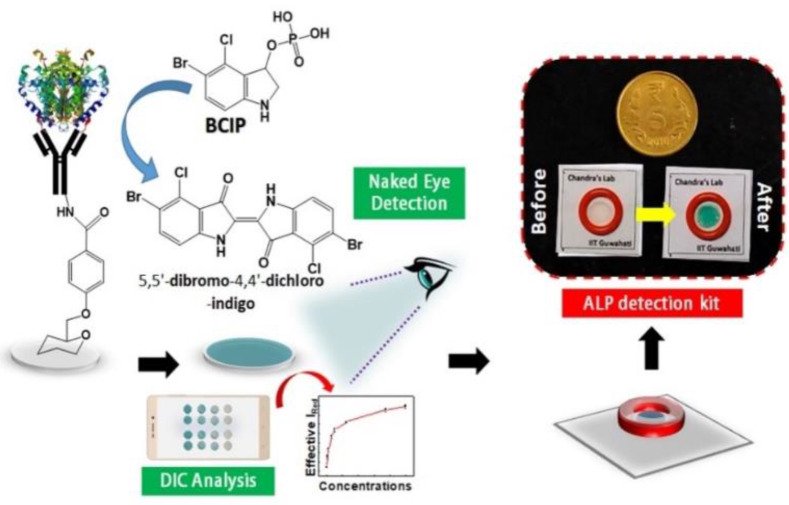
Researchers working on personalized biosensors are trying to move medical and food-safety testing out of centralized labs and into clinics, farms, and even people’s hands. The source article highlights one example built around detecting ALP, or alkaline phosphatase, an enzyme that can act as a useful marker in milk and human serum. The team describes a two-part system: a paper-based sensor that can spot ALP within minutes, and a bioelectronic chip-based platform designed for more sensitive measurement. They also connected the setup to a smartphone and, more recently, to a Raspberry Pi computer to create a palm-sized optical sensing device called OPTILIZER. According to the source, that handheld version can deliver a reading in about 30 seconds, much faster than conventional testing approaches that depend on lab equipment and trained staff. The broader goal is not just speed, but point-of-care diagnostics - tests performed where the sample is collected, rather than being shipped away for analysis. That matters because delays, infrastructure requirements, and cost can make useful tests impractical in the real world. By showing how one enzyme-sensing platform can work across raw milk and human serum, the article frames personalized biosensors as tools that could bridge the gap between bench-top prototypes and bedside or field use.
What the biosensor is designed to do
At the center of the work is ALP detection. A biosensor is a device that translates a biological signal - here, the presence of an enzyme - into something measurable, such as a color change or an electronic readout. Think of it like a smoke detector for chemistry: it does not analyze everything in the room, but it is tuned to react to one important sign.
In this case, the source says higher ALP levels can indicate that milk came from a diseased or udder-infected cow. That gives the sensor a practical use beyond pure research, because dairy screening often needs to happen quickly and close to the source. The same platform was also tested in human serum, suggesting a path toward medical applications where enzyme measurements could help with rapid assessment.
A two-module approach
The system described in the article uses two modules with different strengths. The first is a paper-based module, which can detect ALP in a couple of minutes. Paper sensors are appealing because they are inexpensive, lightweight, and easy to use, much like a home pregnancy test that turns chemistry into a visible signal.
The second is a bioelectronic chip-based module, built for more sensitive discrimination. The source says this platform can distinguish raw and pasteurized milk from synthetic milk, which points to a broader role in food authentication as well as enzyme sensing. Chip-based systems often offer better precision because they control how light, electricity, or fluids move across a small engineered surface.
Why miniaturization changes the picture
A recurring problem in diagnostics is that many accurate tests are not practical outside specialized labs. The article notes that earlier ALP methods often required dedicated infrastructure, expensive instruments, trained personnel, and significant processing time. Those demands may sound routine in a hospital lab, but they become major barriers in farms, rural clinics, mobile screening programs, or low-resource settings.
Miniaturization addresses that problem by shrinking the test into a portable format without losing its usefulness. The researchers say earlier methods also struggled to quantify ALP in small, miniaturized settings. Their answer was a smartphone-enabled, handheld colorimetric optoelectronic device, meaning a system that reads color changes using optical and electronic components and converts them into a measurable result.
From smartphone reader to OPTILIZER
The smartphone connection is a practical design choice. Phones already provide a camera, screen, processor, and network link, so they can act like a pocket-sized lab console. Instead of needing a benchtop reader, the user can capture and interpret the sensor output on a device they already know how to use.
The source says the team later integrated the system with a Raspberry Pi, a small single-board computer, to create a palm-sized optical sensing device called OPTILIZER. That version reportedly performs ALP sensing in about 30 seconds. If that speed holds up in broader testing, it could make the device useful in settings where rapid decisions matter, such as screening perishable milk before distribution or checking samples during a clinic visit.
Bench to bedside - and beyond
The phrase bench to bedside usually refers to taking an idea from laboratory research into real patient care. Here, the concept stretches a little wider. The same sensing principles are being applied to milk screening, human serum testing, and portable field deployment, showing how one platform technology can cross boundaries between healthcare and food safety.
That kind of flexibility is part of what makes personalized biosensors attractive. A clinician, technician, or field worker does not always need a massive machine; they need a trustworthy answer, quickly, from a small sample. When a test becomes handheld and connected, it can fit more naturally into everyday workflows instead of forcing samples into a slow, centralized pipeline.
What the source claims - and what it does not
The article presents the device as a translational technology, meaning it has moved beyond a basic proof of concept toward practical use. It also says the bioelectronic device was successfully tested for ALP detection in milk and human serum samples, and that the work is associated with a patent. Those are meaningful markers that the team sees commercial or applied potential in the platform.
At the same time, the source excerpt does not provide all the details a reader would want to fully judge performance, such as study size, sensitivity limits, false-positive rates, or head-to-head comparisons with standard clinical assays. That does not weaken the core idea, but it does define the current level of certainty. The promise here lies in portability, speed, and usability; the next question is how consistently those strengths hold up across large and varied real-world samples.
Why This Matters
Point-of-care diagnostics succeed when they remove friction. If a test can be done on-site, in under a minute or two, with simple hardware and a familiar interface, it becomes easier to use at the exact moment a decision needs to be made. In dairy testing, that could reduce waste by identifying problematic milk faster instead of waiting for centralized analysis. In healthcare, similar design logic could help bring screening tools closer to patients who do not have easy access to advanced labs.
The bigger story is that personalized biosensors are becoming less like one-off academic gadgets and more like adaptable platforms. A paper strip for quick screening, a chip for more sensitive measurement, and a connected handheld reader together form a practical stack: cheap sampling, stronger analysis, and portable interpretation. If researchers can validate such systems at larger scale and across more biomarkers, devices like this could help turn diagnostics into something more immediate, local, and responsive.
What comes next
The next step for this kind of technology is careful expansion, not just faster hardware. To move fully from bench to bedside, or from prototype to farm and clinic, developers will need broader validation, durable manufacturing, and workflows that fit how users actually handle samples. The source shows that a miniaturized ALP sensor can be made portable, smartphone-friendly, and fast. The real test now is whether that convenience can be paired with the reliability needed for routine decisions in health and food systems.
Topics: Biosensors · Diagnostics & precision medicine · Food & agriculture
Start here: Biosensors explained