.png)
Source: The Microbiologist, by Tulay Ugurlu; Linda Stewart (October 8, 2026). AI-generated summary by biochip.com, published . Not independently reviewed.
Key takeaways
- SKKU researchers built a Herd-Immunity-on-a-Chip with 444 interconnected hexagonal microchambers to model viral transmission.
- Transmission was suppressed when non-susceptible cells reached 80% or more, fragmenting pathways across the chip.
- The experiments model cell networks and do not establish a human herd-immunity threshold.
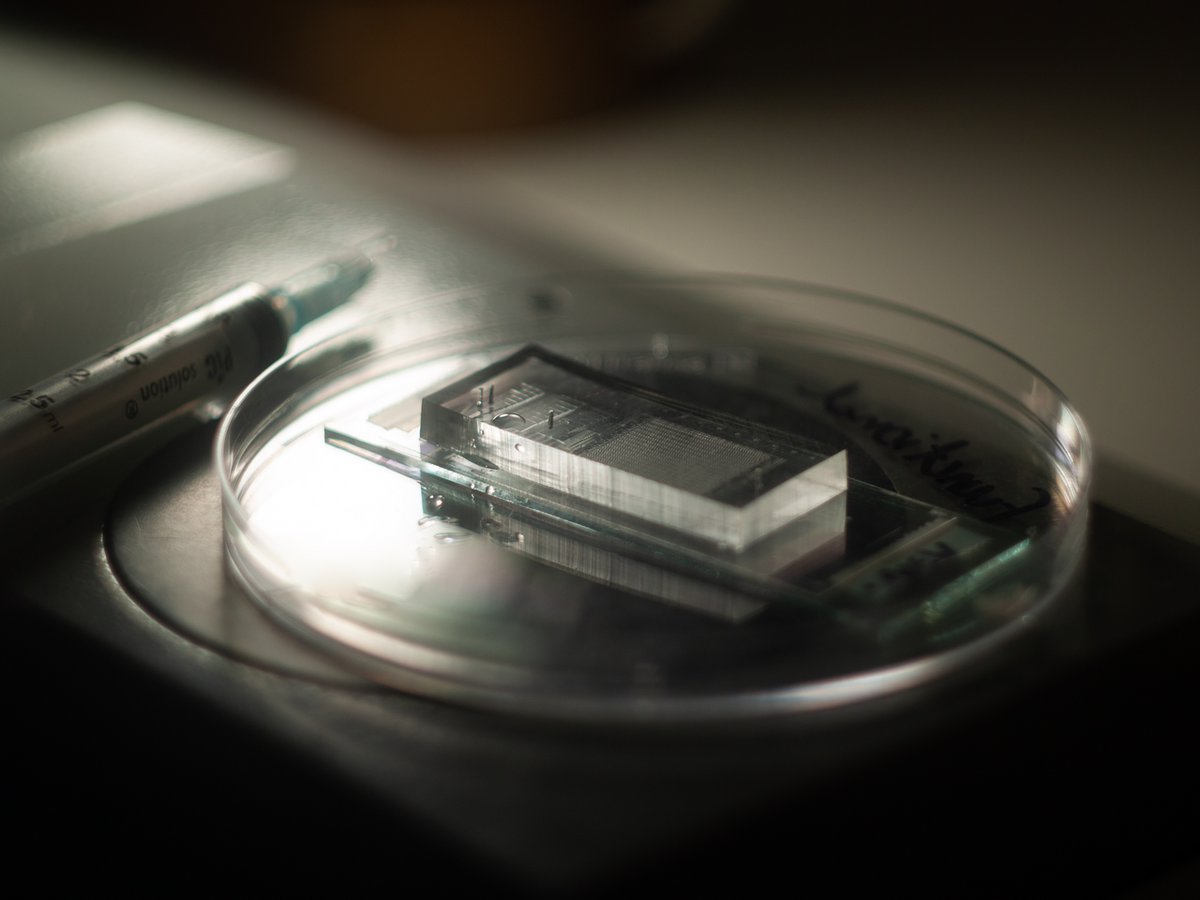
Researchers at Sungkyunkwan University have built a centimeter-scale microfluidic device that models viral spread across a miniature, organized cell population. Their Herd-Immunity-on-a-Chip uses 444 connected chambers containing lung fibroblast cells to test how density, susceptibility, and movement affect transmission. In seven-day experiments, increasing non-susceptible cells to at least 80% fragmented transmission routes and suppressed spread. The platform offers a physical laboratory model for questions that are often examined with computer simulations and population data.
A miniature model of social contact
The device treats a cell network as a simplified society. Lung fibroblast cells represent individuals, hexagonal microchambers represent distinct social spaces, and connecting microchannels represent routes through which contact can occur.
That layout gives researchers direct control over spatial organization. Rather than assuming every member of a population mixes evenly with every other member, the chip can alter cell density, susceptibility, and the connections available between groups.
How the Herd-Immunity-on-a-Chip works
The team, led by Professor Sungsu Park of SKKU's School of Mechanical Engineering and Professor Byung Mook Weon of its School of Advanced Materials Science and Engineering, placed coronavirus-infected lung fibroblast cells at the center of the platform. They arranged susceptible and non-susceptible lung fibroblast cells in surrounding chambers, then monitored transmission for seven days.
Think of the chip as a map of small neighborhoods connected by roads. If many vulnerable people occupy neighboring spaces and the roads remain open, infection can move outward more readily. If enough protected or non-susceptible cells interrupt those paths, the network breaks into smaller disconnected sections that are harder for infection to cross.
Density and contact changed transmission
Dense arrangements of susceptible cells accelerated spread, as did a larger starting number of infected cells. The results link frequent cell-to-cell contact with faster movement of infection through the chamber network.
Restricting cell movement slowed transmission. The experiment therefore reproduced, at the cell-network level, the basic effect that reduced contact can have on the paths available for infection to travel.
Herd-immunity-like suppression
When non-susceptible cells made up 80% or more of the modeled population, viral transmission pathways became fragmented and spread was effectively suppressed. The researchers describe this as a herd-immunity-like effect because the protection arose from the structure of the whole cell network, not simply from changing the condition of a single chamber.
The result does not establish a universal immunity threshold for people. Instead, it shows how a controllable microfluidic system can visualize the relationship between susceptibility, spatial arrangement, and transmission in a defined experimental setting.
Why This Matters
Outbreak models and epidemiological studies remain essential, but they often simplify the uneven contact patterns found in real communities. This chip provides an experimental middle ground: more structured than a conventional cell-infection assay, yet more directly observable than a population-scale outbreak.
Park said the team expects the platform could help examine protection needed against emerging viral variants, assess distancing strategies, and evaluate therapeutic or antiviral interventions. Future work will determine how closely this simplified cell-based society can inform the far more complex social and biological dynamics of human outbreaks.
Topics: Microfluidics · Infectious diseases
Start here: Microfluidics explained
Related articles
- CRISPR-on-Chip for Point-of-Care Diagnostics
- Ancient Dujiangyan water wisdom inspires AI microfluidic chip to spot hidden sub-resistant bacteria
- Paper-Based Microfluidic Chips for At-Home Point-of-Care Nucleic Acid Testing: Applications and Challenges
- Bruin Engineer Builds Startup to Tackle Sepsis One Cell at a Time