Source: Micromachines, by Mirjam P M Poschmann; Lucas Holtorf; Igor Titov; Nahomy M Lizarde; Thomas Strunskus; Martina Gerken (September 2, 2026). AI-generated summary by biochip.com, published . Not independently reviewed.
Key takeaways
- Kiel University bonded six PDMS microfluidic chips with an Ossila UV ozone cleaner after at least 70 minutes of surface activation.
- The chips achieved at least 170 microliters per minute at plus or minus 180 mbar, with bonding stable near 428 plus or minus 60 mbar.
- The findings apply to PDMS-to-PDMS bonding and do not establish performance across other cleaners, materials, or chip geometries.
Researchers at Kiel University have developed a practical method for sealing polydimethylsiloxane, or PDMS, microfluidic chips with a benchtop UV ozone cleaner rather than a conventional oxygen plasma system. The team used an Ossila UV ozone cleaner to activate two PDMS surfaces before bonding them, then addressed a key drawback: long treatment times stiffen the surface and can make delicate chips easier to damage. In tests of six chips, the bonded devices supported flow rates of at least 170 microliters per minute at pressures of plus or minus 180 mbar. The work offers a lower-cost option for small-batch chip prototyping when an oxygen plasma etcher is unavailable or produces inconsistent results.
A benchtop alternative for PDMS bonding
Microfluidic chips guide tiny liquid volumes through microscopic channels, much like plumbing shrunk to the scale of a hair. PDMS is widely used for research prototypes because it is transparent, can be molded quickly, and can be integrated into devices without complex manufacturing equipment.
Those channels begin as open grooves in a molded PDMS layer. To make a functioning chip, researchers must seal that layer to another surface without crushing channels or creating leaks. Oxygen plasma is a common way to activate PDMS surfaces for this step, but its results can vary with equipment condition, gas pressure, chamber contamination, and maintenance changes.
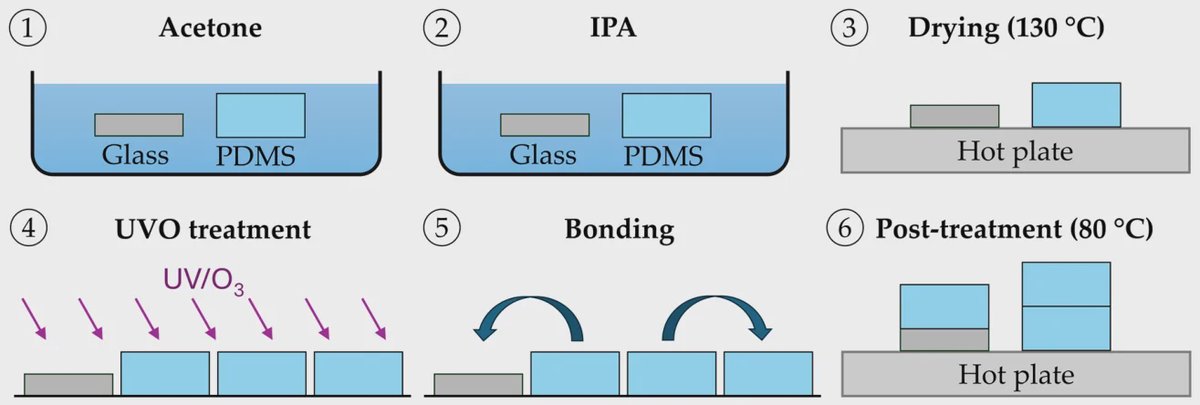
The Kiel team evaluated UV ozone treatment as an alternative specifically for PDMS-to-PDMS bonding. Their process uses ultraviolet light at 185 and 254 nanometers to produce reactive oxygen species that remove surface methyl groups and leave a thin, glass-like silicon dioxide layer. This makes the surface hydrophilic, meaning it attracts water, and enables the two activated PDMS layers to bond.
Long activation strengthens bonding but hardens the surface
The team found that reliable bonding with its Ossila cleaner required at least 70 minutes of UV ozone exposure. That duration is longer than conditions reported in several earlier device studies, which used treatments from 3 to 40 minutes. The authors could not reproduce those conditions with their own instrument, pointing to differences that may include lamp intensity, device geometry, or other operating parameters.
The tradeoff was mechanical. UV ozone treatment slightly hardened the PDMS near its surface, creating a more brittle layer. Infrared spectroscopy and X-ray photoelectron spectroscopy, methods used to examine chemical composition, helped investigate changes at the surface and in the bulk material after treatment.
A hardened outer layer can crack if a chip is handled carelessly, especially around tubing connections. The researchers used static simulations and laboratory tests to examine this failure mode. They found that predetermined break structures, designed to direct damage away from critical areas, could mitigate the consequences of accidental stress.
Designing the fluidic connections
The group also adapted how tubes connect to the chip. They recommend tubing with an outer diameter smaller than the inlet diameter, which reduces mechanical strain around the ports. This design choice matters because tubes can act like small levers when inserted or moved, concentrating stress on a stiffened PDMS surface.
To prevent leaks, the researchers suggested using pre-polymerized PDMS glue and PDMS seals around the connections. These materials can help secure tubing without allowing uncured glue to flow into the microchannels. That is especially relevant for channels at or below 200 by 200 micrometers, where conventional adhesive approaches may partly or completely block the flow path.
Pressure and flow performance
The team conducted a burst test in air to assess the stability of the combined bonding and gluing approach. The PDMS-to-PDMS bonds remained stable up to approximately 428 plus or minus 60 mbar. In six prepared microfluidic chips, the devices achieved flow rates of at least 170 microliters per minute at plus or minus 180 mbar.
These results define a practical working range for the particular device design and UV ozone cleaner tested. They do not establish that the same exposure time or pressure tolerance will apply to every UV ozone instrument, PDMS formulation, channel layout, or tubing configuration.
Why This Matters
Microfluidic platforms are central to many lab-on-a-chip systems, where small volumes of samples and reagents can be mixed, separated, filtered, reacted, or measured. Reliable sealing is therefore not a minor fabrication detail. A leak or damaged port can determine whether a prototype works at all.
For labs making small numbers of PDMS chips, a benchtop UV ozone cleaner could provide a useful fallback when oxygen plasma equipment is inaccessible or unreliable. The study also makes a practical point that is easy to overlook: surface activation is not just a chemistry problem. It changes the mechanical behavior of the chip, so bonding conditions, port geometry, tubing, and seals need to be designed together.
Future work can test how broadly the protocol transfers across UV ozone systems and chip geometries. For now, the results provide a detailed starting point for researchers who want to use UV ozone treatment while accounting for the hardened surface it creates.
Topics: Microfluidics
Start here: Microfluidics explained
Related articles
- Microfluidic Organ-on-A-chip: A Guide to Biomaterial Choice and Fabrication
- Machine Learning and Centrifugal Microfluidics for Bedside Sepsis Prediction
- Next generation microfluidics: fulfilling the promise of lab-on-a-chip technologies
- Doroth Raises US$4.5 Million to Build Latin America’s First Microfluidic Chip Plant