Source: IEEE, written by Nikolaos Ntetsikas, Frederick Research Center and Frederick University; Styliana Kyriakoudi, University of Cyprus and Frederick Research Center; Ariel Klavaris, University of Cyprus; Antonis Kirmizis, University of Cyprus; Chrysostomos Chrysostomou, Frederick Research Center and Frederick University; Ian F. Akyildiz, Truva Inc.; Marios Lestas, Cyprus University of Technology (November 17, 2026). AI-generated summary by biochip.com, published . Not independently reviewed.
Key takeaways
- The researchers tested a copper-responsive yeast biosensor using GFP, with fluorescence and messenger RNA measurements supporting the model.
- A Lux-based bioluminescent output coupled to a photodetector produced a modeled photocurrent above estimated dark current.
- The bioluminescent sensor and detector were not experimentally validated, and performance in the gut remains untested.
Researchers have modeled and experimentally tested a copper-sensing yeast system that could act as a biological receiver in molecular communication networks. The team, led by Nikolaos Ntetsikas and colleagues, engineered yeast to respond to copper and produce a green fluorescent protein signal, then developed a model of the cellular response. They also modeled a version that uses bioluminescence, light produced by a chemical reaction, and a photodetector to read the signal. The work offers a step toward compact monitoring systems, including swallowable devices, but its bioluminescent design remains theoretical.
How yeast detects copper
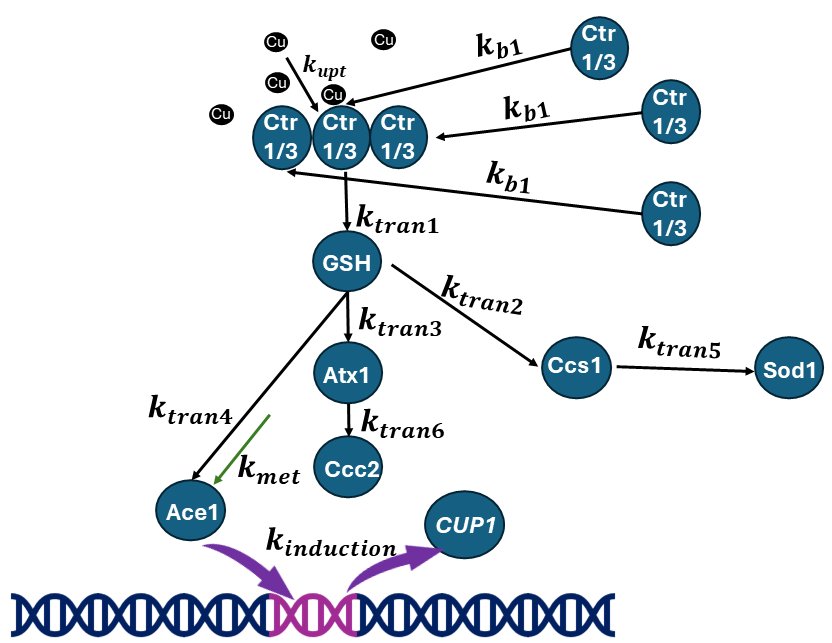
The sensor uses Saccharomyces cerevisiae, a single-celled yeast that responds to copper through a detoxification pathway. When copper levels rise, the cells activate the CUP1 gene, which helps protect them from the metal. The researchers treated the activity of this gene as the sensor’s output, a biological indication that copper is present.
To describe how that response unfolds, the team built a mathematical model from coupled ordinary differential equations. In everyday terms, the equations work like a time-based map: they represent how copper enters the cell, moves between molecules, activates regulators, and ultimately prompts gene expression. The model brings these linked steps together to predict changes in the CUP1 response.
Testing the model with a fluorescent reporter
For experimental testing, the researchers replaced CUP1 with the gene for green fluorescent protein, or GFP. The yeast cells’ fluorescence provided a measurable signal that could be compared with the model’s predictions. The team also measured messenger RNA, the molecule cells use to carry instructions from a gene to protein-making machinery.
Fluorescence and messenger RNA measurements showed satisfactory agreement with the model across multiple copper concentrations. The researchers also used the measurements to assess whether the sensor responded specifically to copper rather than zinc, a chemically related metal. The experiments support the GFP-based testbed as a way to study and refine the yeast sensor, although the reported results do not establish how it would perform inside a person.
Modeling a light signal for a Smart Pill
GFP fluorescence requires external light to excite the reporter, so the team also explored a self-sustained bioluminescent output using Lux-based models. Unlike fluorescence, bioluminescence generates light through a chemical reaction and does not require an external excitation source. The researchers coupled this modeled light output to a photodetector, a device that converts light into an electrical signal.
The predicted photocurrent was in the femtoampere range and exceeded the model’s estimate of the detector’s dark current, the small signal it produces without incoming light. That comparison suggests detection could be possible under idealized conditions. It is a theoretical prediction, not an experimental demonstration: the Lux-based response and photodetector coupling were not validated in the study.
Why This Matters
The work connects a living sensor to a communication-system concept in which molecules carry information between biological components. A yeast receiver could, in principle, detect copper while an electronic device reads its output. The researchers point to Smart Pills as a possible application, alongside future systems that pair the sensor with engineered biological senders.
The immediate contribution is a tested GFP-based yeast platform and a mathematical framework for exploring its response. The next step is to test the proposed bioluminescent signal and detector together, then determine whether the system can operate reliably in the more complex conditions of the gut.
Topics: Biosensors
Start here: Biosensors explained