Source: Biosensors, written by Wenjing Zhang; Yuru Liu; Jingjing Liu; Feng Long; Hejie Li; Xinyu Zhang; Yuxiang Shi; Chunsheng Li (October 20, 2026). AI-generated summary by biochip.com, published . Not independently reviewed.
Key takeaways
- The optical-fiber immunosensor measured clarithromycin from 7.50 to 77.45 micrograms per liter, with a 1.67 micrograms-per-liter detection limit.
- Automated testing took less than 20 minutes, and the fiber probe remained stable for more than 200 regeneration cycles.
- Testing used water samples spiked with clarithromycin, so performance in naturally contaminated water and routine field settings remains unestablished.
A research team in China built an optical-fiber immunosensor that measures the antibiotic clarithromycin in water in less than 20 minutes. The device pairs a fluorescent antibody test with an evanescent wave, a light field that reaches only a short distance beyond the fiber’s surface. In tests with tap water and river water spiked with clarithromycin, the sensor produced results that agreed with a standard laboratory immunoassay. The approach could make it easier to screen water samples outside specialized laboratories.
How the Fiber Sensor Works
Think of the optical fiber as a narrow light guide that also illuminates a thin layer just outside its surface. When light travels through the fiber by total internal reflection, a small part of its energy extends into the surrounding liquid. The researchers used this evanescent field to excite fluorescent labels close to the fiber, where the sensor can detect them.
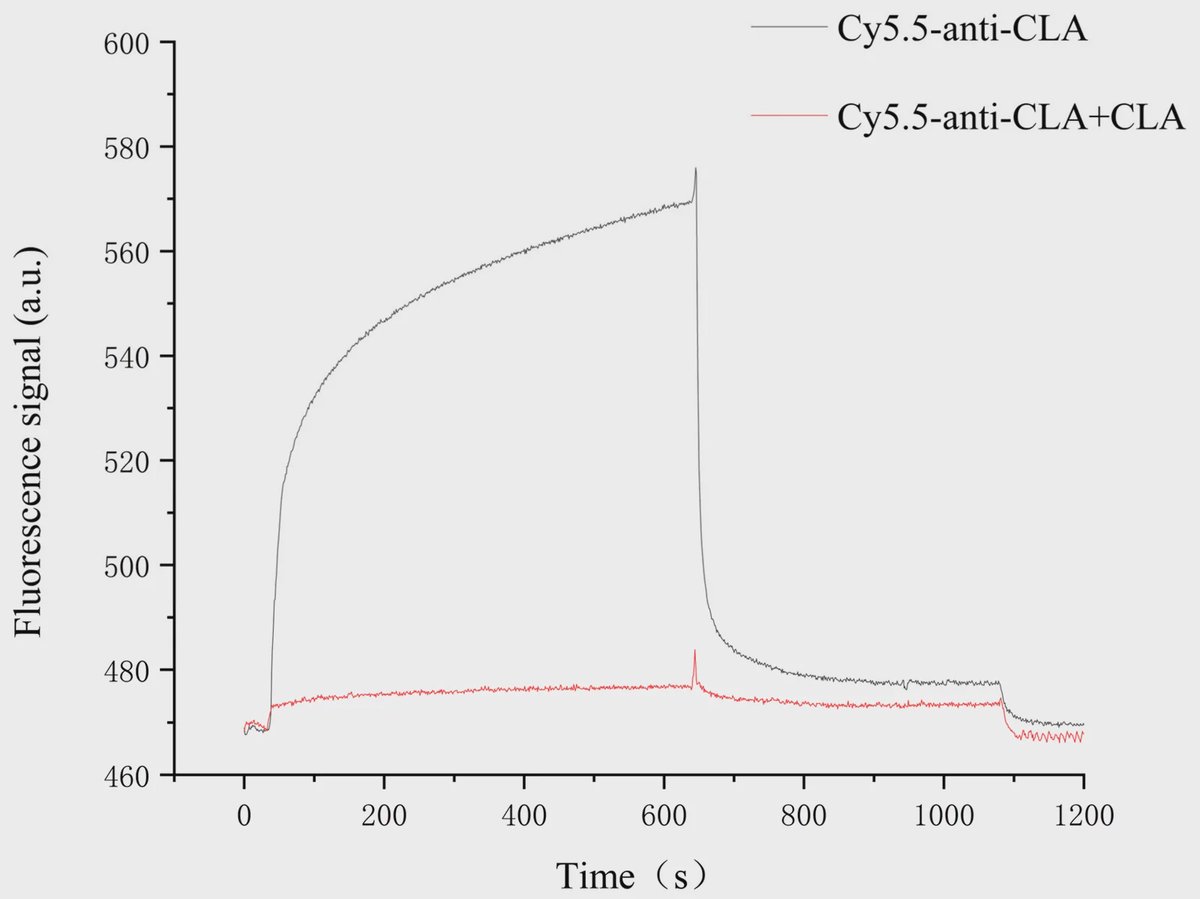
The team attached a clarithromycin-bovine serum albumin conjugate to the fiber probe. Bovine serum albumin, or BSA, is a protein used here to carry the antibiotic molecules on the probe’s surface. A fluorescent dye called Cy5.5 was attached to an antibody that recognizes clarithromycin.
The assay uses an indirect competitive format: clarithromycin in the water competes with the molecules fixed to the fiber for the fluorescent antibody. More clarithromycin in the sample means fewer labeled antibodies bind to the probe, so the measured fluorescence falls. The instrument’s photomultiplier tube converts that light into an electrical signal for analysis.
Results in Spiked Water Samples
The sensor measured clarithromycin across a linear range of 7.50 to 77.45 micrograms per liter. Its limit of detection, the lowest concentration it could detect under the study’s conditions, was 1.67 micrograms per liter. The limit of quantification, the lowest concentration it could reliably measure quantitatively, was 7.50 micrograms per liter.
Researchers tested tap water and river water samples spiked with 10, 30, and 60 micrograms per liter of clarithromycin. Recoveries ranged from 87.13% to 104.84%, meaning measured concentrations were generally close to the amounts added; relative standard deviations were below 13.08%. The team also compared the results with an enzyme-linked immunosorbent assay, or ELISA, and reported that the methods corroborated one another.
Built for Repeated, Automated Testing
The in-house instrument combined a 635-nanometer laser, a fluid-handling system, a photomultiplier detector, and a mini-computer. It automatically handled baseline measurement, sample incubation, rinsing, and probe regeneration, completing the workflow without manual intervention in under 20 minutes.
The fiber probe remained stable through more than 200 regeneration cycles, with a relative standard deviation of 5.63%. Reuse could help reduce the need to replace probes between measurements, although the study’s reported performance applies to the tested setup and conditions.
Why This Matters
Clarithromycin can enter waterways through human and animal waste, and its presence raises concerns about antibiotic resistance and environmental effects. Standard laboratory methods such as liquid chromatography-tandem mass spectrometry can quantify antibiotic residues, but they require specialized equipment and sample preparation. A portable fiber-based test could offer a faster way to screen water where samples are collected.
The results show that this immunosensor can detect clarithromycin in prepared tap and river water samples with a short, automated workflow. Further testing on naturally contaminated water and in routine field conditions would help establish how well it performs beyond the spiked samples used in this study.
Topics: Biosensors
Start here: Biosensors explained
Related articles
- Portable Biosensors Speed Food And Water Contamination Detection
- Microfluidic biosensors for biomarker detection in body fluids: a key approach for early cancer diagnosis
- Electrochemical Biosensor Rapidly Detects Cerebrospinal Fluid Leaks
- MXene-Polydopamine-Cyanobacteria Photobioelectrochemical Biosensor for Atrazine Detection in Environmental Waters