Source: Foods, by Lele Zhang; Yan Ping Chen; Suet Yee Tan; Zhiping Xie; Xichang Wang; Yuan Liu (September 21, 2026). AI-generated summary by biochip.com, published . Not independently reviewed.
Key takeaways
- An OR5K1 electrochemical biosensor detected pyrazines from 10^-14 to 10^-9 M, with a reported 10^-14 M detection limit.
- In four malt samples, sensor signals correlated with GC-TOF/MS pyrazine measurements at r = 0.96.
- The device was tested only in four malt samples, so performance across other foods and production conditions remains unestablished.
Researchers at Shanghai Ocean University, Shanghai Jiao Tong University, and collaborating institutions have built an electrochemical olfactory biosensor that detects pyrazines, food aroma compounds associated with baked, roasted, and nutty notes. The device uses the human olfactory receptor OR5K1 as its molecular recognition element, paired with a nanomaterial-coated electrode that converts odorant binding into an electrical signal. In tests of four malt samples, its signals closely tracked pyrazine concentrations measured by gas chromatography and mass spectrometry. The work points toward a more portable, receptor-based way to assess roasted food aromas.
A receptor borrowed from the sense of smell
Pyrazines are nitrogen-containing compounds found in foods including coffee, beer malt, meat, and Chinese baijiu. They form largely through the Maillard reaction, the chemistry behind browning during cooking and roasting, and can be perceptible at very low concentrations.
The team selected OR5K1, a human olfactory receptor known to respond strongly to certain pyrazines. Olfactory receptors act a little like molecular locks: each has a shape and chemical environment that favor interaction with particular odor molecules. When a pyrazine binds to OR5K1 on the sensor, the electrode detects a change in electrical current.
Building an electrochemical sensing surface
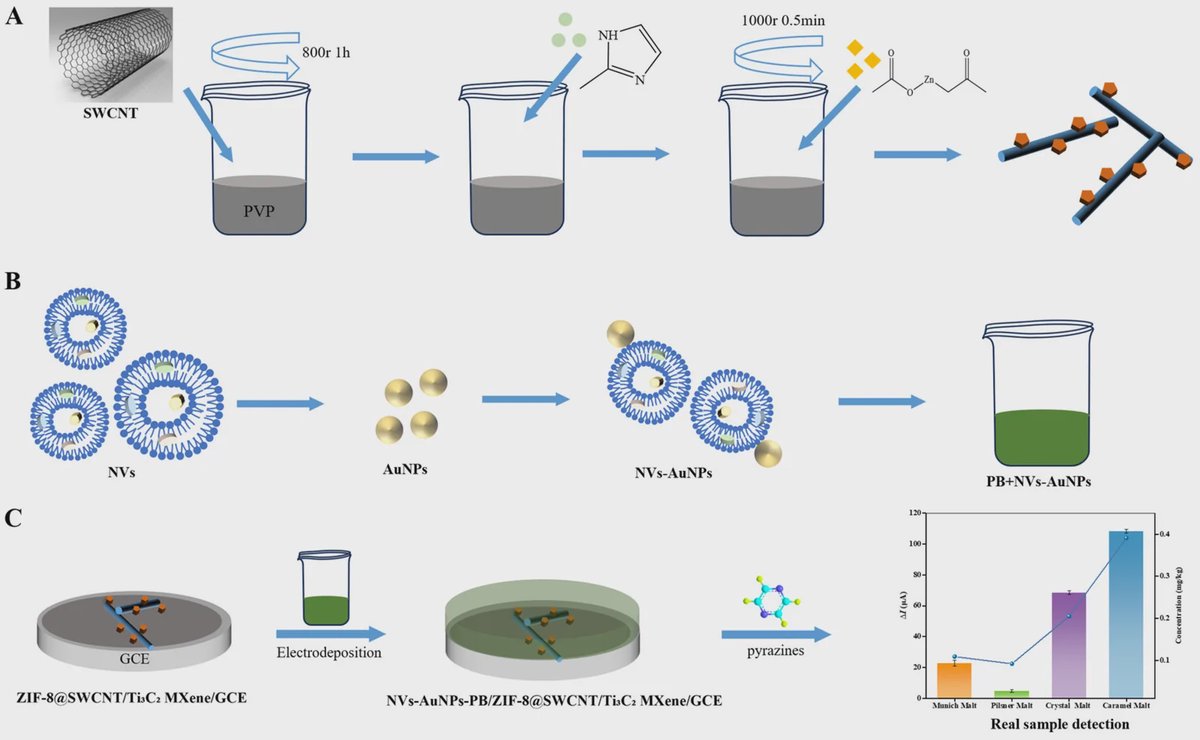
The biosensor combined OR5K1 with a composite sensing matrix made from gold nanoparticles, Prussian blue, zeolitic imidazolate framework-8, single-walled carbon nanotubes, and titanium carbide MXene. Each component has a distinct role in the electrode architecture.
Zeolitic imidazolate framework-8 is a porous metal-organic framework that provides a large surface for loading receptors. The carbon nanotubes and MXene create conductive routes for electrons, while gold nanoparticles support receptor immobilization and electron transfer. Together, these materials were designed to make the binding event easier to measure as an electrochemical response.
Sensitivity and selectivity
The sensor produced a linear response across pyrazine concentrations from 10-14 to 10-9 molar, with a reported detection limit of 10-14 molar. The analytical readout was the change in reduction peak current, labeled ΔI, after pyrazine was introduced.
It also generated substantially stronger current responses to pyrazine compounds than to ethanol, hexanal, acetone, and phenol. That comparison matters because foods contain many volatile chemicals, and a useful aroma sensor needs to distinguish its intended target from common background compounds. After 12 days of storage, the device retained 79% of its original signal.
Testing malt samples
The researchers applied the biosensor to pilsner, Munich, crystal, and caramel malts. The measured ΔI values ranged from 4.6 ± 0.2 microamperes to 108 ± 6 microamperes across the samples.
They compared those electrical results with total pyrazine content measured using gas chromatography coupled to time-of-flight mass spectrometry, or GC-TOF/MS. That laboratory method separated and identified pyrazines at concentrations from 0.092 to 0.391 milligrams per kilogram. The biosensor signal and GC-TOF/MS measurements had a correlation coefficient of 0.96, indicating that the two measurements moved closely together across the four malts.
How OR5K1 may recognize pyrazines
The team also used molecular docking, a computer-based method for predicting how molecules fit together, to examine interactions between OR5K1 and pyrazines. The predicted binding energies ranged from -3.9 to -6.0 kilocalories per mole, consistent with spontaneous receptor-ligand interactions in the model.
The simulations identified several amino acids as possible contributors to recognition: Leu14, Met81, Asn84, Phe17, Phe85, and Lys90. Hydrogen bonds, hydrophobic interactions, and pi-pi stacking appeared to help hold pyrazine molecules in the receptor binding region. In silico site-directed mutagenesis further examined the potential importance of these residues.
Why This Matters
Food laboratories commonly use gas chromatography systems to measure pyrazines accurately, but those instruments can be expensive, nonportable, and technically demanding. Electronic noses can be more portable, yet their sensing materials often respond broadly rather than recognizing a defined aroma compound.
By placing a pyrazine-responsive human odor receptor at the center of an electrochemical device, the researchers aimed to combine biological selectivity with an electrical readout. Further testing across more foods and real production settings could show whether OR5K1-based sensors can become practical tools for flavor analysis and food quality control.
Topics: Biosensors · Food & agriculture
Start here: Biosensors explained
Related articles
- Portable Biosensors Speed Food And Water Contamination Detection
- A target-responsive and signal-amplified DNA hydrogel biosensor for visual and quantitative detection of aflatoxin B1
- Personalized biosensors for point-of-care diagnostics: from bench to bedside applications
- Development of a Photostable pH Biosensor Based on mStayGold