Source: Mikrochimica Acta, written by Caio César Gonçalves Silva; Maiza de Lima Bueno; Max Fabricio Falone; Lucas Felipe de Lima; William Reis de Araujo; Maria Valnice Boldrin Zanoni; Maisa Azevedo Beluomini (October 23, 2026). AI-generated summary by biochip.com, published . Not independently reviewed.
Key takeaways
- The cyanobacteria-based sensor detected atrazine at 1.92 nM, with a reported linear range of 5 to 200 nM.
- Water-sample tests in groundwater, river water, and seawater produced recoveries of 99.75% to 103.9%.
- Stored at 4 °C, the sensor lost 61% of its signal by day five, limiting its demonstrated storage stability.
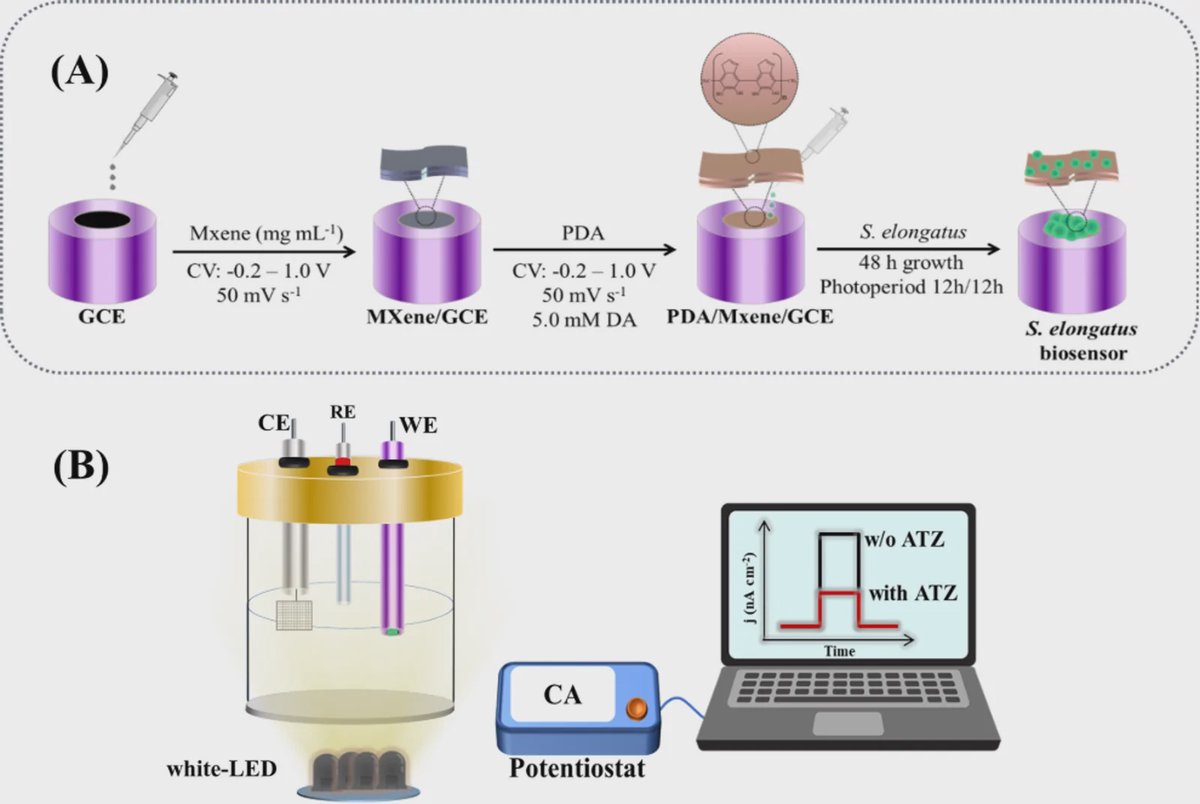
Researchers at universities in Brazil developed a light-powered biosensor that uses living cyanobacteria to detect the herbicide atrazine in water. The device pairs the cells with a conductive MXene electrode and a polydopamine layer that helps transfer electrons, turning changes in photosynthesis into an electrical signal. In tests, it detected atrazine at concentrations as low as 1.92 nanomolar and measured the herbicide in groundwater, river water, and seawater. The approach could support water monitoring, although the living-cell sensor’s signal weakened during storage.
Turning photosynthesis into a signal
The team immobilized whole cells of Synechococcus elongatus, a cyanobacterium, on an electrode made with Ti₃C₂Tₓ, a type of MXene. MXenes are thin, electrically conductive materials; here, the material provided a surface for the cells and a route for electrical signals.
A layer of polydopamine, or PDA, connected the biological and electronic parts. Think of it as a bridge for electrons: redox-active chemical groups in the PDA help carry electrons from the cells to the electrode. The researchers used microscopy and chemical and electrochemical analyses to characterize the sensor and its surface.
The device detects atrazine by monitoring photosystem II, the part of photosynthesis that helps move electrons when cells capture light. Atrazine and related herbicides interfere with this process. When photosystem II activity drops, the sensor’s light-driven electrical current falls too, giving the team a measurable response.
Detection and water testing
Under optimized conditions, the sensor’s response varied linearly across atrazine concentrations from 5 to 200 nanomolar. Its reported detection limit was 1.92 nanomolar, equivalent to 0.414 parts per billion, and its sensitivity was 177.71 nanoamperes per decade per square centimeter.
Tests with other compounds showed a response to several photosystem II-inhibiting herbicides, including DCMU, simazine, and desethylatrazine, while compounds outside that herbicide class produced negligible responses. This means the sensor responds to a group of chemicals that affect the same photosynthetic target, rather than uniquely identifying atrazine among all possible substances.
The researchers also tested water from groundwater, rivers, and the sea. Measurements returned recoveries between 99.75% and 103.9%, meaning the sensor’s estimates were close to the amounts present in the samples.
Why This Matters
Conventional pesticide monitoring often relies on chromatography, which can require sample preparation and large, nonportable instruments. A sensor that translates biological activity into an electrical readout offers a different route for environmental testing. The study demonstrates that a whole-cell system can detect atrazine in several types of water, but it does not establish that the device is ready for routine field use.
Storage stability is a practical challenge. The signal remained above 95% after one day, but fell by 61% by day five when the sensor was stored at 4 °C. Improving that stability will matter for any future use beyond the laboratory.
The next step is to determine whether the sensor can maintain reliable performance during longer storage and real-world monitoring. The reported results establish a working platform and show its potential in water samples, while leaving its durability over time as an important open question.
Topics: Biosensors · Environment & water
Start here: Biosensors explained
Related articles
- Indigoidine and deoxyviolacein co-pigmentation in a single bacterial cell enables visual discrimination of Pb( ii ) and Hg( ii ) in environmental water matrices
- Electric-Field-Assisted Enrichment and Electrochemical Detection of Gram-Positive Bacteria Using an FEM-Guided Interdigitated Electrode Biosensor
- Portable Biosensors Speed Food And Water Contamination Detection
- Development of an Olfactory Receptor (OR5K1)-Based Biosensor for Pyrazine Detection in Foods