Source: Scientific Reports, written by Runliu Li; Shengnan He; Daniel Gruber; Markus Krämer; Andreas Stürmer; Roger Hasler; Christoph Kleber; Wolfgang Knoll; Ann-Kathrin Kissmann; Frank Rosenau (November 19, 2026). AI-generated summary by biochip.com, published . Not independently reviewed.
Key takeaways
- Nine rounds of FluMag-SELEX produced a DNA aptamer library that preferentially recognized alpha-Klotho and was evaluated against KL1.
- The library supported fluorescence responses in 50% and undiluted serum, and gFET detection of recombinant Klotho in 1% serum.
- The gFET results used recombinant protein and 1% serum, so clinical validation and performance with patient samples remain open questions.
Researchers developed a DNA-based recognition library and paired it with a graphene field-effect transistor to detect the Klotho protein. The team used the library to build a fluorescence assay that responded to Klotho in human serum, and a transistor sensor that detected the protein in buffer and diluted serum. The work offers two ways to investigate a protein that is difficult to measure consistently in blood. Both approaches still need further analytical validation.
Building a Klotho-selective DNA library
Klotho circulates in several forms, including a soluble form produced when the membrane-bound protein is cut. Existing enzyme-linked immunosorbent assays, or ELISAs, cannot distinguish all these forms, which can make measurements inconsistent. The study focused on human alpha-Klotho and its KL1 domain, one of the protein’s two extracellular sections.
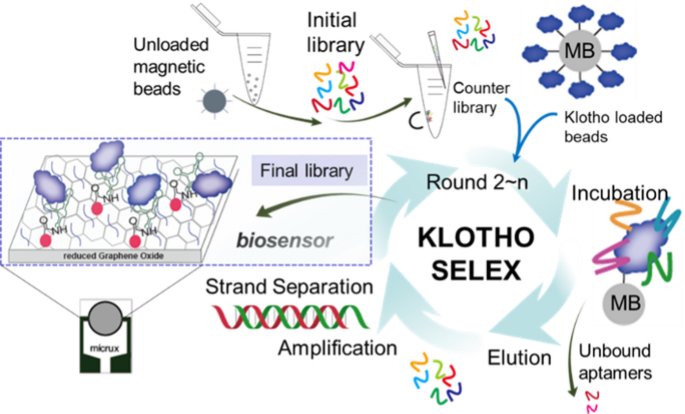
To find DNA molecules that recognize Klotho, the researchers used FluMag-SELEX, a selection process that tests many candidate sequences and enriches those that bind a target. The team attached Klotho to magnetic beads, exposed it to a starting library of single-stranded DNA, and recovered sequences that stuck to the protein. They repeated the selection for nine rounds, monitoring the process with quantitative polymerase chain reaction, a method for measuring DNA.
The result was a focused polyclonal aptamer library. Aptamers are short DNA or RNA molecules that fold into shapes able to bind particular targets. Unlike a single selected sequence, a polyclonal library contains multiple candidate aptamers. The researchers found that the enriched library preferentially recognized alpha-Klotho and also evaluated its recognition of KL1.
Two ways to read the binding signal
The team first used the library in an Aptamer-Linked Fluorescence Assay, or ALFA. In this approach, fluorescence provides a readout of target recognition, much like a visible indicator that changes when a matching key meets its lock. The assay produced Klotho-associated fluorescence responses in human serum diluted to 50% and in undiluted serum.
For electronic detection, the researchers connected the aptamer library to a graphene field-effect transistor, or gFET. A transistor’s electrical current can shift when a nearby molecule changes the local electrical environment. In the study, aptamer binding produced concentration-dependent electrical signals for recombinant alpha-Klotho and KL1 in buffer and in 1% human serum, without requiring a fluorescent label.
Why This Matters
The fluorescence and transistor results show that the same enriched DNA library can support two different sensing formats. That flexibility matters because Klotho measurement is complicated by the different forms of the protein found in circulation, and reliable measurements are needed to study its links with health and disease.
The findings establish a starting point, not a clinically validated test. The gFET experiments detected recombinant protein in buffer and 1% serum, while the fluorescence assay was tested at higher serum concentrations. Further work will need to assess analytical performance in biological samples and clarify how well either approach distinguishes Klotho forms in real-world testing.
Start here: What is a biochip?