Source: Advanced Science, written by Linlin Bai; Bei Wang; Mingmin Shi; Dianwei Liu; Huimin Ji; Ting Wang; Ziwei Wang; Kaiming Guo; Xinyang Dou; Chunyan Qian; Fang Zhang; Yongming Wang; Hongju Mao; Rui Wang (October 14, 2026). AI-generated summary by biochip.com, published . Not independently reviewed.
Key takeaways
- CRISPR-Scan used one crRNA to detect multiple NPM1 four-base insertions while distinguishing the normal sequence.
- The assay detected mutations at 0.01% mutant allele frequency and matched NGS results in 120 AML samples.
- Patient monitoring included four people, and the study does not establish performance in larger prospective cohorts or routine clinical use.
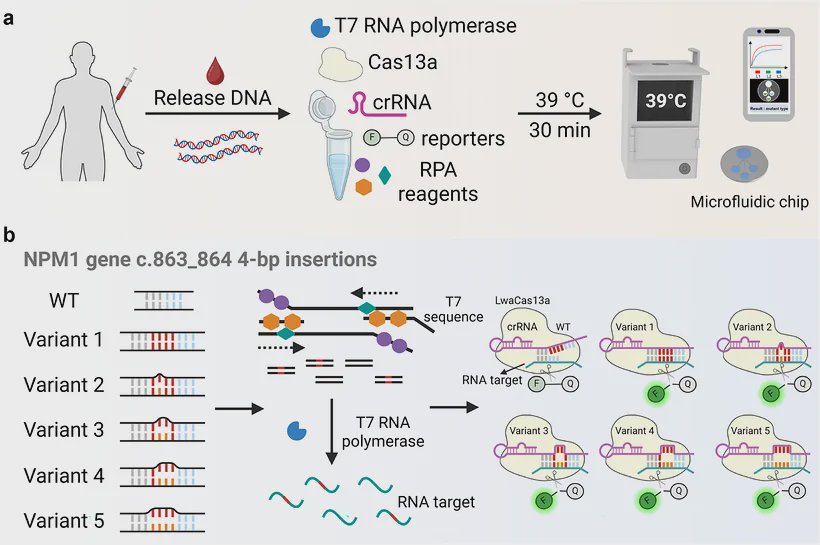
Researchers at Fudan University and collaborating institutions developed CRISPR-Scan, a CRISPR-Cas13a assay that detects multiple insertion mutations at the same position in the NPM1 gene, a common mutation target in acute myeloid leukemia (AML). The team combined the assay with a microfluidic chip and portable device, bringing the molecular test into a compact format. In tests, it detected mutant sequences at frequencies as low as 0.01% and matched next-generation sequencing results across 120 patient samples. The approach could help identify AML mutations and track disease remaining after treatment, though the reported patient monitoring involved four people.
One guide for many mutations
Many AML-associated NPM1 mutations are four-base insertions at the same location, but the inserted letters can vary. That creates a design problem: a test built around one exact sequence may miss other versions of the mutation. The researchers report that more than 100 types of these NPM1 insertions have been described.
The team studied how Leptotrichia wadei Cas13a, or LwaCas13a, responds when its guide RNA does not perfectly match a target. A CRISPR RNA (crRNA) works like an address label, directing the Cas13a protein to a chosen RNA sequence. The researchers found that Cas13a could tolerate consecutive base substitutions, but reacted strongly to insertions or deletions at particular positions in the guide-target pairing. They used that mismatch pattern to design one crRNA that could recognize multiple NPM1 four-base insertions while distinguishing them from the normal sequence.
From molecular recognition to a signal
When Cas13a recognizes its target RNA, it also cuts nearby reporter RNA molecules. The assay turns that activity into a detectable signal. CRISPR-Scan combines this Cas13a reaction with recombinase polymerase amplification (RPA), a method that copies targeted genetic material, in a one-pot format. The design allows the amplification and detection steps to take place in the same reaction vessel.
The researchers report a limit of detection corresponding to a mutant allele frequency of 0.01%. In clinical validation, CRISPR-Scan identified NPM1 mutations in 43 of 120 AML patient samples, with results consistent with next-generation sequencing (NGS), a method that reads many DNA fragments in parallel. The team also followed four patients over time. In those cases, CRISPR-Scan indicated recurrence earlier than first-generation sequencing and agreed with NGS.
Why This Matters
For patients with AML, detecting a mutation at very low levels can matter when clinicians are checking for measurable residual disease, meaning cancer cells that remain after treatment but are too scarce to detect with some routine methods. A test that covers multiple mutation variants at one site could avoid the need to build a separate guide for every insertion type. The study's results support that possibility for NPM1, but do not establish performance across other genes or mutation classes.
The researchers also integrated the assay with a microfluidic chip and portable device, which they say facilitates AML mutation detection. The reported findings do not establish how the platform performs in a larger prospective study or routine clinical use. Further validation would help determine whether the compact system can provide reliable results across more patients and care settings.
Topics: Microfluidics · Diagnostics & precision medicine
Start here: Microfluidics explained
Related articles
- New cell-collection device could improve early cancer detection
- From Population Genomics to Clinical Diagnostics: UNC and Tulane Researchers Advance CRISPR-Based NTM Detection
- Microfluidic biosensors for biomarker detection in body fluids: a key approach for early cancer diagnosis
- Microchip Detection of Magnetically Labeled Cancer Biomarkers