Source: Micro Nano Science, by Peiying Yin; Weiwei Zhang; Shanshan Geng; Yilin Wang; Zhenghan Di; Zhihong Liu; Guangsheng Guo; Xiayan Wang (October 10, 2026). AI-generated summary by biochip.com, published . Not independently reviewed.
Key takeaways
- The review compares adult stem cell and induced pluripotent stem cell gastric organoids for disease modeling and drug testing.
- Microfluidic gastric chips can add fluid flow, peristalsis-like motion, stroma, vasculature, and immune cells to gastric models.
- Key barriers include cell sourcing, experimental throughput, reproducibility, and scalable device fabrication.
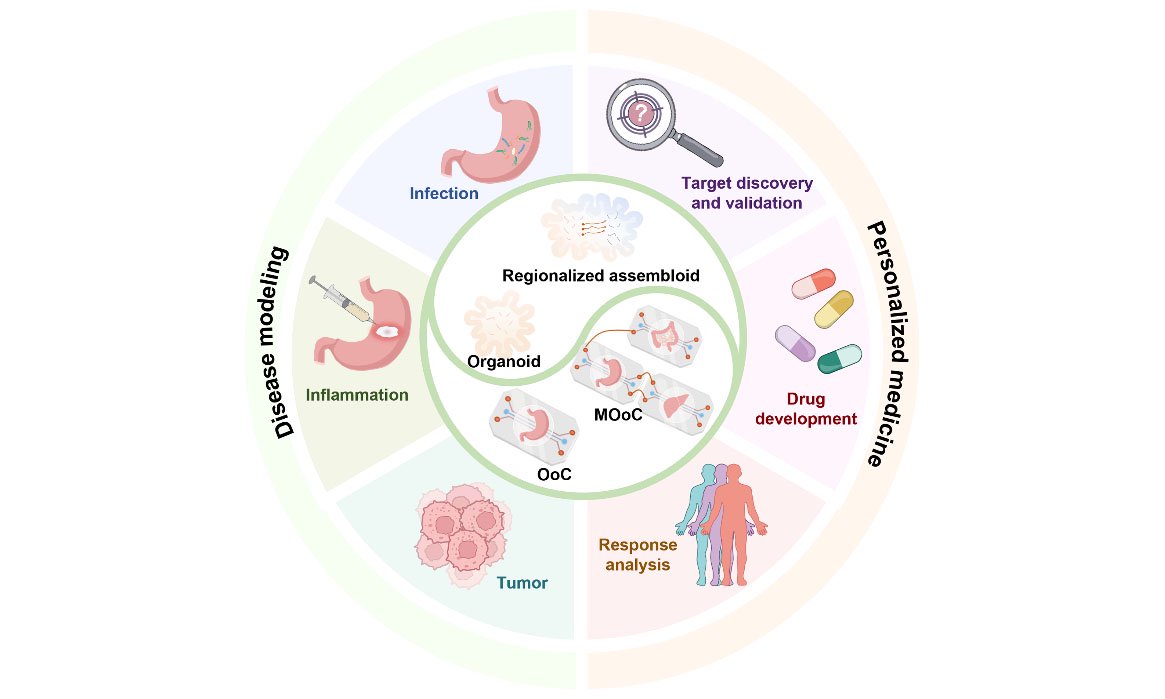
A review by Peiying Yin, Weiwei Zhang, Xiayan Wang, and colleagues examines how gastric organoids and stomach-on-a-chip systems can model the human stomach more faithfully than conventional cell cultures or animal studies. The review focuses on platforms that reproduce stomach tissue architecture, fluid flow, mechanical motion, and interactions among epithelial, stromal, vascular, and immune cells. These tools could help researchers study gastritis, peptic ulcers, Helicobacter pylori infection, and gastric cancer in human-relevant settings. The central challenge is turning sophisticated laboratory models into reproducible, scalable systems suitable for personalized testing.
Why the Stomach Is Difficult to Model
The stomach is not simply a bag of acid. Its lining contains specialized cells that produce mucus, bicarbonate, digestive enzymes, hormones, hydrochloric acid, and intrinsic factor, a molecule needed to absorb vitamin B12. The organ also continually renews its epithelial lining while contracting to mix food and control its movement into the intestine.
That complexity makes standard two-dimensional cell cultures incomplete models. Flat layers of immortalized or cancer-derived cells can support early toxicity and mechanism studies, but they do not capture the stomach's three-dimensional gland structure, mixture of cell types, or changing chemical and mechanical environment.
Organoids Build Miniature Gastric Tissue
Gastric organoids are three-dimensional, self-organizing cell structures grown in an extracellular matrix, the supportive material surrounding cells in tissues. They can be made from adult stem cells collected from normal stomach tissue or patient biopsies, or from induced pluripotent stem cells, which are reprogrammed cells capable of developing into many tissue types.
Adult stem cell-derived organoids tend to retain the region-specific features of mature stomach epithelium. This makes them useful for studying adult tissue maintenance, patient-specific drug responses, and epithelial interactions with H. pylori, the bacterium strongly linked to chronic gastritis, ulcers, and gastric cancer.
Induced pluripotent stem cell-derived organoids follow developmental steps that guide cells toward stomach lineages. These models can include mesenchymal cells, which help form supporting tissue, and can be useful for studying fetal development and congenital disorders. Their limitation is that their epithelial cells often remain more fetal-like than adult gastric tissue.
What a Stomach-on-a-Chip Adds
An organoid can resemble a tiny piece of stomach tissue, but it is usually grown in a static environment. A microfluidic organ-on-a-chip adds small channels that continuously perfuse cells with liquid, much as plumbing delivers and removes fluids in a building. This flow can supply nutrients, remove waste, and expose cells to changing conditions that conventional cultures cannot easily reproduce.
The review describes gastric chips ranging from single-channel devices containing gastric epithelium under continuous flow to multi-channel designs. More complex systems place the epithelium beside perfusable blood-vessel-like structures, collagen-rich stroma, or immune cells. Such arrangements aim to recreate the interfaces where disease processes unfold, rather than examining epithelial cells in isolation.
Mechanical cues matter as well. Gastric chips can be designed to incorporate peristalsis-like motion, the repeated muscular contractions that churn stomach contents, alongside fluid flow and relevant pH conditions. These features may improve studies of mucus-barrier function, nutrient handling, infection dynamics, and tissue responses to drugs.
Why This Matters
Animal models remain important, but differences in anatomy, physiology, and immune responses can limit how reliably they predict human gastric disease. Human organoids and organ chips offer a route to study disease mechanisms in systems built from human cells, including cells obtained from individual patients.
That possibility is particularly relevant for gastric cancer and chronic inflammatory disease, where infection, genetics, environmental factors, and the local tissue environment all contribute. Patient-derived models could eventually support testing of treatment responses in a person's own cells, although the review does not establish that these platforms are ready for routine clinical decision-making.
Engineering Barriers Remain
The field still faces practical hurdles: obtaining consistent cell sources, incorporating the right mix of tissue compartments, increasing experimental throughput, and manufacturing devices at scale. Researchers must also balance biological complexity against reliability, since a highly elaborate chip is less useful if laboratories cannot reproduce it.
Future gastric models will need to combine mature, region-specific cells with controlled flow, mechanical stimulation, and clinically meaningful readouts. If those engineering problems can be addressed, organoid and organ-on-a-chip platforms may become increasingly useful tools for investigating stomach disease and evaluating individualized therapies.
Topics: Organ-on-a-chip · Cancer · Infectious diseases
Start here: Organ-on-a-chip explained