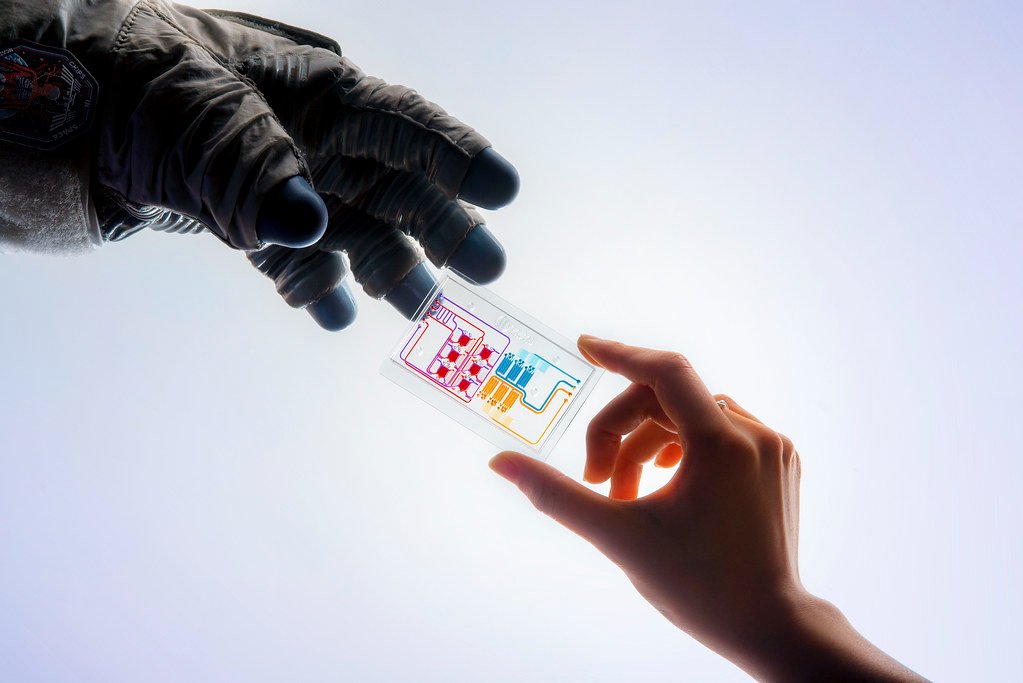
Source: Springer Science and Business Media LLC, by Cl\u00e9ment Quintard; Joice Ren; Josef M. Penninger (October 4, 2026). AI-generated summary by biochip.com, published . Not independently reviewed.
Key takeaways
- Quintard, Ren, and Penninger argue that multi-organ chips have not entered routine pharmaceutical or clinical workflows.
- They propose deriving multiple tissues from one pluripotent stem cell line to create shared-genome body-organoids-on-chip systems.
- The Comment does not establish that shared-origin multi-organ systems outperform existing platforms in clinical or pharmaceutical settings.
A Comment in Nature Reviews Bioengineering argues that simply linking more organ chips together will not automatically create a useful “human body on a chip.” Clement Quintard, J. Ren, and J. M. Penninger contend that today’s multi-organ systems face a core biological problem: they often combine tissues from different donors, grown under different conditions. That makes it difficult to tell what causes an observed effect. Their proposed direction is an integrated body-organoid-on-chip system, in which multiple tissues arise from a shared pluripotent stem cell source.
Why connecting organs is not enough
Single-organ chips, miniature devices that culture a tissue under controlled fluid flow, have shown that they can model specific organ functions. Some have reached the regulatory qualification bar. Multi-organ platforms were intended as the next step, connecting several such tissues so that drug responses and physiology could be studied across organs.
But none has become part of a routine pharmaceutical pipeline or clinical workflow after roughly a decade of development. The Comment argues that this gap is not only an engineering issue. It is also a question of whether the model can produce results that researchers can interpret confidently.
The problem of mixed biological origins
Building a five-organ chip can require maintaining about a dozen cell populations at once. Each population may need its own growth medium, timing, and handling conditions. That is a bit like trying to run several kitchens at the same time, each with a different recipe, temperature, and schedule, while expecting the finished dishes to explain one another.
The challenge becomes sharper when the tissues come from unrelated donors. Once cells from different people share a common circulation in a chip, they remain immunologically distinct. If a new phenotype appears, researchers may struggle to distinguish a genuine signal between organs from an effect caused by donor genetics or by the supplements used to keep individual tissues alive.
A shared developmental starting point
Quintard and colleagues propose starting with one pluripotent stem cell line, a cell source capable of developing into many tissue types, then using separate differentiation programs to create the needed organs. Tissues produced this way would share a genome and developmental history. That common origin could reduce a major source of variation in multi-organ experiments.
The approach also relies on organoids, three-dimensional tissue models that self-organize as they develop. Rather than arranging every cell type as a designed approximation, organoids can reproduce aspects of native tissue composition and architecture. The researchers argue that this biological coherence is more important than simply increasing the number of organs connected on a device.
Why This Matters
For a multi-organ platform to inform a regulatory or clinical decision, an observed effect must be traceable to a plausible cause. A system assembled from many donors and many media can blur that chain of evidence. Shared-origin tissues could make it easier to determine whether a response reflects inter-organ physiology rather than mismatched donor biology or culture conditions.
The proposed shift does not dismiss organ-on-chip technology. Instead, it sets a higher target for integration: build systems around common developmental origin, not organ count alone. The next test will be whether body-organoids-on-chip can preserve that shared biology while providing the reproducibility and interpretability needed for real drug-development and clinical use.
Topics: Organ-on-a-chip · Drug development & safety
Start here: Organ-on-a-chip explained