Source: Biosensors, written by Tianci Wang; Lingyun Li; Yunxiang Wang; Yongjun Han; Teng Li; Chaoran Yu; Yufeng Lou; Zhen Rong; Kai Lin; Shengqi Wang (October 11, 2026). AI-generated summary by biochip.com, published . Not independently reviewed.
Key takeaways
- Ccard combines a microfluidic chip with a single-step RPA-Cas13a assay to detect HPV16 and HPV18 in about 30 minutes.
- The study reports a 5 copies-per-microliter detection limit and clinical-sample sensitivities of 96.8% for HPV16 and 100% for HPV18.
- The reported clinical results do not establish performance across larger or more varied populations.
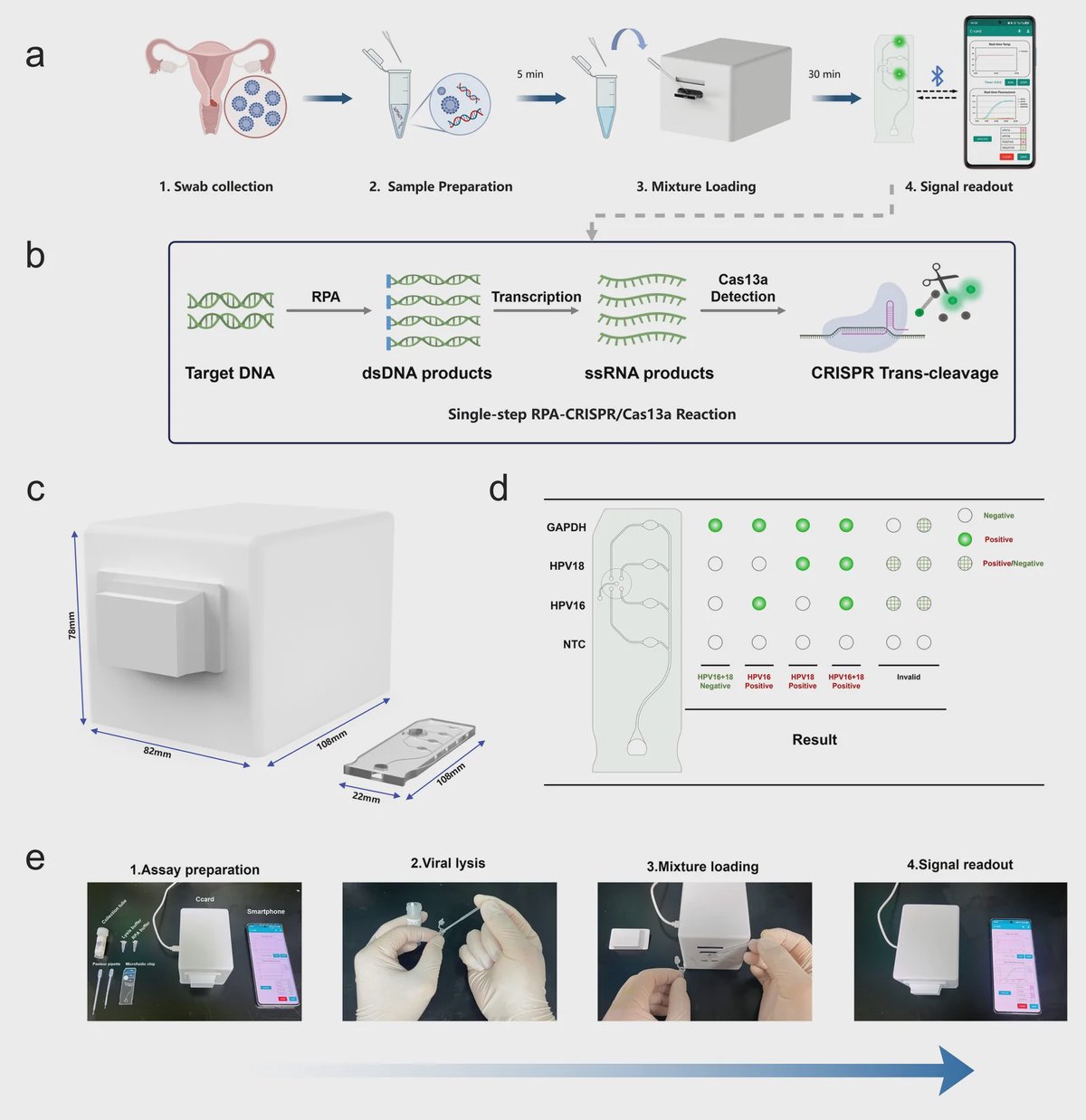
Researchers have developed Ccard, a compact microfluidic device that tests cervical swab samples for two high-risk human papillomavirus types, HPV16 and HPV18. The system combines sample preparation, genetic testing, and real-time fluorescence monitoring in a workflow that takes about 30 minutes. In clinical samples, the team reported sensitivities of 96.8% for HPV16 and 100% for HPV18, with 100% specificity for both. The approach could make HPV testing less dependent on sample-processing equipment and specialized laboratory workflows.
From swab to reaction chamber
Ccard uses a microfluidic chip, a small device that moves fluids through narrow channels and reaction chambers. A vacuum pump draws the treated sample through the chip, while physical barriers help meter it into separate testing areas. The chip contains dried reagents that dissolve when the sample enters the reaction chambers.
Before loading the chip, the team treats a cervical swab sample at room temperature for five minutes with a sample-release solution. This releases genetic material directly into the liquid, so the workflow skips the usual DNA extraction and purification steps. The processed sample can go straight into the downstream reaction.
Amplification and CRISPR detection in one step
The assay pairs recombinase polymerase amplification (RPA), which makes many copies of a target sequence, with CRISPR-Cas13a detection. A useful analogy is to make extra copies of a page before using a guide to find one specific sentence: amplification increases the available target, and the CRISPR system checks for the matching sequence.
In Ccard, the reaction runs at 37 degrees Celsius for 30 minutes. Cas13a uses a short guide molecule to recognize its target, then cuts a fluorescent reporter molecule when activated. The device tracks that fluorescence in real time, and a connected device sends the results to a smartphone over Bluetooth Low Energy.
The chip tests for HPV16 and HPV18, and includes GAPDH, a human gene used as an internal reference to help check the result. The researchers report a detection limit of 5 copies per microliter for each HPV type. That figure describes the lowest concentration detected under the study's test conditions.
What the results show
When the team evaluated clinical samples, Ccard achieved 96.8% sensitivity for HPV16 and 100% sensitivity for HPV18. Sensitivity measures how often a test correctly identifies samples that contain the target. The reported specificity was 100%, meaning the tested negative samples were correctly classified as negative.
The results show that the integrated chip can combine sample handling and a single-step molecular assay in a short test. They do not, on their own, establish how the device will perform across larger or more varied populations. The next question is whether its speed and reported accuracy hold up in broader testing, including in the resource-limited settings the system is intended to serve.
Topics: Microfluidics · Diagnostics & precision medicine
Start here: Microfluidics explained