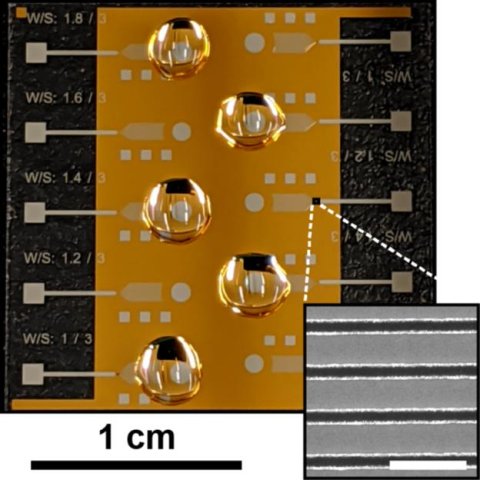
Researchers at the University of Minnesota have shown that a smartphone can wirelessly power a tiny diagnostic chip, a step that could make at-home medical tests cheaper and easier to use. The work centers on a lab-on-a-chip, a miniature device that handles small amounts of liquid to run chemical or biological tests. Instead of relying on complex built-in plumbing, the team found a way to move fluids through narrow channels without conventional microfluidic structures, the tiny engineered pathways commonly used to steer droplets on a chip. That matters because microfluidic systems can add cost and manufacturing complexity, two big barriers for consumer tests. The researchers say this is the first time a smartphone has been used to wirelessly activate such narrow channels in this way. Their study, published in Nature Communications, points toward a future in which sophisticated diagnostics could be produced at scale and used at home rather than only in clinics or labs. The idea gained urgency during the Covid-19 era, when rapid, accessible testing became part of daily life. If the approach can be translated into products, it could help close the gap between high-performance laboratory tools and low-cost point-of-care testing.
How the chip works
Think of the chip like a tiny road system for droplets, except the researchers are trying to simplify the roads as much as possible. In many existing devices, fluids must be pushed, pulled, or guided through carefully fabricated channels and valves, which can make the chip harder to build and more expensive to mass-produce.
In this new approach, a smartphone provides wireless activation, allowing liquid to move through narrow spaces without the usual microfluidic architecture. That is the core technical advance: reducing the need for intricate fluid-handling structures while still controlling where the sample goes.
Why skipping microfluidic structures matters
Microfluidics refers to the handling of very small amounts of liquid, often in channels thinner than a human hair. These systems are powerful because they can process samples quickly and use little material, but they often require precise manufacturing that can raise costs.
For at-home diagnostics, that trade-off is a problem. A test may work beautifully in a research setting, but if it is too expensive or too complicated, it will struggle outside the lab. By removing some of that built-in complexity, the Minnesota team is aiming for devices that are both capable and practical.
An idea inspired by wine bottle “legs”
The inspiration came from a familiar sight for wine drinkers: the streaks or “legs” that form inside a glass or bottle. Those lines appear because alcohol evaporates faster than water, changing the surface tension and causing liquid to climb and gather in thin droplets.
That same basic principle, surface tension, helps explain the new chip. Surface tension is the force that makes the surface of a liquid act a bit like a stretched skin. By harnessing that behavior, the researchers found a way to move fluid in tiny spaces without depending on the normal network of microchannels that lab-on-a-chip devices usually need.
What the researchers and industry partner say
Lead author Christopher Ertsgaard, described in the source as a recent University of Minnesota alumnus, called the work a new concept with clear relevance to home testing. He linked the effort directly to the demand for rapid, point-of-care diagnostics that became impossible to ignore during the pandemic.
Ertsgaard also argued that scaling and high-density manufacturing could make these more sophisticated diagnostic tools affordable for home use. That is an important distinction: the study is not just about proving a physical effect, but about designing a platform that might fit real manufacturing constraints.
Bruce Batten, founder and president of GRIP Molecular Technologies, emphasized the commercial side. He said in-home diagnostics have to be low-cost and easy to use, and that low-voltage fluid movement such as the kind achieved by Professor Oh's team helps meet those requirements.
Batten also said GRIP Molecular Technologies has been collaborating with the University of Minnesota on the technology platform. That academic-industry link matters because many promising chip technologies fail in the handoff from lab prototype to market-ready product.
What makes smartphone power appealing
Using a smartphone as the activating device is clever for a simple reason: people already own one. Rather than asking users to buy or operate a separate reader, the system could potentially lean on a tool that is already familiar, portable, and connected.
Wireless activation also opens design possibilities for compact tests that feel more like consumer electronics than laboratory instruments. For home diagnostics, ease of use often matters as much as scientific sensitivity, because even a strong test can fail if it is confusing or inconvenient.
Why This Matters
At-home diagnostics sit at the intersection of public health, engineering, and everyday convenience. The better these tests become, the more people can screen for infection or monitor health conditions quickly, without waiting for a lab appointment or specialized equipment.
This study matters because it tackles a stubborn bottleneck: how to keep advanced chip-based testing accurate while making it simple and cheap enough for broad use. If the researchers' approach can maintain sensitivity and reliability in real products, it could expand access to testing in homes, rural settings, and low-resource environments where traditional lab infrastructure is harder to reach.
What comes next
The published work is an early but important step, not the final product. The next challenge will be turning the concept into robust diagnostic devices that can handle real samples consistently, survive manufacturing at scale, and meet regulatory standards for medical testing.
Still, the direction is clear. By pairing a familiar device like a smartphone with a simplified fluid-handling chip, the University of Minnesota team has outlined a plausible route toward more accessible diagnostics. If future studies confirm that the method is fast, sensitive, and dependable across different tests, the idea could help reshape what people expect from healthcare at home.