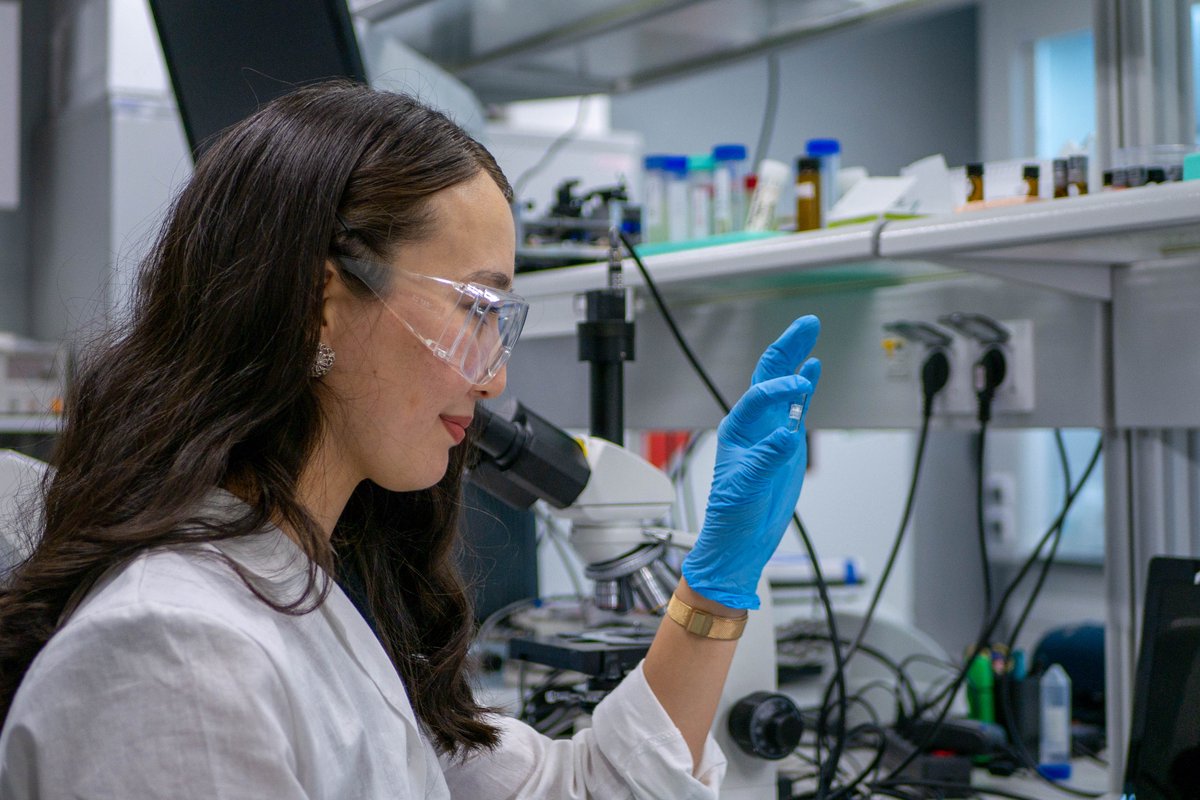
Source: Luddy School of Informatics, Computing, and Engineering, Indiana University, by Pete DiPrimio, Indiana University (September 25, 2026). AI-generated summary by biochip.com, published . Not independently reviewed.
Key takeaways
- Weihua Guan received an NIH R21 award to develop MegaPixel for broad-based bacterial identification.
- MegaPixel distributes samples into about 1.2 million chambers and uses fluorescence imaging, a GPU, and machine learning to classify melting curves.
- Initial testing uses purified bacterial DNA and controlled mixtures, not patient blood or clinical specimens.
Indiana University Luddy School professor Weihua Guan has received a National Institutes of Health R21 award to develop MegaPixel, a chip-based system intended to identify bacteria from their DNA melting patterns. The platform divides a sample across roughly 1.2 million miniature reaction chambers, then combines fluorescence imaging with artificial intelligence to analyze the individual signals. Guan's early work will test purified bacterial DNA and controlled mixtures, not patient blood. If the approach works at scale, it could support faster and more detailed testing for bloodstream infections, where treatment decisions can precede conventional blood-culture results.
A Digital Approach to Bacterial Identification
The project, called AI-Driven MegaPixel Digital Melting Platform for Broad-Based Bacterial Identification, focuses on a familiar molecular principle. A bacterium's DNA sequence can act like a fingerprint: different species carry small sequence differences that can distinguish them from one another.
Researchers amplify a DNA region with enough variation to separate bacterial species, then gradually heat it. Heating causes the paired strands of DNA to come apart, a process called melting. Because each sequence separates at slightly different temperatures and patterns, it generates a characteristic melting curve, much like different songs can be recognized from their distinctive sound patterns.
Why Millions of Chambers Matter
MegaPixel builds on digital versions of high-resolution melting technology. Instead of measuring all DNA in a single tube, the system distributes the sample into about 1.2 million tiny chambers on a chip. Ideally, each chamber that produces a signal starts with one bacterial DNA molecule.
That physical separation could be particularly useful for mixed infections. When DNA from several bacterial species is measured together, their melting signals can overlap and become hard to interpret. Separating molecules into many chambers gives the system many cleaner, individual melting fingerprints rather than one complex combined signal.
Imaging and AI in One System
The chip is heated while a wide-field fluorescence camera repeatedly captures images of the full array. Fluorescence changes as DNA melts, allowing the system to reconstruct a melting curve from every chamber that contains DNA.
At that scale, the experiment may produce hundreds of thousands of curves, far too many for manual review. An integrated graphics processing unit, or GPU, will process the images, extract the curves, and run machine-learning models that estimate which bacterial species generated each pattern.
Guan also expects the chamber counts to provide a measure of how much DNA each organism contributed. In principle, one run could indicate which bacteria are present, whether multiple species occur together, and the approximate amount of each organism's DNA.
Testing the Platform's Boundaries
The R21 grant will support a systematic evaluation of how the platform performs as the number of bacterial species, mixture complexity, and available digital information increase. R21 grants from the National Institutes of Health are intended to encourage new research activities in designated program areas.
The first experiments will use purified bacterial DNA and carefully controlled mixtures. This design lets the team establish the system's capabilities and limits under controlled conditions before confronting the added complexity of blood or other clinical material.
Why This Matters
Bloodstream infections and sepsis can require urgent treatment, yet conventional blood culture may not immediately identify the bacteria responsible. A system that preserves information from individual DNA molecules could eventually help clinicians distinguish organisms in complex samples more quickly and with greater detail.
For now, MegaPixel remains an early-stage diagnostic platform. The next steps, if the controlled DNA experiments succeed, would include integrating sample preparation and evaluating the technology with more complex biological and clinical specimens.
Topics: Infectious diseases
Start here: What is a biochip?
Related articles
- Rochester students’ award-winning device instantly detects sepsis via sweat
- Ancient Dujiangyan water wisdom inspires AI microfluidic chip to spot hidden sub-resistant bacteria
- Researchers develop paper-based diagnostic tool for rapid, affordable infectious disease detection
- From Population Genomics to Clinical Diagnostics: UNC and Tulane Researchers Advance CRISPR-Based NTM Detection