Source: Biomaterials Research, by Sanghyun Ahn; Jung-Soo Suh; Yoonkwan Jang; Gyuho Choi; Kiseok Han; Yerim Lee; Dahee Lee; Chanhui Song; Jeong-Min Go; Minji Kim; Jinyoung Lee; Jung-Hwan Lee; Hae-Won Kim; Hwayoung Yun; Tae-Jin Kim (September 7, 2026). AI-generated summary by biochip.com, published . Not independently reviewed.
Key takeaways
- Pusan National University and Dankook University researchers built NEKfla, a FRET biosensor for early NEK7-NLRP3 signaling in living cells.
- NEKfla responded to lipopolysaccharide, nigericin, MCC950, and licochalcone B, and detected changes earlier than a caspase-1 reporter.
- The study does not establish clinical performance or validation in human disease models.
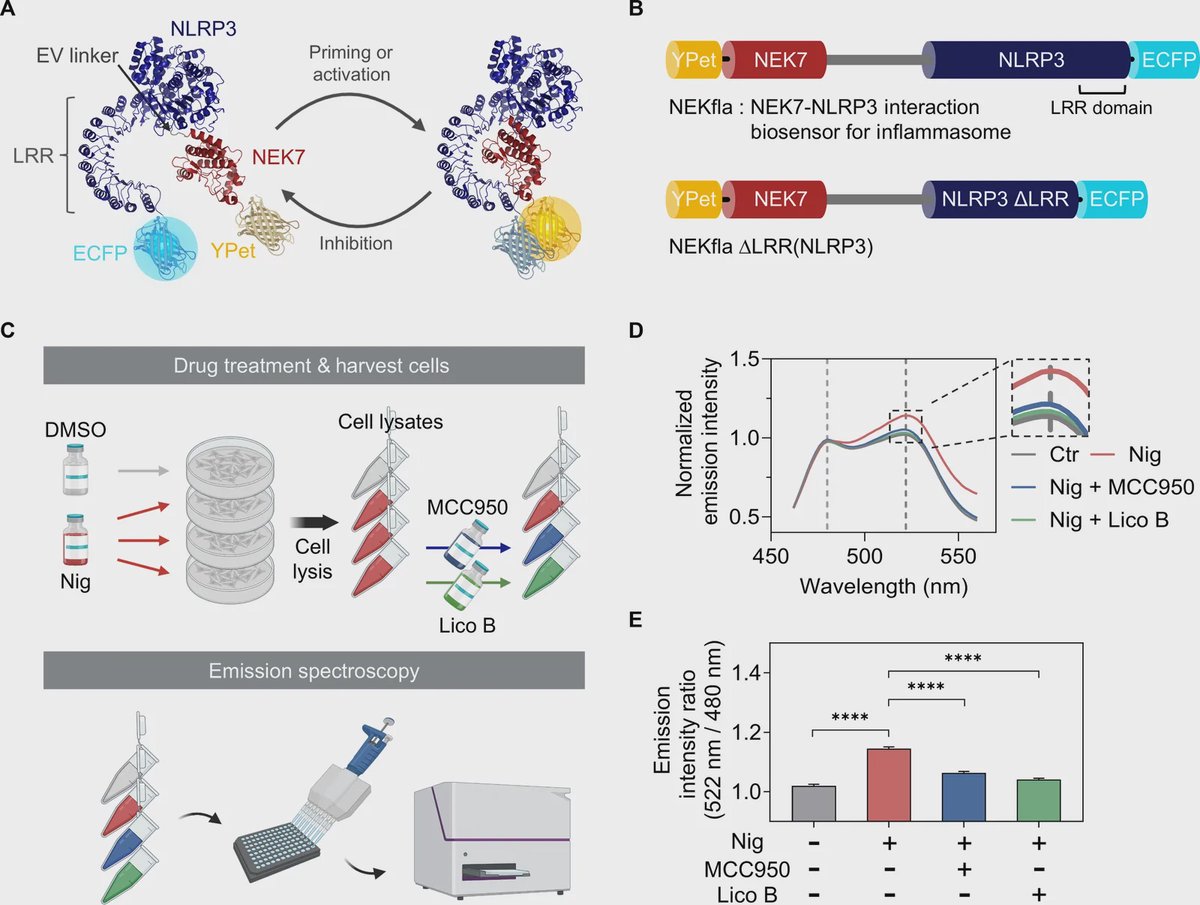
Researchers at Pusan National University and Dankook University have developed NEKfla, a genetically encoded fluorescent biosensor that tracks an early step in NLRP3 inflammasome signaling inside living cells. The sensor reports changes involving the interaction between NEK7 and NLRP3, proteins that help initiate a powerful inflammatory response. Unlike common assays that detect later outcomes such as caspase-1 activity, NEKfla detected signaling changes earlier and at single-cell resolution. The work could give researchers a more direct way to study how inflammation starts and to test compounds that interrupt it.
Watching an Early Inflammatory Signal
The NLRP3 inflammasome is a cellular protein complex that helps the immune system respond to infection, tissue injury, and other signs of danger. When its activity is excessive or prolonged, however, it can contribute to damaging inflammation associated with conditions including inflammatory bowel disease, rheumatoid arthritis, Crohn's disease, and encephalitic disorders.
Inflammasome activation unfolds in stages. Early signals help NLRP3 assemble with other proteins, eventually activating caspase-1, an enzyme that matures inflammatory cytokines and contributes to pyroptosis, a form of inflammatory cell death. Many existing live-cell reporters focus on caspase-1, meaning they capture an event that occurs after the inflammasome has already assembled.
NEK7, a serine/threonine kinase, is a key partner in this process. It binds the leucine-rich repeat region of NLRP3 and helps support the protein clustering, or oligomerization, needed to form a productive inflammasome. That makes the NEK7-NLRP3 interaction a useful window into the pathway's earlier activity.
How NEKfla Works
NEKfla uses Förster resonance energy transfer, or FRET, a fluorescent technique that works a little like a molecular proximity alarm. When two fluorescent proteins are close enough, energy can transfer from one to the other, changing the fluorescent signal researchers measure. That change can reveal when the linked proteins shift position or interact inside a living cell.
The team built NEKfla by linking full-length NEK7 and NLRP3 to an ECFP-YPet FRET pair. They also created a control version, called NEKfla ΔLRR, that lacks NLRP3's leucine-rich repeat domain. Because NEK7 binds this region, the control helped the researchers assess whether observed signal changes depended on the expected interaction.
In live-cell and laboratory analyses, NEKfla produced stimulus-dependent FRET increases after treatment with lipopolysaccharide and nigericin. Lipopolysaccharide is a bacterial component commonly used to prime inflammatory responses, while nigericin is a compound used experimentally to activate NLRP3 signaling. The sensor also visualized dynamic changes associated with NLRP3 oligomerization.
Testing Inhibitors and Cell Types
The biosensor responded to MCC950 and licochalcone B, two pharmacological inhibitors tested by the team. This result indicates that NEKfla can register changes in the early signaling process when it is chemically suppressed, rather than simply detecting the final consequences of inflammasome activation.
NEKfla functioned in several cellular contexts, including macrophage-like cells. Macrophages are immune cells that play a central role in inflammatory signaling, so demonstrating sensor activity in these cells strengthens its relevance for studying the NLRP3 pathway. The researchers also found that NEKfla detected signaling changes earlier than a caspase-1 reporter.
Why This Matters
Timing matters in cell signaling. A late-stage reporter can confirm that an inflammatory pathway became active, but it may not reveal which molecular interactions first pushed it into action. By following NEK7-NLRP3-associated changes before caspase-1 activation, NEKfla could help researchers separate initiating events from later cellular effects.
The platform may be useful for mechanistic experiments and cell-based screening of materials or compounds that modulate early NLRP3 activity. Future studies can determine how consistently its FRET signals predict inflammasome behavior across additional cell types, stimuli, and disease-relevant experimental models.
Topics: Biosensors · Immunity & inflammation
Start here: Biosensors explained
Related articles
- From molecular networks to the clinic: a systems biology–nanomedicine roadmap for osteoarthritis diagnosis, regeneration, and safety-by-design
- Engineered Allosteric Biosensor for In Situ DNA Glycosylase Detection in Neuroblastoma Risk Stratification and Drug Resistance Monitoring
- Physics-informed machine learning for robust calibration and physiological validation of wearable electrochemical sweat biosensors for metabolite monitoring
- Novel Biosensor Uses DNA Barcodes to Uncover Disease Signals in Cells