Source: Scientific Reports, by Krishnamoorthy, Umapathi; R., Mohanraj; T., Mariprasath; R., Anand Babu; P., Saranya; Chan, Choon Kit; Bulakhe, Ravindra N.; Jaber, Mustafa Musa; Kamalrudin, Massila; Dixit, Saurav; Varshney, Deekshant (September 28, 2026). AI-generated summary by biochip.com, published . Not independently reviewed.
Key takeaways
- A physics-guided model achieved an R-squared value of about 0.7940 and root mean square error of about 0.90 for sweat sensor calibration.
- The framework showed moderate sweat-serum correlations, with R-squared values of about 0.48 for metabolites and 0.57 for branched-chain amino acids and leucine.
- The method was evaluated on a publicly available dataset, not newly acquired biosensor measurements or an explicit long-term drift-compensation test.
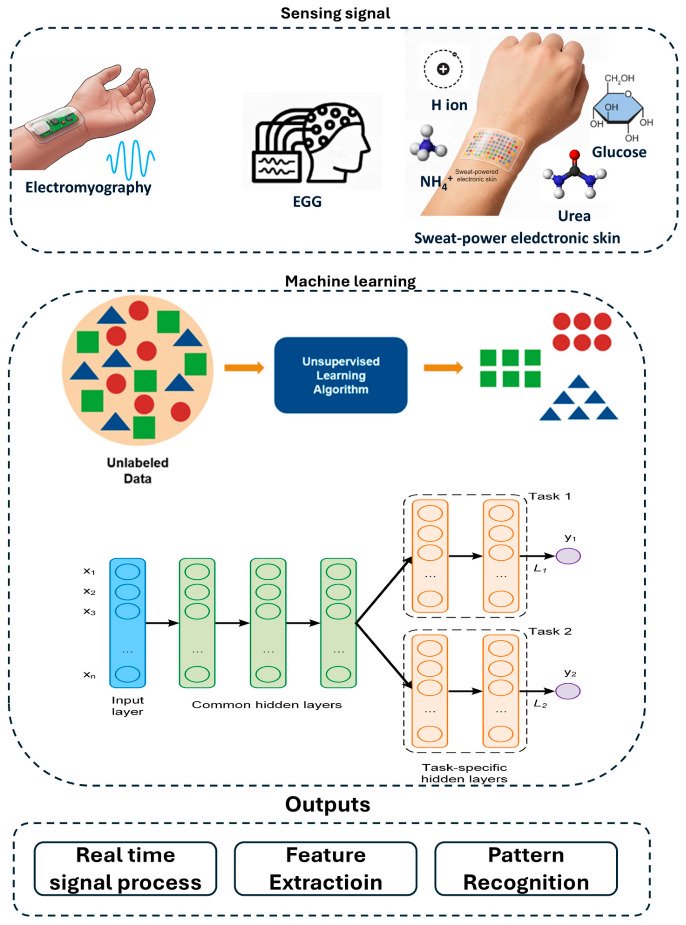
A team reporting in Scientific Reports has developed a physics-guided machine learning method to calibrate wearable electrochemical sweat biosensors more reliably. Rather than building a new sensor, the researchers tested a computational framework on a publicly available dataset of sweat metabolite measurements. The approach adds a simple physical expectation, that a sensor signal should change consistently as analyte concentration changes, to a machine learning model. That constraint improved calibration performance over conventional linear regression and could help make noninvasive sweat monitoring more dependable.
Why Sweat Sensors Need Better Calibration
Wearable sweat sensors aim to measure molecules such as metabolites, electrolytes, proteins, lipids, and amino acids without drawing blood. Electrochemical sensors do this by converting chemical interactions at an electrode into an electrical signal, much like a microphone converts sound waves into an electrical output.
But the electrical signal does not depend only on the target molecule. Sweat rate, hydration, temperature, pH, changing sweat composition, electrode fouling, sensor aging, environmental conditions, and differences between individuals can all affect the measurement. Those influences can cause calibration drift, where the relationship between signal and concentration becomes less accurate over time or across conditions.
Adding a Physical Rule to Machine Learning
Standard linear regression draws a straight-line relationship between a sensor signal and an analyte concentration. That can be useful, but electrochemical sensor behavior is often nonlinear. Purely data-driven machine learning can capture more complicated patterns, yet it may also make predictions that conflict with known sensor behavior when it encounters new conditions.
The team used physics-guided machine learning, sometimes called physics-informed machine learning, to combine data fitting with domain knowledge. Their framework extracted features from electrochemical signals and imposed a monotonicity constraint. In plain terms, the model was encouraged to preserve a consistent directional relationship between concentration and sensor response, rather than learning arbitrary fluctuations from the training data.
Monotonicity is not a complete mechanistic model of electrochemistry. Instead, it acts like a guardrail: the algorithm can learn nonlinear patterns, but it is less free to generate relationships that violate the expected direction of the sensor response. The researchers specifically positioned this as a calibration framework, not as an explicit long-term drift-compensation system.
Calibration Results
On the evaluated dataset, the physics-guided model reached an R-squared value of about 0.7940 and a root mean square error of about 0.90. R-squared measures how much of the variation in the target measurement a model can explain, with values closer to 1 indicating a tighter match. Root mean square error measures the typical size of prediction errors, so smaller values are better.
The reported experiments showed better performance than a conventional linear regression model. Cross-validation, a test in which a model is repeatedly trained and evaluated on different splits of the data, also supported stronger generalization than the baseline models. The researchers further examined resilience to noise, which matters because wearable sensor signals can be noisy outside controlled laboratory settings.
Connecting Sweat Measurements to Physiology
Calibration alone is not enough if sweat concentrations do not meaningfully track physiology. The team therefore compared sweat and serum measurements, finding moderate cross-domain correlations. The reported R-squared values were about 0.48 for sweat-serum metabolites and about 0.57 for branched-chain amino acids and leucine.
Those results do not establish that sweat can substitute for blood testing. They do suggest that the framework could detect part of the physiological relationship between sweat and serum measurements. The time-series analysis also identified differences between people and metabolite-specific changes within the same person over time.
Why This Matters
Reliable calibration is a central obstacle for wearable biochemical sensing. A watch or patch may collect data continuously, but that stream is only useful if the device can distinguish a genuine biological change from a shift caused by the sensor, the environment, or the wearer.
By putting a physically meaningful constraint inside the learning process, this approach offers a route to more interpretable calibration than a model that relies solely on statistical patterns. The next step is experimental validation with newly collected biosensor data and, eventually, models that explicitly account for longer-term sensor drift and additional real-world variables.
Topics: Biosensors
Start here: Biosensors explained
Related articles
- Optical and Electrochemical Biosensors Using Electrochemically Etched Porous Silicon
- Redefining Carbon Electrodes as Hierarchically Designable Reaction Fields for Electrochemical Biosensing
- Miniaturization of Aptasensors in Organic Electrochemical Transistors for Sensitivity Enhancement
- Electric-Field-Assisted Enrichment and Electrochemical Detection of Gram-Positive Bacteria Using an FEM-Guided Interdigitated Electrode Biosensor