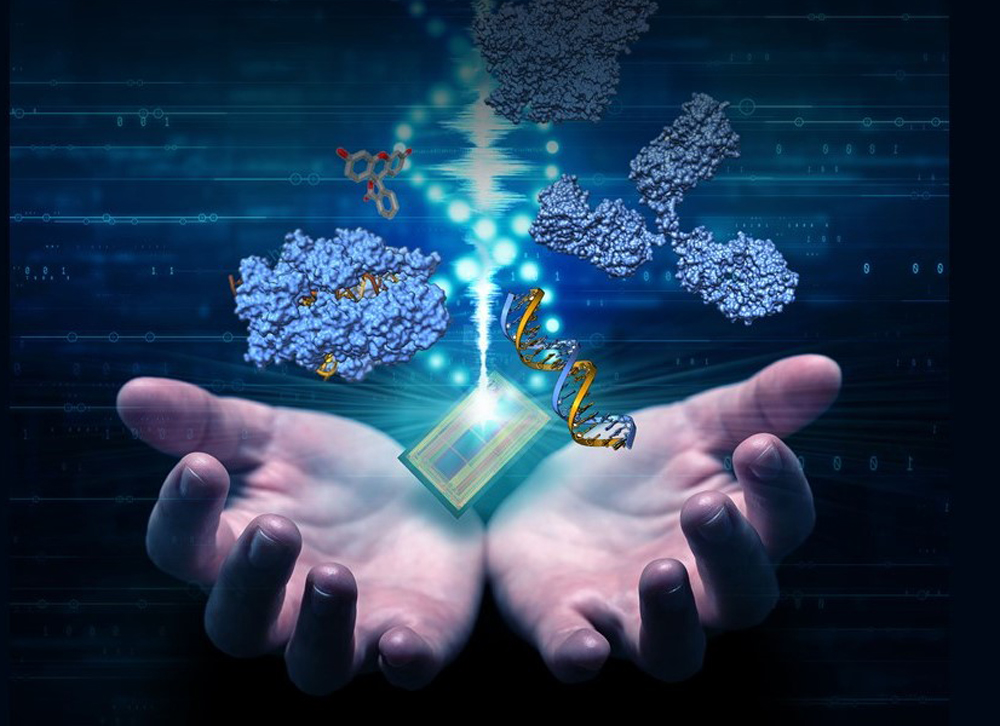
Roswell Biotechnologies and collaborators say they have built a programmable biosensor chip that can watch single molecules interact in real time, turning tiny electrical changes into digital signals. The idea is simple to describe but hard to achieve: instead of measuring large averages across millions of molecules, the chip listens to one molecular event at a time. According to the researchers, that matters because biology is driven by molecules binding, moving, and reacting with each other at extremely small scales. The device uses a semiconductor chip packed with thousands of sensing elements, each linked by a synthetic molecular wire that acts like a nanoscale bridge. By attaching different molecular probes to that wire, the same basic hardware can be reprogrammed to look for different biological targets. The team says the system can record those interactions at 1,000 frames per second, producing a continuous current-by-time readout from each sensor. If the approach scales as hoped, it could support work in drug discovery, diagnostics, DNA sequencing, and proteomics, the large-scale study of proteins. The broader promise is a new kind of digital biology platform: one that brings the logic of semiconductor electronics to the messy, dynamic world of living molecules.
How the chip works
At the center of the device is a semiconductor chip designed as a large sensor array. Each sensing element contains nanoelectrodes, which are extremely small electrical contacts, connected by a synthetic molecular wire made from a 25-nanometer peptide.
You can think of that wire like a tiny suspension bridge carrying signals between two points. When a molecule of interest interacts with a probe attached to the wire, the electrical current changes, and the circuit records that shift as a live signal.
A sensor that can be reprogrammed
The chip is not limited to one biological target. Roswell says the biosensor can be programmed by attaching a chosen molecular probe to a central conjugation site on the molecular wire, effectively telling the sensor what to pay attention to.
That flexibility is important because the same underlying electronics could, in principle, be adapted for different classes of biomolecules. A probe for DNA would make the sensor behave differently from a probe for a protein, but the chip architecture stays the same.
What makes it different
Many standard biology tools detect pooled signals from huge numbers of molecules at once. That is useful for many tasks, but it can blur the moment-to-moment behavior of individual molecules, much like hearing the roar of a stadium instead of one conversation in the stands.
Jim Tour, a Rice University chemistry professor and co-author of the paper, framed the advance in exactly those terms. He said biology works through single molecules "talking to each other," and that existing methods cannot detect those exchanges directly, while the sensors described here make it possible to listen in on that molecular communication.
Scale and speed on one chip
Single-molecule measurements are often associated with delicate, low-throughput lab setups. Roswell's pitch is that this technology brings those measurements onto a chip architecture that can scale, combining sensitivity with the manufacturing logic of electronics.
Barry Merriman, Roswell Biotechnologies' chief scientific officer, said the chip described in the paper contains 16,000 independent sensors. Each one can monitor the solution placed over the array, creating many parallel streams of information instead of relying on a single readout.
The company also says the device converts picoampere-scale current signals into digital information at 1,000 frames per second. A picoampere is one trillionth of an ampere, so the system is working with extraordinarily faint electrical signals and translating them into data that software can analyze in real time.
Why the electronics matter
Roswell's leaders describe the chip as part of a larger shift toward molecular electronics, where molecules do not just serve as targets of measurement but become active parts of the sensing circuit. That matters because semiconductor technology is already optimized for mass production, compact design, and digital output.
Paul Mola, Roswell's founder, president, and chief executive officer, compared the idea to the way mobile phones scaled communication by building on chip technology. His argument is that putting biology "on chip" could make advanced measurement tools cheaper, smarter, and more widely accessible than specialized instruments that remain confined to a few labs.
Where it could be useful
The company points to several application areas: drug discovery, diagnostics, DNA sequencing, and proteomics. Those fields all depend on detecting how biomolecules interact, whether that means a drug candidate binding to a target protein, a DNA strand pairing with its complement, or a diagnostic marker appearing in a patient sample.
In practical terms, a programmable electrical sensor could give researchers a way to compare many interactions quickly while also preserving fine-grained timing information. That combination of throughput and resolution is attractive because biological systems are not static; often the most important information lies in how interactions unfold over time.
Why This Matters
The significance of this work is not just that it measures something small. It is that it tries to merge two worlds that have often advanced separately: the precision and scalability of digital chips, and the complexity of molecular biology.
If that merger works reliably, it could change how scientists gather biological data. Instead of relying only on bulky optical instruments or chemical endpoint assays, they could use dense electronic arrays that watch molecular events directly and continuously, producing data that is easier to digitize, store, and analyze.
There is also a broader scientific angle. Multiomic research aims to connect information from DNA, RNA, proteins, and other biomolecules, and those layers only make sense when researchers can observe interactions between them. A platform that detects those events at the single-molecule level could help fill in some of the missing links between molecular identity and molecular behavior.
What comes next
The source material presents the chip as a platform with wide potential rather than as a finished product for every use case. The next questions will be familiar ones for any emerging biosensor technology: how robust the measurements are across different sample types, how easily the system can be programmed for new targets, and how well it performs outside a controlled demonstration.
Still, the core concept is clear. By building single-molecule sensing directly into a semiconductor array, Roswell and its collaborators are trying to give biology something closer to a digital nervous system—one capable of detecting faint molecular signals at scale and turning them into usable information.