Source: ScienceDaily, written by Michael Shuff. Note; research by Chunhui Yao, Jie Ma, Ningning Wang et al. (University of Cambridge) (October 23, 2026). AI-generated summary by biochip.com, published . Not independently reviewed.
Key takeaways
- The Cambridge and GlitterinTech team built a roughly $10 silicon nitride optical spectrometer that processes measurements in less than a second.
- The device classified plastics, pharmaceuticals, coffee, flour, and tea with 100% success in reported tests and tracked glucose in one participant.
- The glucose demonstration involved one participant, and further testing is needed before the device could become a practical medical product.
Researchers at the University of Cambridge and startup GlitterinTech have built a compact optical spectrometer on a silicon nitride photonic platform, with an estimated cost of about $10. The device analyzes light to identify materials and measure chemical concentrations, and the team demonstrated it on several substances and health markers. In tests, it classified five categories of everyday materials with 100% success and tracked glucose noninvasively in one participant. The results point to a possible way to bring optical testing into smaller, portable devices, though more testing is needed before it could serve as a medical monitor.
A Different Way to Read Light
A spectrometer works like a prism that reveals the colors hidden in a beam, except it measures wavelengths precisely to learn about the material the light has encountered. Traditional instruments often separate wavelengths or use computational methods to reconstruct them. Shrinking those systems can reduce their resolution or accuracy.
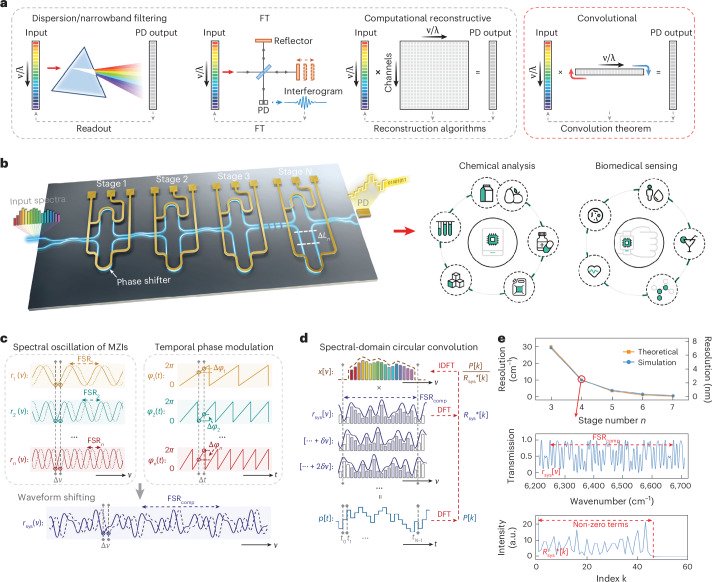
The Cambridge team’s device, called a convolutional spectrometer, takes another route. It uses a sequence of optical components with repeating responses to different wavelengths. The pattern acts somewhat like a carefully arranged set of filters: by shifting their responses in a controlled way, the device performs a mathematical operation called convolution on incoming light. Fast Fourier transforms then recover the light spectrum.
The researchers built the system on a silicon nitride photonic platform and integrated it with onboard electronics. It operates across near-infrared wavelengths from 1,200 to 1,700 nanometers and can collect and process a measurement in less than a second. The team says adding optical components could increase resolution exponentially, while extending the measurement bandwidth may require relatively little change to the design.
Tests on Materials and Health Markers
In reported tests, the spectrometer classified plastics, pharmaceuticals, coffee, flour, and tea with 100% success. It also measured concentrations in water-based and organic solutions with reported accuracy of about 0.01%, outperforming commercial benchtop spectrometers in those experiments. The report does not give the number of samples used for these classification tests.
The team also tested measurements of skin moisture, blood alcohol, blood lactate, and blood glucose under conditions designed to reflect real physiological environments. In one participant, the device demonstrated noninvasive glucose tracking over an extended period. That is an early demonstration, not evidence that the sensor is ready to guide diabetes care.
The sensor operated reliably across temperatures from -20°C to 80°C, a range that could matter for devices used outside controlled laboratory settings. Its designers also say the convolution-based approach reduces the computing needed to reconstruct spectra compared with methods that rely on more demanding algorithms.
Why This Matters
Compact, lower-cost spectrometers could make it practical to collect chemical measurements in settings where large laboratory instruments are inconvenient. The team points to possible uses in wearable health technology, food testing, manufacturing quality checks, and environmental monitoring. These are potential applications, not demonstrated products.
For healthcare, the central open question is whether the glucose result can be reproduced reliably in larger groups and under everyday conditions. The researchers say further testing is needed before the technology could become a practical medical product. The work, published in Nature Photonics, shows a new device design and early demonstrations; it does not establish clinical accuracy or performance in a population of users.
Topics: Diabetes & metabolism
Start here: What is a biochip?