Source: Frontiers in Cellular and Infection Microbiology, written by Ju Long; Juan Xie; Fang Liu; Jie Peng; Wen-Fei Xu; Xu-Hui Li (October 28, 2026). AI-generated summary by biochip.com, published . Not independently reviewed.
Key takeaways
- Droplet partitioning lowered the reported detection limit from 10 to 1 copy per microliter compared with the bulk assay.
- The researchers tested 28 residual vaginal swabs and found full concordance with a routine composite clinical reference.
- The comparison was preliminary: the reference was not specific to C. albicans, and the cutoff came from the study cohort.
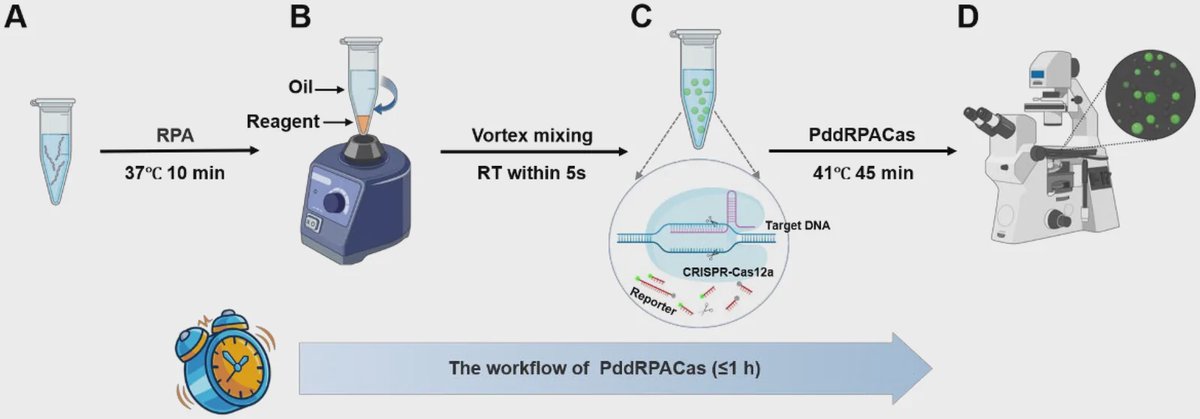
Researchers in China developed a droplet-partitioned CRISPR/Cas12a assay that detected low levels of Candida albicans DNA in vaginal specimens. The method combines a 10-minute DNA amplification step with fluorescence detection in droplets made by vortexing, without fabricating a microfluidic chip. In laboratory tests, the droplet format detected a lower target concentration than the same assay measured in bulk. The early results suggest a way to improve low-copy detection using basic laboratory equipment, though the clinical evaluation was small and preliminary.
Amplify, then divide the reaction
The assay first uses recombinase polymerase amplification (RPA), a method that copies DNA at a steady, relatively low temperature without the repeated heating cycles used in standard polymerase chain reaction. The team amplified a target region from the fungus’s genetic material at 37°C for 10 minutes, then added the product to a CRISPR/Cas12a reaction.
Cas12a is a DNA-targeting protein guided by a short RNA molecule. When it recognizes the target, it cuts nearby reporter molecules and produces a fluorescence signal. Think of the reporter as a light that switches on when the target is found. In a bulk reaction, signals and background activity share one pool; partitioning the mixture into droplets separates those events into smaller compartments.
Droplets improved low-copy detection
The team compared fluorescence detection in a bulk reaction with detection after vortex-assisted droplet partitioning. The droplets were polydisperse, meaning they varied in size, and the method did not require microfluidic chip fabrication. Under the study’s analytical criteria, the reported limit of detection was 10 copies per microliter for the bulk assay and 1 copy per microliter for the droplet format.
Those concentrations refer to the DNA template before amplification, not a direct count of copies measured in the final reaction. The researchers also tested the assay against several non-target organisms, including other Candida species, and reported no cross-reactivity among the organisms tested. The complete workflow took about one hour and used basic laboratory equipment.
Early test in vaginal specimens
In a preliminary evaluation, the researchers tested 28 residual vaginal swab specimens. The assay’s classifications were fully concordant with a routine composite clinical reference when the team applied a droplet-count cutoff derived from that study cohort.
That agreement is not the same as definitive diagnostic accuracy. The reference method was not specific to C. albicans, and the cohort-derived cutoff was exploratory. Detecting the fungus’s DNA also does not, by itself, establish active vulvovaginal candidiasis, because people can carry C. albicans without symptoms.
Why This Matters
Low-abundance targets can be difficult to distinguish from background fluorescence in a single reaction volume. The study’s comparison suggests that dividing an RPA-amplified sample into droplets can improve the analytical readout without relying on fabricated microfluidic devices or specialized droplet systems.
The next step is to assess the method in larger, independent groups of patients and against a reference that specifically identifies C. albicans. That would help establish whether the improved laboratory detection limit translates into reliable clinical testing.
Topics: Microfluidics
Start here: Microfluidics explained
Related articles
- CRISPR-Scan: Cas13a Mismatch Tolerance Enables Multiplexed AML Indel Detection
- Portable Biosensors Speed Food And Water Contamination Detection
- Microfluidic chips: recent advances, critical strategies in design, applications and future perspectives
- An open-source, modular optoelectrical sensor for on-chip flow characterization in droplet-based microfluidics