Source: HardwareX, by Daniel Solano; José Isabel Gómez-Quiñones; Sergio Camacho-Leon (September 8, 2026). AI-generated summary by biochip.com, published . Not independently reviewed.
Key takeaways
- Tecnológico de Monterrey built a $104 open-source sensor for on-chip droplet velocity, length, volume, and monodispersity analysis.
- Two light-dependent resistors 9.88 mm apart measure velocity, while a TSL2561 photodiode characterizes droplet length and related metrics.
- The work does not establish performance across different chip designs, fluids, or clinical deployment settings.
Researchers at Tecnológico de Monterrey have built an open-source optoelectrical sensor that measures key properties of droplets as they move through a microfluidic chip, without relying on a high-speed camera or a separate computer. The modular device calculates droplet velocity, length, volume, and monodispersity, meaning how consistently droplets are sized within a batch. It combines low-cost electronics, a replaceable flow-focusing chip, and embedded processing on an Arduino Zero microcontroller. The work could make droplet-based lab-on-a-chip systems more portable and easier to prototype outside a conventional laboratory.
Replacing cameras with embedded sensing
Droplet microfluidics handles tiny, separated packets of liquid flowing through narrow channels. Those droplets can serve as miniature reaction vessels for applications including single-cell analysis, nanoparticle production, polymerase chain reaction, drug screening, and clinical diagnostics.
For these systems to work reliably, operators need to know how fast droplets are moving and whether they are consistent in size. Conventional measurements often use high-speed cameras, microscopes, and image-processing software. That approach can provide detailed data, but it also ties the instrument to expensive optics and off-chip computation.
The new platform instead senses droplets by watching how they alter transmitted light as they cross a microfluidic channel. It is similar to timing a runner as they pass two checkpoints, while also recording how long they block a beam at the finish line. Those timing and light signals provide the information needed to estimate each droplet's movement and dimensions.
Two optical stages, one microcontroller
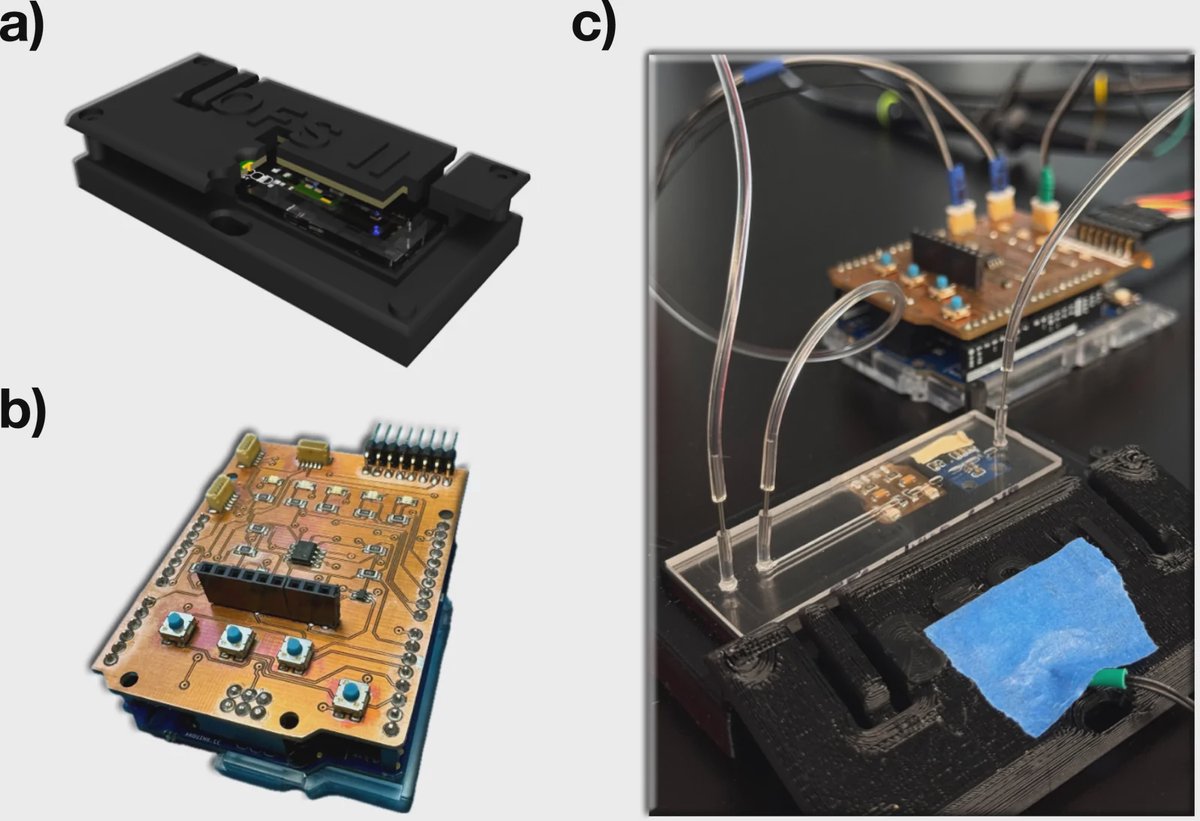
The system uses two printed circuit board, or PCB, sensing modules positioned around a poly(methyl methacrylate), or PMMA, flow-focusing chip. Flow focusing is a method that uses surrounding fluid streams to pinch a liquid into regularly formed droplets, here producing water-in-oil emulsions.
The first board measures velocity with two light-dependent resistors separated by 9.88 millimeters. As a droplet passes the sensors, it changes the received light signal. The Arduino Zero records the time between detections and calculates velocity from the known distance divided by transit time.
A Schmitt-trigger comparator circuit turns the changing analog light signals into cleaner digital detection events. The design also includes two digital potentiometers to support calibration and improve microcontroller operation.
The second stage uses a TSL2561 photodiode-based ambient-light sensor to characterize droplet or slug length. A green surface-mount LED board provides illumination aligned with the main channel and both sensor modules. The platform analyzes the signal on the Arduino Zero itself, rather than exporting raw data for processing in MATLAB or another host-side program.
A modular Lab-on-PCB design
Daniel Solano, José Isabel Gómez-Quiñones, and Sergio Camacho-Leon designed the instrument as a set of replaceable modules. The assembly includes the two sensing boards, LED source board, PMMA droplet-generation chip, and upper and lower 3D-printed alignment enclosures.
The enclosures hold the optical components in position and shield them from ambient light. The microfluidic chip is independent and replaceable, which could help users adapt the overall setup without rebuilding the sensing electronics.
A separate user-interface PCB connects to the Arduino Zero and supplies push-button controls plus LED status indicators. The authors estimate the complete module set and processor cost at about $104. They released build instructions, embedded firmware, and example applications under the CERN Open Hardware Licence Version 2, Strongly Reciprocal.
From an earlier prototype to stand-alone measurement
The team previously demonstrated the basic optical principle using a green LED and photodetector across a flow-focusing channel. In that earlier arrangement, a droplet changed the light intensity reaching the detector, allowing software to identify its boundaries.
That earlier system still depended on MATLAB for droplet-length analysis and video methods for velocity measurement. The new version moves the length-processing workflow into microcontroller firmware and adds the two-resistor velocity stage, allowing the system to report velocity, length, volume, and monodispersity through on-device processing.
Why This Matters
Embedded measurement could remove a practical obstacle for droplet microfluidics: the need to pair every prototype with camera equipment and external analysis software. A self-contained sensor can be particularly useful when portability, rapid iteration, or limited laboratory infrastructure matter.
The platform does not make droplets itself without the accompanying flow-focusing chip, but it brings sensing electronics and the microfluidic device into one aligned package. Its open hardware approach gives other groups a starting point for adapting the design to autonomous droplet-based instruments. Further testing across different chip geometries, fluids, and real-world workflows will determine how broadly the design can be deployed.
Topics: Microfluidics
Start here: Microfluidics explained
Related articles
- Microfluidics-based strategies for molecular diagnostics of infectious diseases
- Microfluidic Organ-on-A-chip: A Guide to Biomaterial Choice and Fabrication
- Microfluidic Impedance Biosensor Chips Using Sensing Layers Based on DNA-Based Self-Assembled Monolayers for Label-Free Detection of Proteins
- Chip in a lab: Microfluidics for next generation life science research