Source: PLOS One, by Md Al Amin Islam Utshob; Maymona Binte Juwel; Nahyan Al Mahmud; S M Ishraqul Huq; Khandakar Mohammad Ishtiak (September 2, 2026). AI-generated summary by biochip.com, published . Not independently reviewed.
Key takeaways
- Ahsanullah University researchers modeled a five-layer SPR sensor for milk-fat detection at a fixed 633 nm wavelength.
- The optimized design reached 401.40 degrees per refractive index unit sensitivity at a refractive index of 1.3621.
- The sensor remains a numerical model and has not been directly calibrated or tested with actual milk samples.
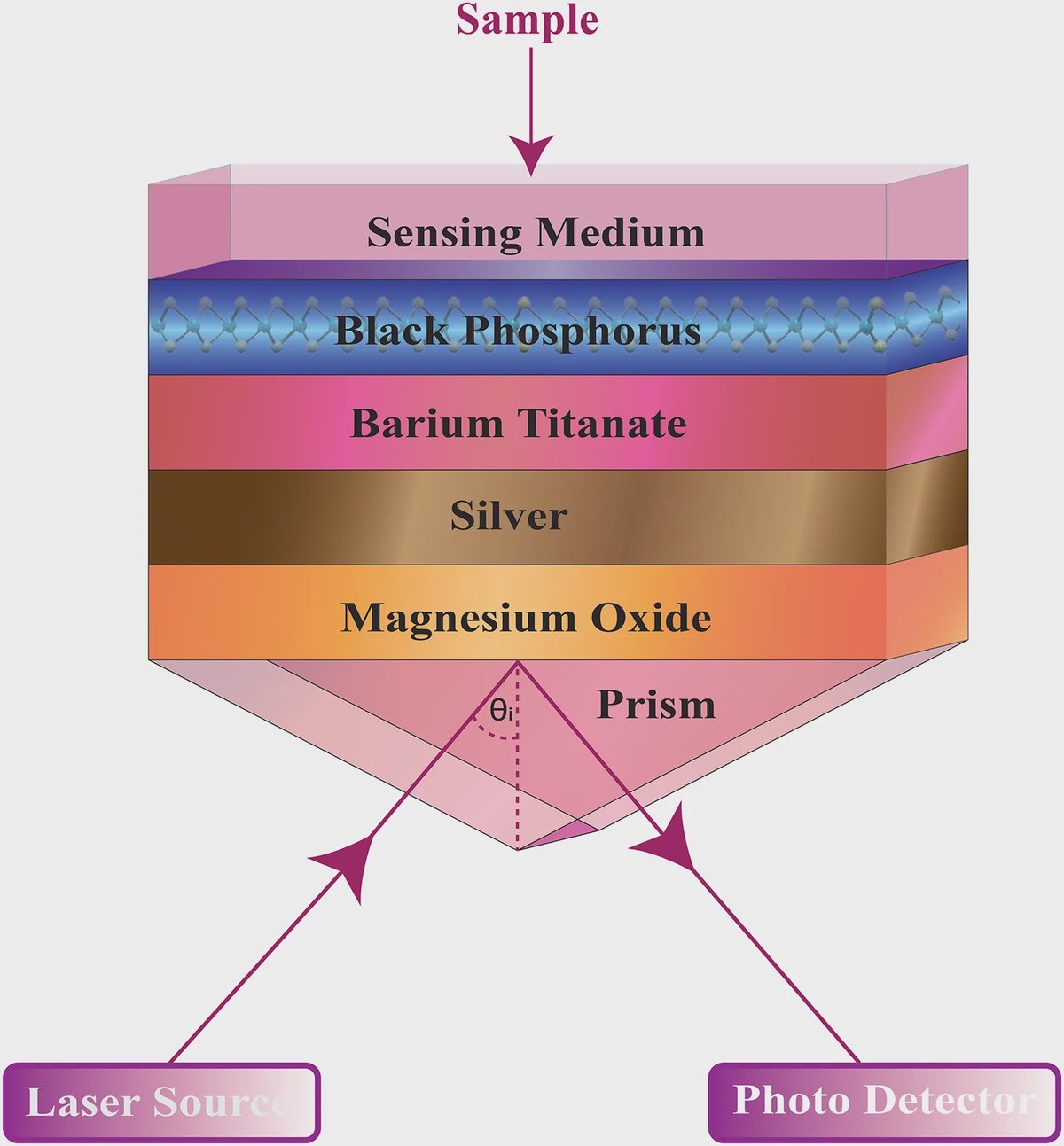
Researchers at Ahsanullah University of Science and Technology have designed a multilayer surface plasmon resonance sensor intended to estimate milk fat from small changes in how light travels through a sample. Their computer-modeled device combines a silica prism with magnesium oxide, silver, barium titanate, and ultrathin black phosphorus, then uses a hybrid optimization workflow that includes machine learning to select layer thicknesses. At a refractive index of 1.3621, the model reached a sensitivity of 401.40 degrees per refractive index unit. The work points to a potential chemical-free route for checking milk quality, although it has not yet been calibrated with real milk samples.
Reading milk fat through light
Milk fat affects both the nutritional value and commercial grading of dairy products. It can also help reveal dilution or skimming, two forms of adulteration that change milk composition. Conventional measurements, including the Gerber and Babcock tests and Fourier transform infrared spectroscopy, can require reagents, time, or complex instruments.
The proposed approach uses surface plasmon resonance, or SPR, an optical effect at the boundary between a metal and another material. A useful analogy is a playground swing: when light arrives at the right angle, it efficiently transfers energy to electrons at the metal surface, producing a sharp drop in reflected light. A change in the sample's refractive index, meaning how strongly it bends light, shifts the angle where that dip occurs.
A five-layer optical design
The sensor uses the Kretschmann configuration, a common SPR setup in which a prism directs light onto a thin metal film. Here, the team modeled a silicon dioxide prism followed by layers of magnesium oxide, silver, barium titanate, and black phosphorus. The system operates at a fixed wavelength of 633 nanometers and measures changes in the resonance angle.
Each layer has a proposed optical role. Silver supports the surface plasmons, while magnesium oxide and barium titanate are high-refractive-index dielectric materials intended to improve confinement of the optical field. Black phosphorus, a thin two-dimensional material placed at the sensing surface, is intended to strengthen light-matter interaction with the sample.
Optimizing the layers
Layer thickness can substantially change an SPR sensor's performance. Rather than choosing dimensions by trial and error alone, the researchers used a hybrid workflow that combined brute-force searching, machine learning, and refinement steps to identify thicknesses that maximized sensitivity.
They evaluated the design with three computational methods: the transfer matrix method, finite element method, and finite-difference time-domain method. These are complementary ways to simulate how electromagnetic waves move through the layered structure. The modeled sensor covered refractive indices from 1.345 to 1.3621, a range the team linked to variation in milk fat content.
Modeled performance
At the upper modeled refractive index of 1.3621, the device produced a reported sensitivity of 401.40 degrees per refractive index unit. It also had a minimum reflectance of 0.086, a quality factor of 148.33 per refractive index unit, and an accuracy of 0.369 per degree.
Those values describe a numerical design, not a finished instrument measuring dairy samples. The team explicitly based its analysis on refractive-index values from prior experimental studies. Direct calibration between a milk fat concentration and the sensor's angular response remains a future experimental task.
Why This Matters
A practical SPR system could monitor a milk sample without labels or chemical reagents, because it detects optical changes directly. The approach may be useful for dairy quality control and for flagging composition changes associated with adulteration. It could also be adapted for more selective sensing by adding enzyme-based recognition layers, such as lipase, which reacts with milk triglycerides and changes the local refractive index.
The next step is to build the multilayer device and test it against real milk samples with known fat contents. That testing will determine whether the simulated optical gains translate into reliable, selective measurements in the chemically complex conditions of everyday dairy products.
Start here: Biosensors explained
Related articles
- Development of semiconductor microchip that can detect prostate cancer markers with ultra-high sensitivity
- Machine Learning and Centrifugal Microfluidics for Bedside Sepsis Prediction
- Miniaturization of Aptasensors in Organic Electrochemical Transistors for Sensitivity Enhancement
- Microfluidic Impedance Biosensor Chips Using Sensing Layers Based on DNA-Based Self-Assembled Monolayers for Label-Free Detection of Proteins