Source: Analytical Chemistry, by Andika Asyuda; Rasheed T Odunbaku; Luka J L Striethorst; Henrique F P Barbosa; Andreas Schander; Ramesh Kumar; Dur E N Gakhar; Sarah Bornemann; Rachel E Armstrong; Björn Lüssem (September 1, 2026). AI-generated summary by biochip.com, published . Not independently reviewed.
Key takeaways
- Universität Bremen-led researchers studied how OECT gate area changes aptasensor sensitivity, detection range, and selectivity.
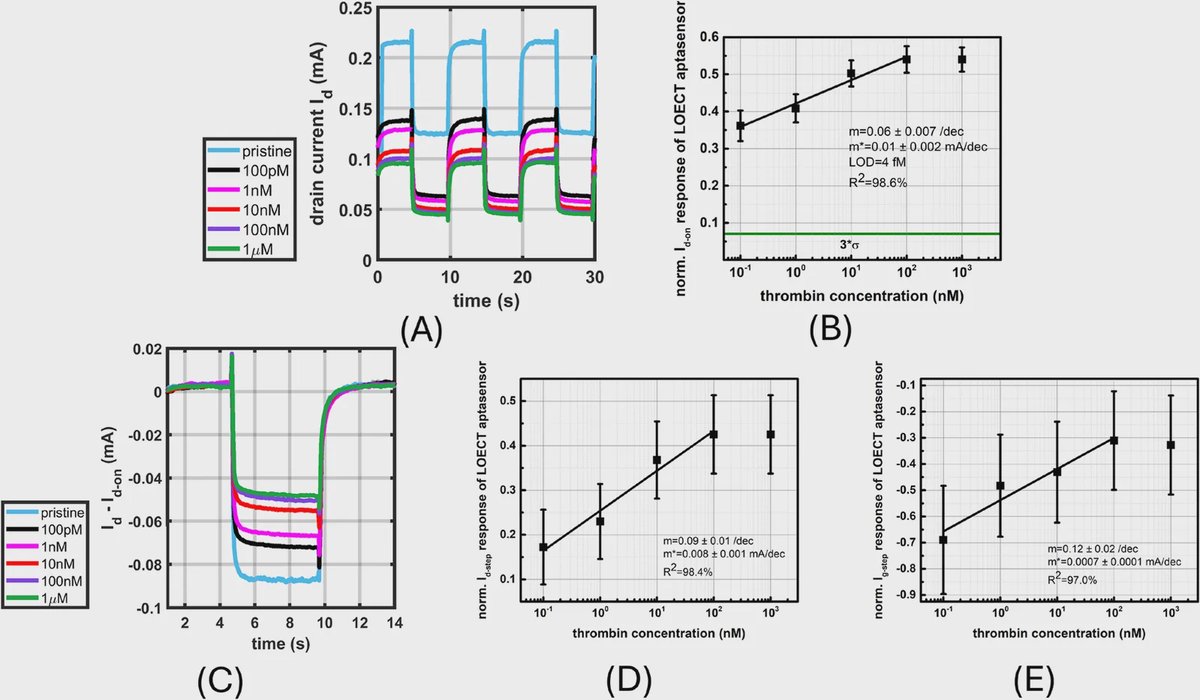
- A vertical OECT paired with a TBA-29 thrombin aptasensor achieved reported sensitivity up to 0.3 mA per decade.
- The study does not establish performance in human clinical samples or long-term real-world continuous monitoring.
Researchers at Universität Bremen and partner institutions have shown that shrinking the gate electrode in an organic electrochemical transistor, or OECT, can strengthen an aptamer-based sensor's response. Their thrombin sensor reached a reported sensitivity of 0.3 mA per decade of concentration when paired with a vertical OECT design. The work matters because it offers practical design rules for making small biosensors that operate at low voltage, a key requirement for continuous measurement without damaging the sensing surface. The study appeared in Analytical Chemistry.
A transistor that amplifies a molecular signal
An aptasensor detects a target molecule with an aptamer, a short synthetic strand of DNA or RNA selected to bind a particular target. In this case, the team used the 29-base TBA-29 aptamer, which recognizes thrombin, an enzyme involved in blood clotting.
Traditional electrochemical aptasensors measure current directly from electrodes. That approach creates a difficult tradeoff during miniaturization: making the active electrode smaller reduces total current, even though the relative response can improve.
An OECT changes that equation. Like a faucet in which a small turn of the handle controls a much larger flow of water, a small chemical change at the transistor gate changes ion movement in an organic channel and produces a larger change in drain current. The aptamer-functionalized gold gate acts as the recognition element, while the transistor provides electrical amplification.
Why gate area changes the response
The team systematically examined how gate-electrode area affected sensitivity, detection range, and selectivity in OECT-based aptasensors. Earlier work on OECTs without aptamers had indicated that smaller gates can increase sensitivity because more of the applied voltage drops across the gate-electrolyte interface rather than across the electrolyte-channel interface.
That voltage distribution is central to the device design. When thrombin binds to the aptamer layer on the gold gate, it changes the gate interface. The OECT converts that interfacial change into a measurable change in channel current.
The researchers also compared the sensing strategy with the limits of conventional gold-thiol aptasensors. Applying too large a voltage can oxidize gold or generate reactive oxygen species, processes that can cause aptamers to detach or degrade. The OECT sensor produced a significant response at gate voltages near 0 V, reducing the need to push the sensing interface into damaging electrochemical conditions.
Using a vertical OECT
To increase the ratio of gate area to channel area, the researchers integrated the aptasensor with a vertical OECT, or VOECT. A vertical transistor routes current through stacked layers rather than across a longer flat channel, allowing a compact channel geometry.
The resulting VOECT aptasensor reached a sensitivity of up to 0.3 mA per decade. Here, “per decade” means the current response associated with each tenfold change in thrombin concentration. The team reported that this geometry enabled both amplified aptasensor response and adjustment of the detection range and sensitivity for diagnostic needs.
The devices used PEDOT:PSS, a conductive polymer that transports both electronic charges and ions, as the transistor channel material. Gold gates were functionalized with thiol-modified TBA-29 aptamers, then treated with 6-mercapto-1-hexanol to prepare the sensing surface.
Why This Matters
Thrombin helps convert fibrinogen into fibrin during blood clotting. Its concentrations can range from trace picomolar to nanomolar levels at an injury site and can rise to micromolar levels during coagulation, making controlled measurement potentially useful in settings such as surgery and pregnancy.
The broader contribution is not limited to thrombin. By tying gate size and transistor geometry to sensor performance, the study provides a route for engineers to balance miniaturization, sensitivity, and operating voltage in OECT aptasensors. Such low-voltage operation could be especially important for sensors intended to measure targets continuously, where repeated electrochemical stress could otherwise shorten device life.
Future work will need to determine how these design rules translate to complex clinical samples and other aptamer-target pairs. Still, the vertical OECT approach shows how transistor architecture can help overcome a basic constraint of miniaturized electrochemical sensors: small recognition surfaces do not have to mean small electrical signals.
Topics: Biosensors
Start here: Biosensors explained
Related articles
- Electric-Field-Assisted Enrichment and Electrochemical Detection of Gram-Positive Bacteria Using an FEM-Guided Interdigitated Electrode Biosensor
- Physics-informed machine learning for robust calibration and physiological validation of wearable electrochemical sweat biosensors for metabolite monitoring
- Development of semiconductor microchip that can detect prostate cancer markers with ultra-high sensitivity
- Optical and Electrochemical Biosensors Using Electrochemically Etched Porous Silicon