Source: Journal of Extracellular Vesicles, written by Eun Ju Lee; Cheng Nie; Sunyoung Park; Yun‐Jeong Kang; Minji Kang; Jake Whang; Go‐Eun Choi; Hyejon Lee; San‐Nae Cho; Kyung‐A Hyun; Sunghyun Kim; Hyo‐Il Jung; Jungho Kim; research by Yun-Jeong Kang (Dong-Eui Institute of Technology) (November 1, 2026). AI-generated summary by biochip.com, published . Not independently reviewed.
Key takeaways
- The eight-channel chip measured a four-marker TB-associated vesicle signature in 10 microliters of plasma in 30 minutes.
- AUCs were 0.98 for distinguishing 25 active-TB patients from 24 healthy controls and 0.95 against 40 people with other respiratory diseases.
- The reported cohorts do not establish performance in larger, independent or routine-care populations.
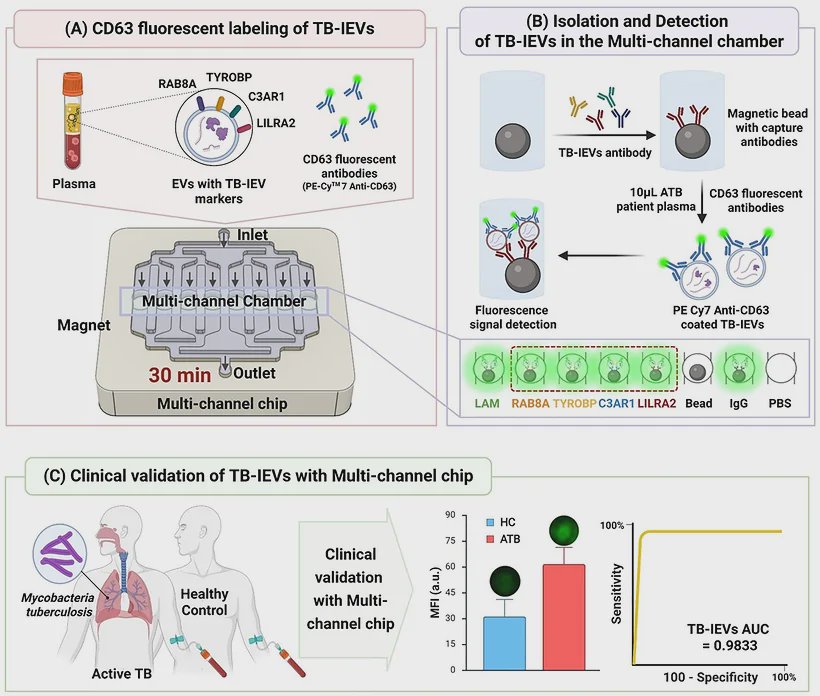
A research team led by Eun Ju Lee and colleagues at Catholic University of Pusan developed an eight-channel microfluidic chip to detect a tuberculosis-linked signature on extracellular vesicles in blood plasma. The device analyzed just 10 microliters of plasma in 30 minutes, offering a way to look for active tuberculosis without relying on a sputum sample. In a clinical cohort, the four-marker signature distinguished active tuberculosis from healthy controls and from people with other respiratory diseases. The team also found that signature levels fell after tuberculosis treatment.
A blood-based signal from immune cells
Extracellular vesicles are tiny, membrane-wrapped particles released by cells. Think of them as small packages carrying clues about the cells they came from: the researchers looked for vesicles displaying proteins associated with innate immune cells, the body's first line of defense.
To select targets, the team compared whole-blood gene activity in people with active tuberculosis and healthy controls. They chose four immune cell-associated surface markers, RAB8A, TYROBP, C3AR1 and LILRA2, and used a bead-based immunoprecipitation test to confirm that vesicles carrying the signature were elevated in plasma from patients with active disease.
How the chip detects the vesicles
The chip works like a set of parallel fishing lines: each channel helps capture and measure target vesicles. The researchers labeled vesicles with a fluorescent antibody against CD63, a protein found on extracellular vesicles, then used antibody-coupled magnetic beads to capture the targets and read their fluorescence.
Running the channels in parallel let the team analyze the four-marker signature using a small plasma volume. The full procedure took 30 minutes, according to the study, and the chip produced a separate signal for each marker rather than relying on one indicator alone.
Results in patient groups
In a cohort of 25 people with active tuberculosis and 24 healthy controls, the chip's diagnostic performance reached an area under the receiver operating characteristic curve of 0.98. This measure summarizes how well a test separates two groups, with higher values indicating better discrimination in the study population.
The signature also distinguished active tuberculosis from other respiratory diseases in a group of 40 people, with an area under the curve of 0.95. It added diagnostic information for patients with active tuberculosis whose results were negative on individual conventional tests, and the researchers observed lower vesicle levels over time after treatment began.
Why This Matters
Many standard tuberculosis tests depend on sputum, which can be difficult to collect, and tests that detect the bacterium can miss cases when bacterial levels are low. A plasma-based approach could address a different part of that problem by measuring the body's immune response rather than requiring the test to find the pathogen in a respiratory sample.
The results are promising, but the reported clinical groups were modest in size. The study does not by itself establish how the chip will perform across larger, independent populations or in routine clinical settings. Further evaluation would be needed to determine whether its speed and small sample requirement translate into reliable diagnosis and treatment monitoring beyond these cohorts.
Topics: Microfluidics · Diagnostics & precision medicine · Infectious diseases
Start here: Microfluidics explained