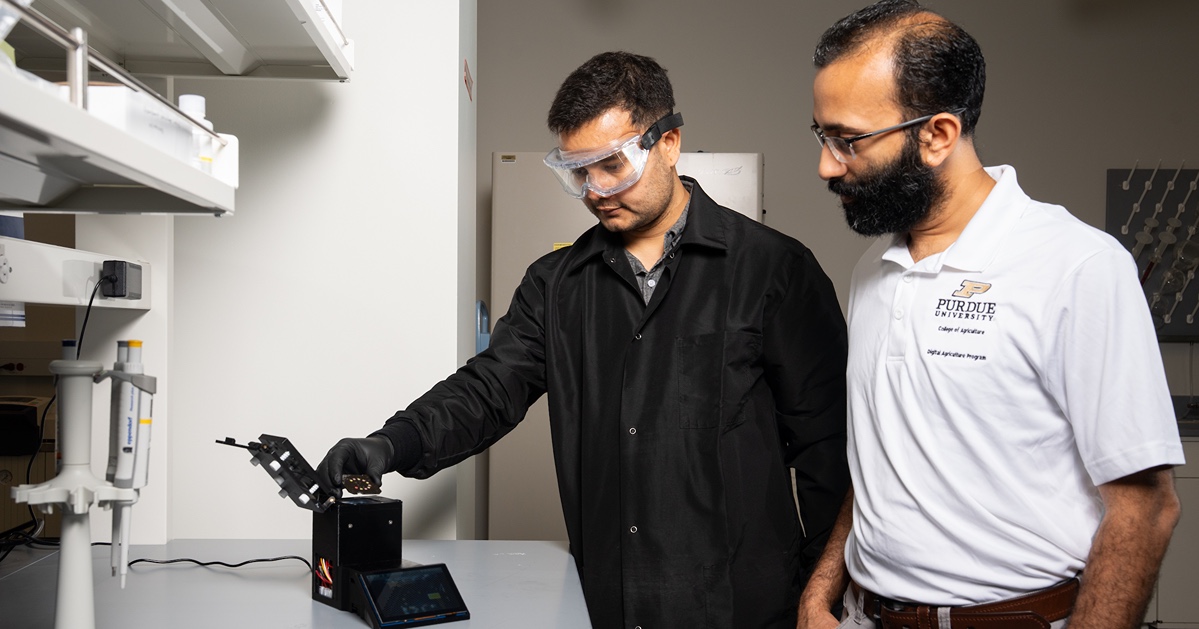
Source: Purdue University - College of Agriculture, by Steve Koppes (September 21, 2026). AI-generated summary by biochip.com, published . Not independently reviewed.
Key takeaways
- Purdue researchers built three ThermiQuant prototypes for high-throughput labs, portable field use, and compact solid-state testing.
- The instruments automate imaging and analysis of paper-based LAMP reactions that change color when target DNA or RNA is detected.
- The prototypes have not yet been described with clinical validation, comparative accuracy metrics, or commercial availability.
Purdue University researchers have built three prototype instruments that automate paper-based molecular tests, aiming to make results more consistent in laboratories, clinics, farms, and field settings. The systems, called ThermiQuant MegaScan, ThermiQuant AquaStream, and ThermiQuant VitroMini, grew from a paper biosensor developed by Mohit Verma's lab in 2021. That earlier sensor could detect genetic material from microbes through a visible color change, but users had to interpret the result with their own eyes. The new instruments use imaging hardware and custom software to read those color changes instead. They are designed to support human and animal diagnostics, environmental monitoring, and food safety testing. Each device keeps samples at a steady temperature, an essential requirement for the chemistry used to amplify and detect target genetic sequences. The three versions address different testing scales, from high-throughput laboratory workflows to compact field use. The work reflects an effort to move molecular testing from specialized laboratory equipment toward simpler systems that can operate closer to where samples are collected.
Turning a Paper Test Into an Instrument
The platform is based on a paper-based biosensor, a test device that carries chemical reactions on paper rather than in conventional laboratory tubes. It uses loop-mediated isothermal amplification, or LAMP, a method that makes many copies of a chosen DNA or RNA sequence while holding the reaction at one constant temperature. Think of it as repeatedly photocopying a specific page from a huge instruction manual until that page becomes easy to spot.
If the target genetic material is present, the reaction changes color. The Purdue team initially used the approach in a sealed plastic cartridge to detect the virus that causes COVID-19, then demonstrated applications in animal health diagnostics and food safety risk management. Color-based readouts can be simple and inexpensive, but they also leave room for disagreement when a faint result must be judged by eye.
Software Replaces Visual Guesswork
Verma's group designed the ThermiQuant instruments to shift result interpretation from the user to software. The systems capture images over time and analyze the progress of the color change, rather than relying on a single person to decide whether a test pad looks positive or negative. The approach can also estimate the concentration of a DNA target in samples whose concentrations are similar but unknown.
The effort builds on a 2024 proof-of-concept instrument developed by Verma, Jiangshan Wang, and colleagues. That device combined a water bath with a camera for time-lapse imaging, but still required substantial manual processing. The newer designs refine the visual readout and package it into instruments tailored for distinct use cases.
Three Formats for Different Workflows
ThermiQuant MegaScan is the high-throughput version, intended for laboratories that need to process large numbers of samples quickly. It can examine multiple DNA targets through an array of tests at the same time. A built-in scanner captures high-quality images every 30 seconds, then uses data collected over an hour to reconstruct color changes that indicate positive or negative reactions.
This imaging strategy addresses a practical difference between paper tests and familiar tube-based molecular assays. Many high-throughput instruments use a narrow beam of light to take a measurement at a single point in a tube. Reactions can vary across the surface of a paper test pad, so Verma's team built a system that images the full reaction area rather than sampling only one spot.
A Portable System for Paper and Tubes
ThermiQuant AquaStream is a portable benchtop instrument designed for clinics, farms, and field environments. It uses a camera rather than a scanner and maintains reaction temperature with a controlled water bath. Its custom Amplimetrics software runs on a miniature onboard computer to generate results.
AquaStream can process both paper-based reactions and tube-based liquid reactions in the same device. That matters because laboratories may begin with liquid assays and then translate their findings to paper, a workflow that otherwise requires two instruments and can produce different results. By handling both reaction formats, AquaStream is intended to provide a more consistent path through testing.
Removing the Water Bath
Feedback from AquaStream field testing led the group to develop ThermiQuant VitroMini, a smaller solid-state instrument without a water bath. Instead, VitroMini uses transparent solid-state heaters made from indium tin oxide-coated glass along with an aluminum heater. Indium tin oxide is a conductive material that can heat while remaining transparent, allowing the system to warm samples and image them.
VitroMini also includes onboard software. Its heater design responds to a problem seen in systems that use a thin-film heater on only one side of a test chip. Heating from one side while the other side remains exposed to surrounding air can create uneven temperatures across the reaction, and molecular amplification depends on stable conditions.
Why This Matters
Molecular diagnostics can identify pathogens by detecting their genetic blueprints, but conventional systems often require specialized instruments, trained personnel, and controlled laboratory settings. The ThermiQuant prototypes combine temperature control, imaging, and analysis in devices intended to reduce manual steps and make paper-based molecular testing easier to interpret. That combination is central to reliable point-of-need testing, where a user may be working at a farm, food production site, clinic, or home rather than a central laboratory.
Verma, an associate professor of agricultural and biological engineering and chief technology officer of the startup Krishi, has assigned pending patents for the instruments to the Purdue Research Foundation. The next practical question is how these prototypes perform across the varied samples and settings they were designed to serve. If the systems can maintain consistent automated readings outside conventional laboratories, they could expand the settings where genetic detection tests are useful.