Source: Analytical Chemistry, by Arya Das; Mark M Somoza (September 17, 2026). AI-generated summary by biochip.com, published . Not independently reviewed.
Key takeaways
- Das and Somoza used RNA-splinted ligation to join surface-bound DNA with independently synthesized DNA on photolithographic microarrays.
- The arrays contained 2,073,600 features at a 10.8 micrometer pitch and supported labeling, reverse transcription, and photopatterning applications.
- The study does not establish clinical performance, commercial deployment, or results across patient samples.
Researchers led by Arya Das and Mark M. Somoza developed an RNA-splinted ligation workflow to modify high-density DNA microarrays after they are made. The approach joins surface-bound DNA to separately prepared DNA strands, potentially extending the kinds of probes and chemical functions an array can carry. Built on maskless nucleic acid photolithography, the work addresses a central manufacturing problem: longer DNA sequences accumulate synthesis errors, while some useful chemical building blocks cannot tolerate the light-based production process. The strategy could make densely patterned microarrays more flexible for genomic assays, biosensing, and other nucleic acid experiments.
Adding DNA After Array Manufacturing
A DNA microarray is a glass surface covered with many small, spatially defined DNA features. In this study, the team made arrays with a maskless microarray synthesizer that uses a digital micromirror device to direct light onto selected locations. Their stated array format contains 2,073,600 features with a 10.8 micrometer pitch.
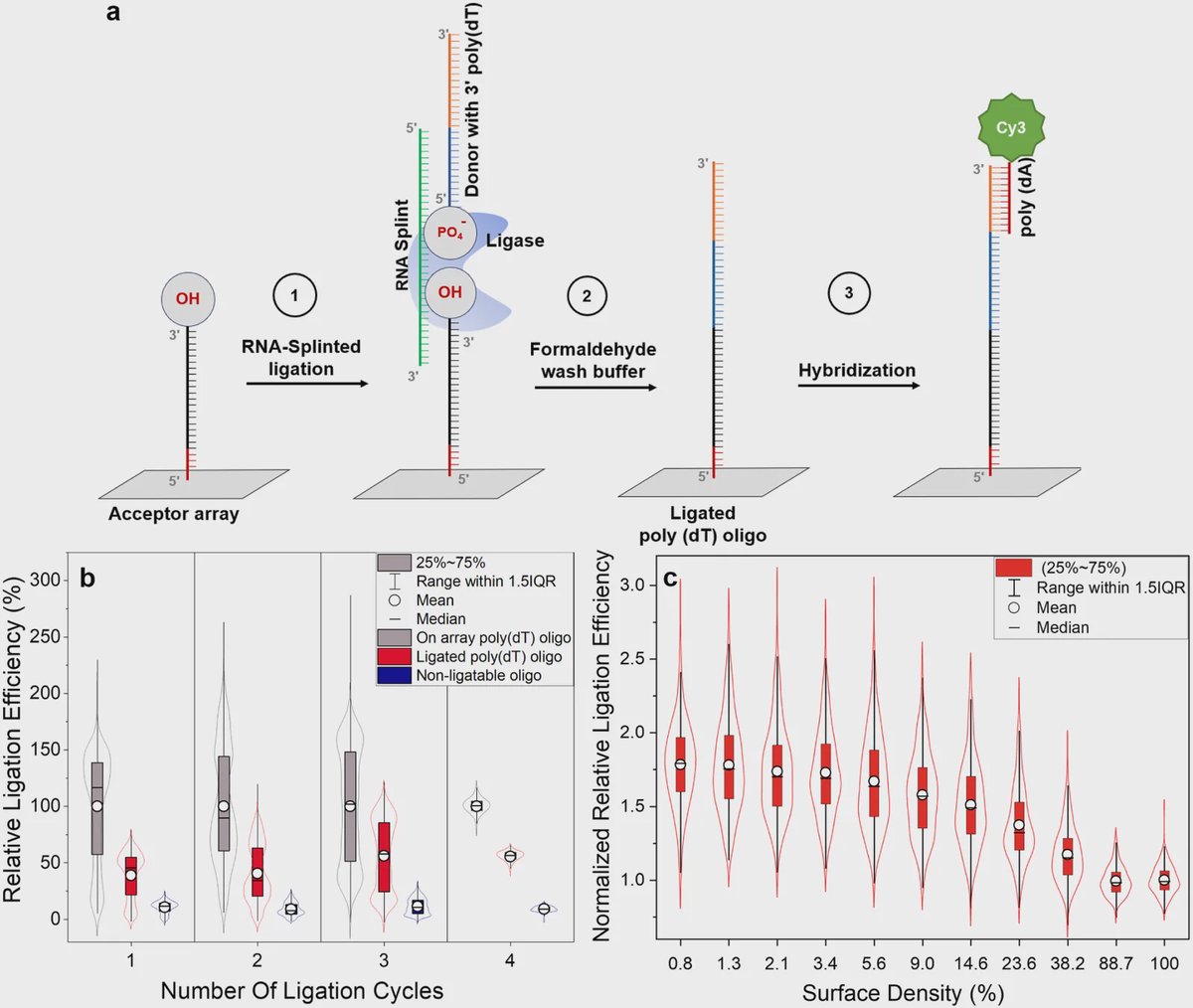
Rather than trying to synthesize every part of a complex probe directly on the slide, the researchers used ligation, an enzyme-driven reaction that creates a permanent phosphodiester bond between nucleic acid strands. Think of the RNA splint as a temporary alignment jig: it holds the surface-bound DNA and incoming DNA in the right position so the ligase can seal them together.
Why Use an RNA Splint?
The work used PBCV-1 DNA ligase, sold as SplintR ligase by New England Biolabs, to join DNA ends aligned by an RNA strand. The RNA splint helps define which DNA sequences are joined and improves the chance that the two ends meet correctly at the ligation junction.
The researchers highlight two practical advantages over a DNA splint. RNA-DNA hybrids are more stable than equivalent DNA-DNA pairings, which can allow shorter complementary regions on the array and reduce the number of synthesis cycles. After ligation, RNase H can selectively remove the RNA splint under relatively gentle conditions, leaving the newly joined DNA probe attached to the surface.
Testing the Constraints of On-Array Ligation
Surface chemistry changes the problem compared with a reaction in a test tube. DNA strands crowded onto glass may be harder for enzymes and incoming oligonucleotides to reach, so Das and Somoza examined factors that could govern ligation performance on an array.
Those factors included how the DNA end was phosphorylated, the length of the linker separating a probe from the surface, probe density, sequence length, the shortest effective splint, and mismatches near the ligation junction. They also examined repeated cycles of ligation and splint removal. For enzymatic phosphorylation, the team treated arrays with T4 polynucleotide kinase at 37 degrees Celsius for one hour before ligation.
Applications Beyond Simple Probe Extension
The team applied the workflow to low-background labeling of single-stranded DNA probes, on-array reverse transcription, and spatial photopatterning using photocleavable spacers. A photocleavable spacer is a molecular connector that can be broken by light, providing a way to create patterns after the initial array synthesis.
These examples illustrate why permanent ligation differs from ordinary hybridization. Hybridization is reversible base pairing, while ligation turns two nucleic acid pieces into one covalently connected molecule. That permanence could be useful when an array needs a defined chemical architecture that remains in place through subsequent washes or enzymatic steps.
Why This Matters
Microarrays are valuable because they run many molecular tests in parallel, but their fabrication chemistry can limit the length and variety of probes that fit onto a surface. RNA-splinted ligation provides a post-synthetic route for installing an independently made oligonucleotide, including components that may be incompatible with photolithographic synthesis.
The study positions ligation as a complement to direct synthesis and click chemistry. Click reactions can provide efficient attachment but create unnatural linkages that may affect how proteins or enzymes recognize DNA. By contrast, enzymatic ligation produces the native phosphodiester bond found in DNA itself. Future work can determine how broadly the method performs across assay formats and increasingly complex surface-bound nucleic acid designs.
Topics: Biochip
Start here: What is a biochip?
Related articles
- Analytical validation of a multiplexed peptide microarray for multi-antigen Epstein–Barr virus serological profiling across diverse clinical specimens
- Optimized Multi-Phosphorothioate Linkers for Iodine Cleavage of Surface DNA
- The Role of Microarray Technology in Pharma Development and Diagnostics
- Analysis of microarray experiments of gene expression profiling